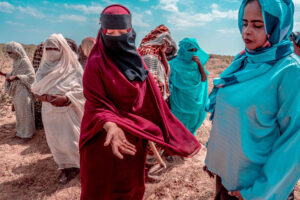
International aid cuts have quietly dismantled the infrastructure keeping millions of Sudanese women alive, exposing the fatal mechanics of donor fatigue and bureaucratic abandonment.
When foreign treasuries slash development and emergency budgets, the shockwave does not hit distant ministries first. It shatters grassroots networks operating in the blind spots of traditional diplomacy. In Sudan, where civil conflict has displaced over twelve million people, the retreat of international funding has transformed local women-led organizations from frontline anchors into struggling survival units.
To understand why this collapse matters, one must look past the headline numbers of multi-million-dollar appeals and examine the micro-economics of local aid delivery. Traditional international non-governmental organizations operate with high overhead, cumbersome security protocols, and rigid bureaucratic timelines. When active combat zones expand, these legacy agencies often retreat to secure compounds or neighboring countries, managing crises via remote spreadsheets.
Local women-led networks do the opposite. They stay.
Operating in besieged urban neighborhoods across Khartoum, Darfur, and Kordofan, these grassroots collectives manage community kitchens, secret safe houses for survivors of conflict-related sexual violence, and makeshift medical triage stations. They do this because they are part of the community under siege. They understand the language of local checkpoints, the shifting dynamics of armed factions, and the specific vulnerabilities of displaced mothers.
Yet, international donors treat these indispensable actors as charitable afterthoughts rather than strategic operational partners.
Financial support rarely reaches the ground unfiltered. Global humanitarian funding typically flows through a towering hierarchy of intermediaries. By the time a grant passes from a Western foreign ministry through United Nations agencies and international NGOs, administrative leakage and overhead costs have shaved away a staggering percentage of the total. What finally trickles down to Sudanese women-led organizations is often a fraction of the promised sum, bound by compliance requirements that demand Western-style accounting from activists working out of active combat zones.
Now, even that meager trickle is drying up.
Major donor governments, facing domestic fiscal pressures and shifting geopolitical flashpoints, have quietly scaled back their humanitarian commitments to East Africa. The Sudan humanitarian response plan remains severely underfunded, hovering at a fraction of what is required to avert mass starvation and medical collapse.
The consequences are immediate and irreversible. Across several states, community-managed kitchens that feed thousands of displaced families daily have shuttered their doors due to empty pantry shelves. Maternal health clinics, which previously subsidized emergency C-sections and provided clean delivery kits for pregnant women, have closed. Survivors of systemic conflict-related sexual violence—whose numbers have surged exponentially since the outbreak of war—find themselves turned away from underfunded support centers because counselors can no longer be paid.
Consider a hypothetical case to understand the mechanics of this failure. Imagine a women-managed volunteer group in South Darfur that previously operated a stabilization center for malnourished children and nursing mothers. When international funding drops by eighty percent, the group cannot afford therapeutic milk supplements, clean water provisions, or stipends for volunteer cooks. Within weeks, infants with moderate acute malnutrition slip into severe, irreversible stages of wasting. Mothers skip meals entirely so their older children can share dwindling household rations. Preventable disease outbreaks, such as cholera, sweep through overcrowded displacement camps unchecked because water purification tablets and basic hygiene kits are no longer being distributed.
This is not a failure of will on the ground. It is a systematic defunding of survival.
The donor community often justifies these cuts through the lens of prioritization, arguing that finite resources must chase the loudest geopolitical crises. This logic ignores a fundamental truth of modern conflict. When local women-led response structures disintegrate, the cost of future intervention multiplies exponentially. Entire generations are lost to malnutrition, trauma, and preventable disease, creating a generational vacuum that no amount of post-conflict reconstruction can easily fill.
Fixing this trajectory requires more than sympathetic diplomatic statements or recycled appeals for voluntary contributions. It demands an immediate restructuring of how humanitarian finance flows into protracted conflicts. International donors must bypass bloated intermediary layers and establish direct, flexible funding mechanisms dedicated exclusively to local responders. Compliance frameworks must be adapted to the reality of active war zones, recognizing that administrative paperwork cannot take precedence over basic human survival.
Until institutional donors stop treating local women-led networks as expendable subcontractors and start recognizing them as the primary architects of community resilience, international aid will remain an illusion for those who need it most. The funds exist, but the political courage to direct them where they actually save lives is missing, leaving millions of Sudanese women to bear the silent cost of an unheeded catastrophe

:max_bytes(150000):strip_icc()/lake-mead-173940030-5c25228846e0fb00014e8584.jpg)
