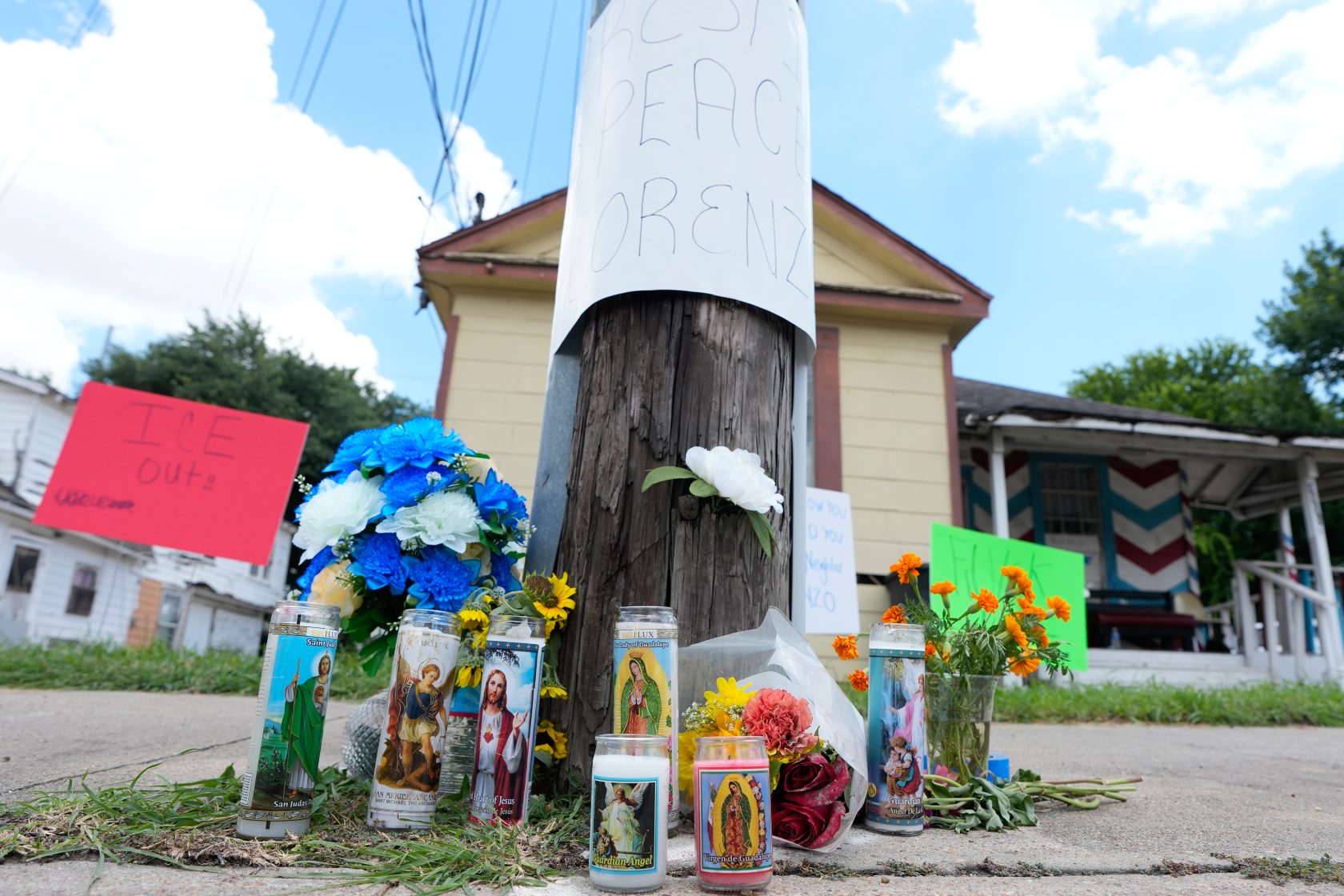
A routine morning commute in Houston’s Magnolia Park neighborhood ended in the fatal shooting of 52-year-old Lorenzo Salgado Araujo by an Immigration and Customs Enforcement (ICE) officer. Within forty-eight hours, federal authorities admitted a catastrophic detail. Salgado Araujo, a homebuilder who had lived in the United States for 35 years with no criminal record, was not the target of the operation. He was simply a man driving his construction crew to work in a white van that resembled one noted by federal surveillance weeks prior.
The Department of Homeland Security (DHS) has tried to contain the fallout by applying a familiar script. They claim Salgado Araujo weaponized his vehicle, rammed an ICE vehicle, and forced an officer to fire in self-defense. Yet, the three surviving passengers, including the victim's brother, who were immediately hauled off to an immigration detention center in Conroe, tell a vastly different story. They maintain that a federal officer opened fire almost immediately after exiting an unmarked vehicle. There is no body camera footage to settle the dispute. The field office lacked the equipment, a failure the administration blames on political gridlock, while local leaders point to systemic evasion of oversight. For an alternative view, read: this related article.
To understand how a regular traffic stop mutates into a fatal federal execution, one must look beyond the immediate chaos on Canal Street. This is not an isolated procedural error. It is the predictable outcome of an enforcement strategy that prioritizes volume and aggressive field tactics over basic operational discipline.
The Illusion of Targeted Enforcement
Federal immigration authorities frequently use the term "targeted enforcement" to project an image of surgical precision. The reality on the ground resembles a dragnet. In the Houston operation, agents were holding administrative warrants for two individuals from Guatemala. Salgado Araujo and his crew were from Mexico. An administrative warrant is not a criminal warrant. It is signed by an immigration officer, not a neutral judge, and it does not grant the authority to enter a private home or stop vehicles on a whim without independent reasonable suspicion. Similar reporting on this trend has been shared by BBC News.
To bypass this legal hurdle, field officers rely on visual profiling and proximity. According to DHS statements, officers observed a white van containing an individual who "resembled the target" near the surveyed address. In a metro area like Houston, where hundreds of thousands of tradespeople drive white cargo vans every morning, treating a vehicle color and a vague physical resemblance as sufficient probable cause is an invitation to tragedy.
This operational looseness is an open secret among veteran immigration attorneys. When field teams fail to locate their specific target, they rarely pack up and go home empty-handed. They pivot to collateral arrests. Anyone caught in the vicinity who lacks legal status is swept up to justify the hours spent on surveillance. In this case, even after killing the driver, ICE agents processed and detained the three passengers. The priorities of the agency were made clear when the focus remained on locking up the witnesses rather than preserving a clean crime scene for local investigators.
The Shield of Missing Evidence
Accountability requires documentation, and the complete absence of video evidence in this shooting is a systemic choice, not a budget constraint. DHS claimed that the officers involved were scheduled to receive body-worn cameras within sixty days, attributing past delays to congressional funding fights. Local officials are not buying it. Harris County representatives point out that an agency with billions in discretionary funding can easily equip its tactical field teams if accountability is a genuine priority.
Without body cameras or dashboard footage, the narrative defaults to the federal government's word against those of detained immigrants whose legal vulnerability makes them easily discredited in the public eye.
Operational Discrepancies on Canal Street
+-------------------------+-----------------------------------+-----------------------------------+
| Metric / Issue          | ICE / DHS Narrative               | Witness & Family Accounts         |
+-------------------------+-----------------------------------+-----------------------------------+
| Primary Objective       | Apprehend two Guatemalan targets  | Driving a Mexican crew to work    |
| Detonation of Violence  | Driver rammed an ICE vehicle      | Officer fired almost instantly    |
| Vehicle Markings        | Standard enforcement stop         | Unmarked cars causing panic       |
| Accountability Tools    | None (Cameras delayed by budget) | Obstructed by vehicle positioning |
+-------------------------+-----------------------------------+-----------------------------------+
The position of the vehicles during the confrontation conveniently blocked the view of nearby residential security cameras. A brief video captured by a bystander shows only the grim aftermath. A bleeding, handcuffed man groans on the asphalt while officers stand over three other restrained men.
We have seen this script play out before. When federal agents shot and killed U.S. citizens Renee Good and Alex Pretti in Minneapolis, initial press releases claimed the officers acted in self-defense against an oncoming vehicle. It was only when independent citizen footage emerged that the official timeline collapsed, showing that the vehicle was stationary or moving away when shots were fired. In Houston, without that independent footage, the truth remains locked behind federal privilege.
The Local Jurisdiction Conflict
When a federal agent kills a civilian on a municipality's streets, a jurisdictional turf war inevitably follows. The Harris County District Attorney’s Office announced an independent review, but local prosecutors face a brick wall. They are currently consulting with Minnesota officials to learn how to navigate the complex legal roadblocks that federal agencies erect during investigations into their own personnel.
"Although access to key evidence remains under federal control, we are pursuing investigative avenues available to us," stated a spokesperson for the local district attorney.
This is polite legal prose for a harsh reality. The federal government rarely allows local police or state prosecutors to interview its agents, view its internal files, or examine evidence without a protracted federal court battle. The FBI’s Houston office has launched an investigation, but its mandate is focused on the alleged assault on a federal officer, not the culpability of the shooter. The DHS Office of Inspector General is also investigating, which means the agency is essentially grading its own homework behind closed doors.
The Human Cost of Policy Shifts
Lorenzo Salgado Araujo was not a transient figure hiding in the shadows. He was a business owner, a homebuilder, and a father who had spent more than three decades building a life in Texas. His oldest son is a school teacher; his other sons are pursuing engineering degrees. According to his family, Salgado Araujo was in the final stages of regularizing his immigration status, working through a sluggish federal backlog to secure a formal work permit.
His death is part of a broader trend. He represents at least the eighth individual killed during the current administration’s intensified domestic immigration sweeps. As field operations become more aggressive, the margin for error shrinks.
When unmarked vehicles box in a construction van at sunrise, a driver's natural instinct is not always political recognition; it is survival. Salgado Araujo’s family notes that he likely feared he was being targeted by thieves looking to steal the expensive tools stored in his van. He did not know he was dealing with federal agents because the operation lacked the visible, unambiguous identifiers that distinguish legitimate law enforcement from criminal actors.
The administration’s aggressive mandate has created an environment where field officers act with the urgency of a high-stakes counter-terrorism mission, even when dealing with routine administrative warrants. When pressure from the top demands high arrest numbers, field discipline erodes. Visual identification becomes careless, stops become confrontational, and the threshold for pulling a trigger drops. The loss of an innocent resident is treated as collateral damage in a political numbers game.
The local community has responded with grief and anger, holding vigils and demanding that federal immigration operations be barred from city neighborhoods. But local resolutions hold no weight against federal supremacy. Until federal immigration enforcement is subjected to the same strict judicial warrants, independent civilian review boards, and mandatory body camera requirements as standard domestic police departments, the streets of cities like Houston will remain a volatile zone where a mismatched vehicle description can cost a worker his life.
The family is left to pursue a civil rights lawsuit that will take years to wind through the system, fought by government lawyers using taxpayer funds to shield the agency from liability. The brother of the deceased remains behind bars in Conroe, a vital witness kept under the direct custody of the agency that cut his brother's life short.