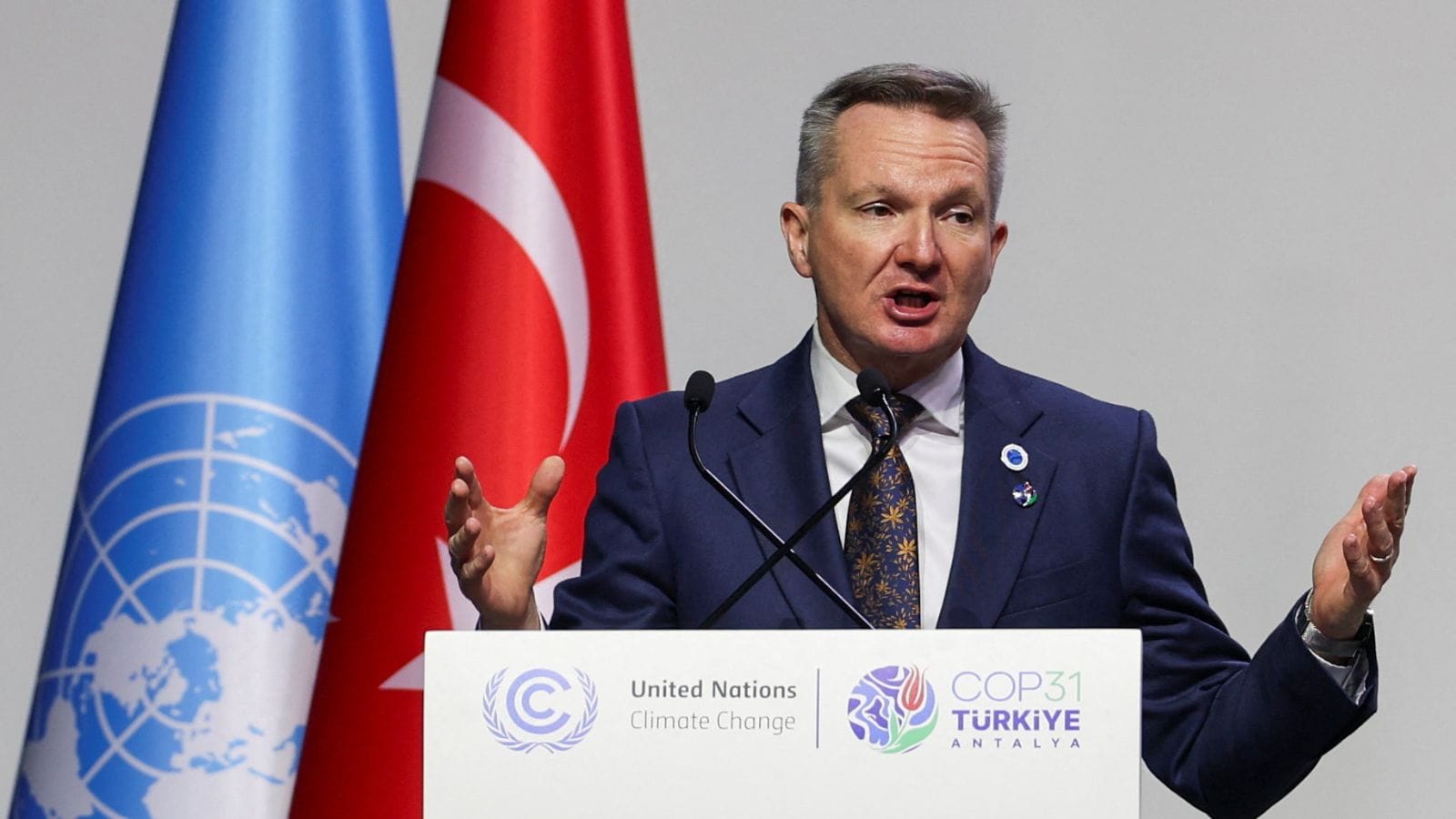
Global climate action is falling dangerously behind schedule because the structural design of international summits prioritizes diplomatic consensus over enforceable economic penalties, leaving COP31 negotiators staring at rising global temperatures with few binding tools to stop them. Despite decades of pledges, global greenhouse gas emissions continue to climb, pushing the planet past critical warming thresholds while national governments subsidize fossil fuels and delay grid modernization.
The diplomats gathering for the thirty-first Conference of the Parties know the math. Everyone in the plenary halls has read the synthesis reports from the United Nations Environment Programme and the Intergovernmental Panel on Climate Change. The gap between what nations promise in their Nationally Determined Contributions and what the atmosphere actually requires to stay below 1.5 degrees Celsius of warming has widened into a chasm. Yet the machinery of the United Nations Framework Convention on Climate Change remains bound by a rulebook written in the early 1990s, when the primary goal was simply getting every country into the same room.
The Architecture of Diplomatic Stalling
Watch how a final communique gets drafted at a UN climate summit and the core problem becomes obvious. Under UNFCCC rules, decisions require consensus. Consensus does not mean a simple majority, nor does it mean a two-thirds vote. It means no single country formally objects when the gavel comes down.
This procedural reality gives petro-states and major coal consumers an effective veto over the language of global ambition. When a draft text calls for the rapid phase-out of unabated fossil fuels, negotiators from oil-exporting economies spend days arguing over single adjectives. By the final night of the conference, exhaustion sets in. Delegations running on three hours of sleep accept watered-down phrases like "transitioning away" instead of "phasing out," just to avoid a total collapse of the talks.
The press releases celebrate a historic agreement. The atmosphere measures molecules of carbon dioxide.
The Accounting Illusion
Even when countries submit ambitious targets, the accounting methods used to track progress often obscure physical reality. Consider how national inventories operate under current international reporting frameworks. Emissions are counted where goods are produced, not where they are consumed.
A wealthy European nation can close its domestic steel mills and coal plants, report a steep drop in territorial emissions, and claim leadership in the green transition. Meanwhile, that same nation imports steel, cement, and manufactured electronics from industrial hubs in Asia, effectively outsourcing its carbon footprint while taking credit for domestic reductions. Until international trade mechanisms universally price embedded carbon at the border, national pledges will continue to look far better on spreadsheets than they do in atmospheric monitoring stations like Mauna Loa.
Where the Trillions Actually Go
Follow the money and the gap between rhetoric and reality grows starker. Climate finance dominates the agenda at COP31, just as it did at COP29 in Baku and COP30 in Belém. Developing nations rightly point out that they cannot decarbonize their power grids or build resilient infrastructure without massive capital inflows from the industrialized economies that caused the bulk of historical emissions.
The numbers thrown around in conference rooms sound enormous. Hundreds of billions of dollars. Trillions in mobilized private capital. Look closer at the ledger, however, and two structural flaws emerge.
First, much of what wealthy nations classify as climate finance arrives not as grants, but as market-rate or slightly concessional loans. For a developing country already spending more on debt service than on healthcare or education, taking on new dollar-denominated debt to build a solar farm is a fiscal trap. When interest rates rise globally, the cost of capital for renewable energy projects in the Global South can be two to three times higher than in North America or Europe. Private investors demand a risk premium for currency volatility and regulatory uncertainty, pricing out the very regions where energy demand is growing fastest.
Second, the flow of green capital is completely dwarfed by ongoing state support for fossil fuels. According to data tracked by the International Monetary Fund and the International Energy Agency, explicit and implicit subsidies for oil, gas, and coal routinely run into the trillions of dollars annually. Governments tax citizens to fund green transition initiatives with one hand while using the other to keep diesel cheap at the pump and underwrite new offshore drilling leases.
The Physical Bottlenecks Nobody Wants to Discuss
Policy papers assume that if enough money is allocated, clean energy deployment scales smoothly. Field engineers know better. The transition away from hydrocarbons is fundamentally a massive industrial and mining challenge, and it is running straight into physical constraints.
Wind turbines, solar panels, utility-scale batteries, and high-voltage transmission lines require staggering quantities of copper, lithium, nickel, cobalt, and rare earth elements. Opening a new copper mine takes an average of sixteen years from discovery to first production. Environmental permitting, local community opposition, water scarcity in mining regions, and supply chain concentration create friction that diplomatic declarations cannot wish away.
The Grid Queue Crisis
Even where solar and wind farms are financed and permitted, they frequently sit idle waiting to connect to the electrical grid. Across North America and Europe, thousands of gigawatts of clean energy projects are trapped in interconnection queues.
The electrical grids of the industrialized world were built in the twentieth century around a few dozen centralized, spinning coal and gas turbines. They were not designed to handle thousands of decentralized, weather-dependent generation sites located in remote deserts or offshore waters. Upgrading transmission infrastructure requires acquiring right-of-way across private land, navigating overlapping municipal and federal jurisdictions, and manufacturing specialized high-voltage transformers that are currently backordered for years.
Building a solar farm takes eighteen months. Building the high-voltage transmission line to carry that electricity to a city takes a decade.
Why Adaptation Remains the Poor Cousin
For years, climate policy treated adaptation as an admission of defeat. The prevailing wisdom held that focusing too heavily on sea walls, drought-resistant crops, and heat-resilient urban planning would distract from the primary mission of cutting emissions. That hesitation cost the world precious preparation time.
Global average temperatures have already pushed past 1.5 degrees Celsius above pre-industrial levels over multi-month stretches, triggering cascading impacts across agricultural belts and coastal infrastructure. Extreme heatwaves are buckling rail lines and reducing labor productivity in outdoor industries. Prolonged droughts are drying up hydroelectric reservoirs, forcing countries like Brazil and China to fire up backup coal plants just to keep the lights on when river levels drop.
Despite these immediate threats, adaptation projects struggle to attract private capital. A solar farm generates electricity that can be sold to a utility, creating a predictable revenue stream to pay back investors. A restored mangrove forest that protects a coastal city from storm surges saves billions in avoided property damage, but it does not generate monthly cash flow. Because private finance relies on measurable returns, adaptation remains heavily dependent on strained public budgets.
The Geopolitical Fracture
The early climate agreements were negotiated during an era of expanding globalization, when supply chains were integrating and major powers viewed climate change as a rare arena for cooperative diplomacy. That era is over.
Trade wars, industrial protectionism, and national security anxieties now dictate energy policy. Governments are increasingly viewing clean technology through the lens of strategic competition rather than collective survival. Tariffs on imported electric vehicles, solar modules, and battery components raise the cost of decarbonization for domestic consumers in order to protect local manufacturing jobs.
Meanwhile, geopolitical conflicts have forced energy security back to the top of the priority list. When natural gas supplies are weaponized or shipping lanes are disrupted, governments prioritize immediate fuel availability over long-term carbon budgets. Liquefied natural gas terminals get fast-tracked. Coal plant retirements get quietly postponed. The political survival of an incumbent administration next November almost always outweighs an emissions target set for 2035 or 2050.
What Breaking the Deadlock Actually Requires
If the annual COP process is going to produce more than incremental paper victories, the mechanism of global climate governance has to shift from voluntary pledges to binding economic rules.
Hypothetically, consider what happens if a coalition of major importing economies enforces a unified Carbon Border Adjustment Mechanism paired with shared industrial standards for steel, cement, aluminum, and fertilizers. Instead of waiting for 190 nations to agree on a single text in a conference hall, a smaller bloc of major markets simply requires any product sold within its borders to meet strict carbon-intensity thresholds or pay a tariff equivalent to the domestic carbon price. Suddenly, decarbonization becomes the price of market access. Exporters in carbon-intensive economies are forced to clean up their factories not out of diplomatic goodwill, but to keep their customers.
At the same time, multilateral development banks like the World Bank must radically alter their risk appetite. Instead of hoarding triple-A credit ratings by lending only to safe, established projects, they need to absorb first-loss risk on clean energy infrastructure in emerging markets, lowering the cost of capital so private pension funds and insurers can step in without demanding predatory interest rates.
The science has been settled for forty years, the technology to replace fossil fuels exists at commercial scale, and the capital sits in global bond markets waiting for bankable projects—what remains missing is the political willingness to dismantle the subsidies and trade rules that keep the carbon economy profitable.