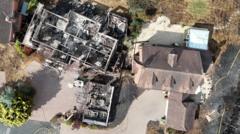
When a wildfire tears through a residential neighborhood, the results often appear random. One house stands unscathed, surrounded by a scorched yard, while the home next door is a skeleton of charred timber and melted glass. Survivors often credit luck or divine intervention. Industry professionals and fire science experts call it the home ignition zone. The survival of a property is rarely an accident. It is the result of thousands of small, granular decisions made years before the first spark ever hit the ground.
The recent tragedy in Stourbridge, where nineteen properties were lost to an inferno, serves as a grim reminder of how volatile the boundary between safe and destroyed can be. Local reports confirmed that some structures were saved through the immediate intervention of farmers who ploughed fields to create crude firebreaks. While these emergency measures were effective in that specific instance, they mask a deeper, uncomfortable reality. Reliance on reactive manual labor is a symptom of a systemic failure to plan for environmental threats that are no longer theoretical.
Survival hinges on two primary mechanics: structural ignitability and defensible space.
The Myth of the Unstoppable Fire
Many homeowners operate under the mistaken belief that a fire must touch their house to destroy it. In reality, the most common culprit is the ember shower. During high-wind events, burning debris can travel miles ahead of the primary flame front. These embers land in gutters, wedge themselves under roof shingles, or drift through small attic vents.
A house typically ignites because it is a collection of vulnerabilities waiting for a spark. If your roof has gaps, your eaves are unshielded, or your windows are single-paned, your home is essentially a basket of kindling. The fire does not need to reach your front door. It simply needs to find one point of entry that leads to combustible insulation or stored belongings in a garage.
Consider a hypothetical scenario of two identical houses in the same path of a wildfire. House A has wood mulch pushed up against the siding and a deck filled with dried leaves. House B has a five-foot gravel perimeter and metal mesh screens on every ventilation point. When an ember lands, House A is compromised within minutes. House B may catch a small, manageable flame that is easily doused or simply dies out. The difference isn't structural magic. It is engineering.
The Spatial Lottery
Neighborhood density is a double-edged sword. In modern urban-wildland interfaces, the proximity of structures creates a chain reaction. When one house catches fire, it radiates intense heat—often enough to ignite the siding of a neighbor thirty feet away. This is why clusters of houses often vanish while isolated homes survive.
Research consistently identifies the distance between structures as a primary predictor of loss. In densely packed subdivisions, the fire becomes self-sustaining. The heat from a burning home is often hotter and more dangerous than the original wildfire itself. To combat this, building codes must evolve beyond basic fireproofing. We need to rethink how we space homes and how we use non-combustible building materials in high-risk areas. If we continue to build houses with narrow gaps and flammable exterior finishes, we are essentially building dominoes.
The Failure of Passive Preparation
There is a pervasive attitude that clearing brush is a seasonal chore rather than a life-safety requirement. Many residents view the area within five feet of their foundation as an opportunity for landscaping. They plant dense shrubs, stack firewood, or lay down bark mulch to make the house look inviting. This is an invitation to disaster.
The immediate zone—the first five feet around your structure—is the most critical line of defense. This area should ideally be devoid of all vegetation. No shrubs. No bark. No wooden fencing that acts as a fuse, leading flames directly to your siding.
Hardscaping with stone, gravel, or concrete is the most effective way to neutralize this danger. It is not about turning your property into a barren wasteland; it is about recognizing that your home is not an island. It is a part of a larger, flammable ecosystem. If you do not manage the fuel surrounding your building, the building will eventually become the fuel.
A Call for Structural Hardening
We are reaching a point where individual effort is no longer sufficient. Municipalities often point to firefighters as the primary defense, but this creates a false sense of security. In a major wildfire, fire services are almost always overwhelmed. Their resources are finite, and their primary mandate is the protection of life. Property is a secondary concern.
When the smoke clears, we look for reasons why some houses survived. We search for patterns, hoping for a simple answer. The truth is found in the building materials and the maintenance logs. Did the homeowner use fire-resistant siding? Was the roof a Class A rated material? Was the ventilation screened with fine-gauge metal mesh?
These are not architectural suggestions. They are survival requirements. We must shift our focus from reactive measures to proactive structural hardening. This means updating local building codes to mandate higher standards for new construction and providing clear, actionable incentives for retrofitting older homes.
The climate is changing, and with it, the behavior of fires is becoming more erratic and intense. We cannot rely on the tactics of the past to survive the reality of the present. The fire is coming, and it does not care about your property value or your aesthetic preferences. It cares only about what is available to burn. Your only defense is to ensure that when the sparks arrive, they find nothing left to consume.