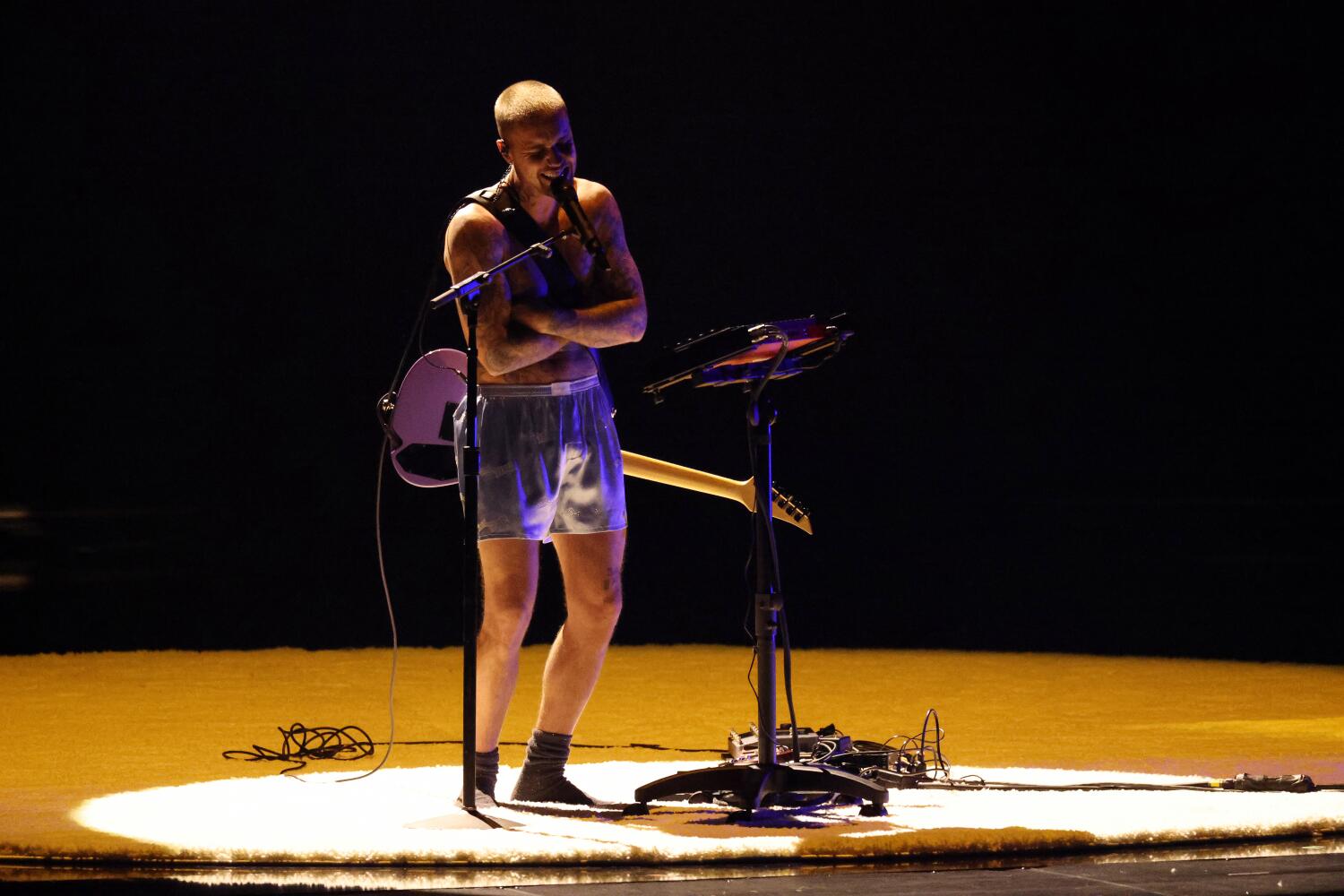
When the lights dimmed at the 68th Annual Grammy Awards, the expected pyrotechnics and massive backup troupes were nowhere to be found. Instead, Justin Bieber stood center stage at the Crypto.com Arena in nothing but lavender satin boxer shorts and black socks. Within seconds, the internet moved from confusion to a frenzy. But this wasn’t just a pop star forgetting his pants. It was a calculated, high-stakes gamble on the future of his career and his brand.
By performing "Yukon" from his 2025 album Swag with only a 1980s Yamaha electric guitar and an Akai MPC Live III, Bieber effectively dismantled the machinery of the modern pop spectacle. He answered the primary question of the night—is he still a relevant musician or just a tabloid fixture?—by stripping away every possible distraction. The performance served a dual purpose: a raw proof-of-talent for a singer who has spent years battling health issues and a aggressive marketing masterstroke for his new fashion label, SKYLRK. For a more detailed analysis into this area, we recommend: this related article.
The Engineering of Vulnerability
The industry is used to the "unplugged" trope, but Bieber took it to a literal extreme. Standing in front of a mirror, he spent most of the set with his eyes closed, building a live loop of guitar riffs and drum pads. This wasn't a pre-recorded track masquerading as a live moment.
Ben Winston, the show’s executive producer, later revealed that Bieber only used 15 minutes of his allotted 90-minute rehearsal time. He walked in, ran the song once, and left. That level of confidence is rare in an era where most A-list sets are micro-managed down to the millisecond. By appearing nearly naked, Bieber forced the audience to look at the "work" of the music—the pressing of the pads, the strumming of the strings, and the grit in his vocals. For broader information on this development, in-depth coverage can be read at The New York Times.
The choice of the 1988 Yamaha RGX 612S guitar wasn't accidental either. It was a nod to a specific era of technical proficiency, a tool for a player rather than a prop for a star. When he hit the loop pedal, he wasn't just making a song; he was making a point. He doesn't need the Balenciaga armor he wore on the red carpet to command a room.
The SKYLRK Payoff
While the critics focused on the "bravery" of the performance, the business analysts were looking at the waistband of those lavender boxers. The crystal-patched logo for SKYLRK was visible in every high-definition close-up.
The strategy worked with terrifying efficiency. Reports indicate the boxers sold out within minutes of the performance ending. In a saturated market where every celebrity has a brand, Bieber bypassed the traditional commercial route. He didn't buy a Super Bowl ad; he turned the Grammy stage into a bedroom-style "Get Ready With Me" (GRWM) session that felt authentic to a generation raised on TikTok.
Why the Minimalism Matters Now
We are entering an era of "post-spectacle" music. As AI-generated tracks and hyper-processed pop fill the airwaves, there is a growing premium on the organic and the flawed.
Bieber’s performance tapped into several emerging trends:
- The Rise of Organic Sounds: Audiences are pivoting toward live instrumentation and "real" takes.
- The Bedroom Aesthetic: The set mirrored the intimacy of a home studio, bridging the gap between a global superstar and a kid with a guitar.
- Brand Integration as Art: The line between the performance and the product has vanished entirely.
This wasn't a comeback in the traditional sense. Bieber has been around, but he hasn't been seen like this since he was a teenager with an acoustic guitar on a YouTube screen. By returning to that simplicity at 31, he effectively reset his narrative. He isn't the chaotic star of the 2010s or the shielded recluse of the early 2020s. He is a technician.
The Risk of the Bare Truth
Not everyone was convinced. Critics argued that performing in underwear at an industry-defining event bordered on hubris. There is a fine line between "stripped-down" and "unprofessional," and some felt Bieber crossed it by barely acknowledging the live audience, choosing instead to sing to his own reflection.
However, the standing ovation from his peers suggested a different reality. In a room full of artists who know exactly how much "fake" goes into a Grammy set, the sight of a man standing alone with a loop pedal was a reminder of why they started making music in the first place.
His wife, Hailey Bieber, watched from the front row, wearing an "ICE Out" pin—a political statement mirrored by other Canadian artists like Joni Mitchell that night. Amidst the political undertones and the high-fashion suits of his contemporaries, Bieber’s silence and his skin felt like the loudest thing in the room. He didn't give a speech. He didn't do a press circuit. He just played.
The "Yukon" performance will likely be remembered as the moment the "Dad-R&B" era of Bieber’s career found its teeth. It was a reminder that while you can buy the boxers, you can’t buy the ability to hold a silent arena with nothing but a guitar and a handful of pedals.
Would you like me to analyze the projected market impact of the SKYLRK brand following this performance?


