High Altitude Eyes and the Price of Airspace Control
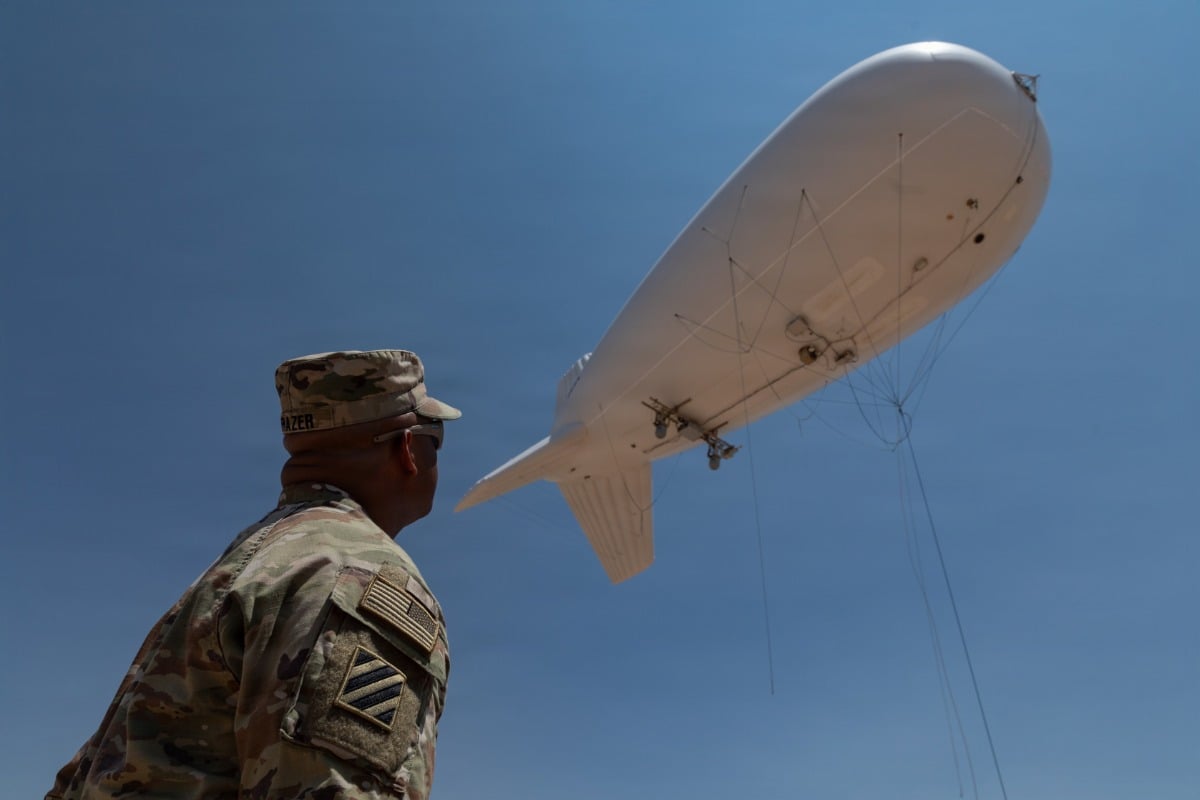
The U.S. Army committed $447 million to tethered aerostat surveillance systems, placing a massive financial stake on floating blimps to guard strategic borders and critical infrastructure. These lighter-than-air vessels hoist heavy radar payloads thousands of feet into the air, offering persistent coverage that traditional satellites and fixed-wing aircraft simply cannot match at an equivalent cost per hour. Yet this massive capital outlay exposes deep operational vulnerabilities. Unmanned aerostats are notoriously susceptible to extreme weather, electronic jamming, and asymmetric strike threats, turning a multi-million-dollar defense strategy into a fragile target for modern battlefields.
Defense planners like aerostats for one simple reason: unblinking persistence.
A standard reconnaissance drone must land, refuel, and rotate out. Satellites offer precise imagery, but their orbits dictate when they pass over a given grid. A tethered aerostat stays aloft for weeks at a time, pumping real-time high-definition video, thermal imaging, and radar telemetry directly to ground commanders. When operating at optimal capacity, these airborne platforms detect low-flying cruise missiles, incoming drone swarms, and clandestine border crossings long before ground-based sensors register a blip.
The financial logic seems solid on paper. Operating an aerostat costs a fraction of the hourly flight expense required for an AWACS aircraft or a fleet of high-altitude drones. But paper calculations rarely survive contact with operational reality.
The Tether Problem and Physical Fragility
Every aerostat relies on a high-strength umbilical cord. This tether provides continuous electrical power to the sensor suite while transmitting high-bandwidth data back to the ground terminal.
It is also the system's single greatest point of failure.
Environmental Vulnerabilities
High winds, lightning, and icing conditions pose constant hazards to static airborne platforms. When sudden atmospheric storms roll through an operational zone, crews must quickly winch these massive envelope structures back down to their mooring stations.
- High Wind Shears: Severe gusts can strain ground winches to their absolute engineering limits, risking structural failure.
- Electrical Storms: A multi-thousand-foot cable hanging from the clouds acts as a giant lightning rod.
- Icing: Freezing rain adds thousands of pounds of dead weight to the hull, forcing sudden emergency retrievals.
During a storm, the eye in the sky goes dark. That creates predictable windows of vulnerability that adversarial forces can monitor and exploit.
Target Profile and Vulnerability
Aerostats are huge. They sit motionless against the sky, visible for miles.
[ Sensor Payload ] <---> [ High-Tension Cable ] <---> [ Ground Mooring Station ]
                                                               |
                                                   (Single Point of Attack)
In a contested airspace, an aerostat is a stationary target. Modern long-range artillery, anti-radiation missiles, and cheap kamikaze drones make short work of a tethered balloon. While supporters point out that the envelope can sustain small arms fire without immediately collapsing—as the internal pressure is nearly equal to the surrounding atmosphere—a targeted strike on the ground winch or the tether itself renders the entire platform useless.
Radar Mechanics and the Physics of Persistent Coverage
To understand why defense departments keep returning to aerostats despite their obvious flaws, you have to look at the geometry of radar coverage.
Radar operate on line-of-sight principles. Ground-based installations suffer from the curvature of the Earth and terrain masking, where mountains, trees, and buildings create blind spots.
By lifting a primary radar array to an altitude of 10,000 feet, the operational horizon expands dramatically.
$$d \approx 1.23 \times \sqrt{h}$$
In this classic horizon calculation, where $h$ is the radar height in feet and $d$ is the distance to the horizon in nautical miles, raising the sensor array fundamentally alters what commanders can see. At ground level, a radar might spot an incoming low-altitude threat at 10 or 15 miles. At 10,000 feet, that detection range extends past 100 nautical miles.
| Sensor Platform | Operational Altitude | Deployment Duration | Weather Sensitivity |
|---|---|---|---|
| Ground-Based Radar | 0 – 100 ft | Continuous | Very Low |
| Tethered Aerostat | 1,000 – 10,000 ft | Weeks | High |
| Reconnaissance Drone | 10,000 – 60,000 ft | 24 – 36 Hours | Moderate |
| Low-Earth Orbit Satellite | 100+ Miles | Years (Orbital Path) | None (Above Weather) |
This mathematical reality explains the government's recurring obsession with aerostats. They offer an unmatched view for tracking low-altitude cruise missiles that attempt to hug the terrain to avoid detection.
Financial Sinkhole or Practical Necessity
Spending $447 million on aerostat technology is a calculated risk that highlights a broader tension in military modernization. Is it wiser to fund exquisite, high-cost technology that might get shot down on day one of a major conflict, or invest in cheaper, vulnerable systems that provide immense value during long stretches of relative calm?
Opponents argue that pouring hundreds of millions into tethered balloons prepares the armed forces for yesterday's counter-insurgency battles rather than tomorrow's high-tech engagements. In a peer-to-peer conflict, an aerostat array near the front lines wouldn't survive twenty minutes.
Proponents counter that not every mission involves facing advanced integrated air defense networks. For maritime domain awareness, drug interdiction, and static border monitoring, aerostats provide a practical solution that keeps expensive manned flights grounded.
The strategic trade-off comes down to risk tolerance. When the system works, it delivers unrivaled situational awareness at a low operational cost. When it fails—whether knocked down by a sudden squall or severed by enemy action—it leaves a gaping blind spot in defense networks that costs tens of millions to replace.
Military procurement programs routinely double down on legacy concepts by wrapping them in modern electronics. Equipping an aerostat with advanced signal intelligence packages, active electronically scanned array (AESA) radars, and optical tracking systems transforms an old airship into an information node. Yet no amount of computing power can alter the basic physics of a gas-filled bag tethered to the dirt by a wire.
When defense contractors promise continuous, unbreakable surveillance from tethered platforms, they are selling an ideal scenario that ignores the unpredictable nature of actual deployment zones. Ground commanders who rely on these systems know that the moment the wind turns or the skies darken, their eye in the sky is coming down.


