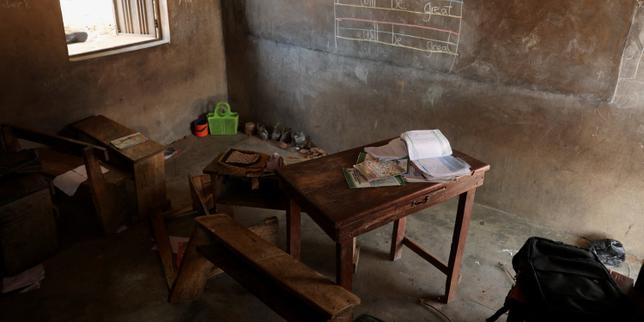
Nigerian teachers are walking out of their classrooms, but this is not a standard dispute over wages or pension funds. Across the northern and central regions of the country, educators are executing wildcat strikes and structured protests to protest a stark reality. They refuse to serve as soft targets in a multi-million-dollar kidnapping industry. For over a decade, mass abductions of schoolchildren have evolved from sporadic acts of ideological terror into a highly organized, commercial enterprise. The state's inability to secure rural schools has effectively turned classrooms into friction points where educators and children are used as financial leverage.
The crisis reached a tipping point as successive mass abductions forced the hands of major teaching unions, including the Nigeria Union of Teachers (NUT). When schools close because of security fears, the immediate focus usually lands on the disruption to education. The deeper crisis lies in the complete collapse of the rural social contract. Also making waves in related news: The Theater of Distraction and the Unheard Voices of Muzaffarabad.
The Evolution of the Abduction Enterprise
To understand why teachers are striking, one must look at how the mechanics of school raids changed. When Boko Haram abducted 276 girls from Chibok in 2014, the motivation was primarily ideological and geopolitical. The group sought to make a statement against Western education and use the captives for propaganda and prisoner exchanges.
Today, the landscape is dictated by highly mobile, heavily armed criminal syndicates often referred to locally as bandits. These groups operate with little ideological fervor but high corporate efficiency. They have realized that abducting fifty children yields a faster, more reliable payout from desperate families and complicit local authorities than raiding remote villages for livestock. Schools are uniquely vulnerable. They house large concentrations of defenseless individuals in predictable locations, often guarded by little more than a lone nightwatchman with a baton. Additional information into this topic are detailed by NPR.
When a raid occurs, teachers are not just bystanders. They are frequently taken alongside their students to manage the group during long marches into vast forest reserves like Rugu or Kamuku. Those left behind, or those in neighboring districts, realize that staying in the classroom means gambling with their lives. The strike action is a direct rejection of this risk. Teachers are demanding that the federal government move beyond reactive military deployments and establish permanent, verifiable security architecture around vulnerable institutions.
The Failure of the Safe Schools Initiative
The standard government response to these vulnerabilities has long been the Safe Schools Initiative. Launched in 2014 with significant international backing and millions of dollars in pledges, the program was designed to build fences, install alarm systems, and train local communities in emergency response.
The reality on the ground tells a different story. Walk into a rural school in Kaduna, Katsina, or Niger State, and you are unlikely to find a reinforced perimeter or a functional communication system. The funds have historically been swallowed by bureaucratic inertia and centralized procurement processes that favor urban centers over the high-risk periphery.
Infrastructure Vacuums
In many districts, schools lack basic perimeter walls. A lack of fencing means anyone can ride a motorcycle directly onto school grounds from the surrounding bush, execute a raid, and vanish within fifteen minutes.
Communication Blackholes
Rural communities often suffer from poor cellular network coverage. When an attack happens, it can take hours for news to reach the nearest military or police outpost, rendering any tactical response obsolete before it even begins.
Teachers are striking because they see the Safe Schools Initiative as a paper shield. They know that a lack of physical security cannot be compensated for by security seminars held in luxury hotels in Abuja. The union demands are concrete. They want perimeter fencing around every rural school, armed security presence during school hours, and rapid-response communication hubs installed in high-risk zones.
The Economic Chain Reaction of Empty Classrooms
The strike actions amplify a broader trend that is quietly dismantling the economy of northern Nigeria. When teachers strike or schools shut down indefinitely due to security threats, the economic fallout ripples far beyond the education sector.
Education in these regions has long been the primary lever for poverty reduction and breaking the cycle of subsistence farming. With schools closed, a generation of youth is pushed back into informal, low-productivity labor. For girls, the closure of a school often accelerates early marriage, permanently removing them from the formal economy. For boys, the lack of schooling creates a vacuum that criminal syndicates actively exploit, recruiting idle youth into the very networks responsible for the insecurity.
Furthermore, the flight of teachers from rural areas creates an internal brain drain. Qualified educators refuse postings to northern stations. Those who can afford it bribe their way into urban assignments or leave the profession entirely. The result is an educational apartheid, where safe, functional schooling becomes an exclusive luxury for the urban elite, while rural populations are left with abandoned structures and zero prospects.
The Complicity of the Ransom Pipeline
A significant factor driving the teacher protests is the open secret of the ransom economy. While federal law officially criminalizes the payment of ransoms to kidnappers, the reality on the ground involves complex negotiations.
Local communities, desperate to save their children, often crowdfund payouts by selling land, livestock, and grain reserves. In several documented instances, state governments have facilitated these transactions under the guise of logistics expenses or community reconciliation funds. This constant influx of cash has allowed criminal syndicates to upgrade their arsenals. Bandits now routinely carry rocket-propelled grenades and sophisticated assault rifles that outgun the local police units stationed at rural checkpoints.
Teachers understand that every successful ransom payment guarantees a future attack. It proves the business model works. By withdrawing their labor, educators are attempting to break this cycle. They are forcing a public conversation on the failure of state intelligence and law enforcement to track these massive cash flows, which often move through regular banking channels or informal networks that the state claims it cannot monitor.
Beyond the Security Perimeters
Fixing this crisis requires looking past simple military interventions. Armed guards at school gates are a temporary fix, not a systemic solution.
The state must address the vast, ungoverned spaces that allow these syndicates to operate with impunity. Millions of hectares of forest reserves cutting across state lines have become sovereign territories for criminal groups. Until the state reclaims physical control of these geographic vacuums through sustained policing, aerial surveillance, and infrastructural development, schools will remain under threat.
The strike by Nigerian teachers is an act of self-preservation, but it is also a diagnostic report on a failing state apparatus. It exposes the fiction that a nation can develop when its foundational institutions are left undefended against commercialized terror. The unions have made their position clear. The chalk will not touch the blackboard until the state guarantees that an afternoon lesson will not end in a march into the forest.