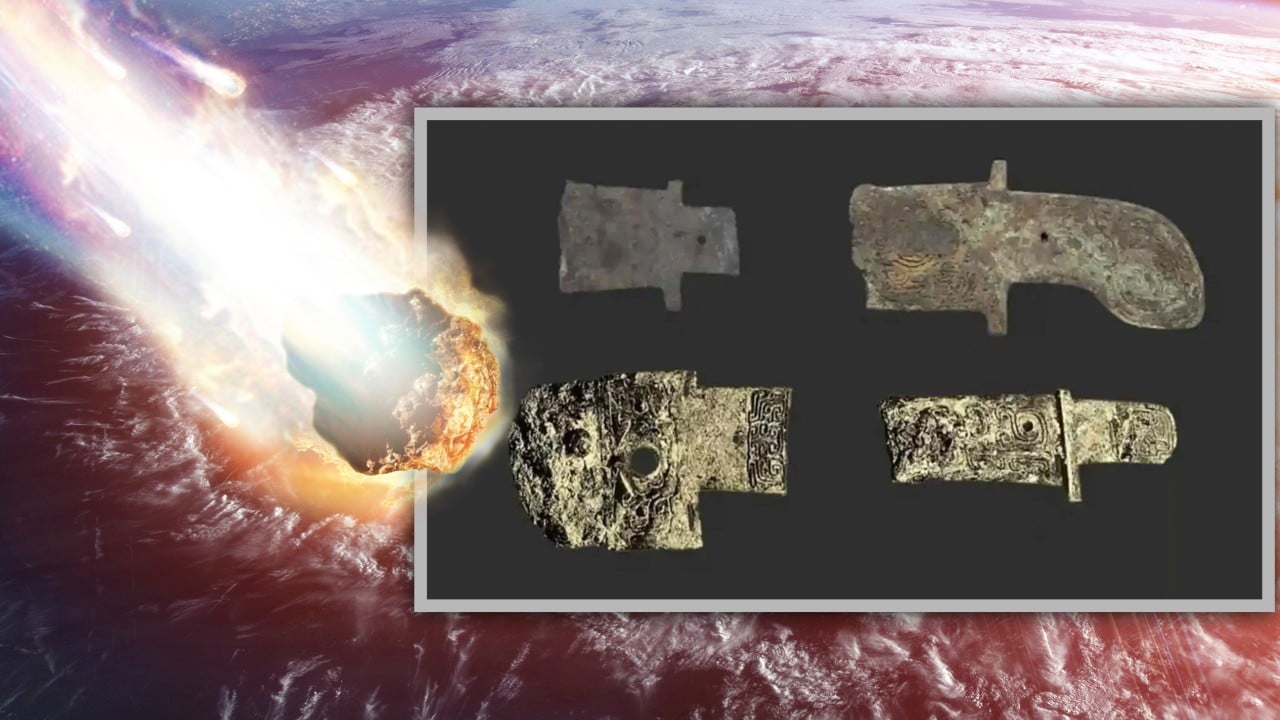
Archaeologists at the Sanxingdui ruins in Sichuan Province recently confirmed that a ceremonial axe discovered at the site contains material of extraterrestrial origin. This is not a science fiction script. It is a cold, hard fact of Bronze Age metallurgy that shifts our understanding of ancient Chinese capability. The blade features trace elements of iron, nickel, and cobalt in ratios only found in iron meteorites. While the public is captivated by the "alien" allure of space rocks, the real story lies in the terrifyingly sophisticated manufacturing process required to turn a frozen chunk of the cosmos into a functional weapon of state.
For decades, the standard narrative of Chinese history placed the cradle of civilization strictly in the Yellow River valley. Sanxingdui shattered that. The discovery of this meteorite axe proves that the Shu people were not just regional outliers; they were masters of high-heat manipulation and material science long before the Iron Age officially began in the region. They weren't just "finding" shiny rocks. They were identifying specific celestial debris and integrating it into their most sacred artifacts.
The Impossible Forging of Celestial Iron
To understand why this axe matters, you have to look at the chemistry of the blade. Most bronze artifacts from this period rely on a mix of copper and tin. Iron, however, was a mystery to most of the world 3,000 years ago. Smelting iron from terrestrial ore requires temperatures exceeding 1,500 degrees Celsius, a feat the Shu people hadn't quite mastered for mass production.
Meteoritic iron is different. It arrives on Earth already in a metallic state, but it is notoriously difficult to work. It is brittle. It shatters under a hammer unless the smith understands the specific thermal window required to soften the nickel-iron alloy. The Sanxingdui axe isn't a crude lump of stone tied to a stick. It is a sophisticated composite.
Archaeological analysis shows the blade was hammered into a thin, lethal edge and then cast into a bronze handle. This requires a terrifying level of precision. If the bronze is poured too hot, it ruins the structural integrity of the meteorite iron. If it's too cool, the bond fails. The Shu smiths were performing a metallurgical balancing act that shouldn't have been possible with their available tools. They were bridging the gap between the Stone, Bronze, and Iron ages in a single object.
A Monopoly on the Divine
We have to stop looking at these artifacts as mere art. In the context of the Sanxingdui culture, this axe was a weapon of psychological warfare. Imagine a society where most people deal with soft copper tools that dull after a few strikes. Suddenly, a priest-king appears with a blade that literally fell from the sky, a blade that holds an edge better than anything known to man.
This wasn't just craftsmanship. It was the ultimate branding exercise. By wielding "heavenly" iron, the ruling elite of Sanxingdui signaled their direct connection to the cosmos. They weren't just claiming divine right; they were holding the physical proof of it in their hands. The scarcity of meteoritic iron meant that this technology couldn't be democratized. It was a closed-loop system of power. You couldn't just go mine a meteorite. You had to wait for the gods to throw one at you.
The Missing Link in Global Metallurgy
Critics often argue that these finds are accidental or that the iron was a byproduct of copper smelting. That argument falls apart under the microscope. Terrestrial iron ore lacks the high nickel content found in this axe. The presence of specific crystalline structures, known as Widmanstätten patterns, confirms the material spent millions of years cooling in the vacuum of space before hitting the Sichuan basin.
When we compare this to other global civilizations, the Sanxingdui axe sits in an elite category. Tutankhamun had a meteorite dagger. The Inuit used the Cape York meteorite for harpoon tips. But the Sanxingdui approach was different because of the bronze-iron integration. They weren't just using the iron as a substitute; they were using it as a specialized component within a complex assembly. This suggests a modular understanding of tool design that was centuries ahead of its time.
The Problem with the Current Narrative
The issue with the current archaeological coverage is that it treats this as a "mystery" or a "miracle." It was neither. It was a result of rigorous, iterative experimentation. The Shu people likely spent generations testing different stones they found in craters, learning which ones shattered and which ones could be shaped. We see the final, successful product, but we ignore the centuries of failed attempts and burnt fingers that led to it.
We also overlook the logistics. Finding a meteorite isn't easy today with satellite imagery and metal detectors. Three thousand years ago, it required a massive network of scouts and a cultural obsession with the sky. The Sanxingdui civilization was likely the most "space-aware" culture of its era, tracking celestial events not just for calendars, but for raw materials.
The High Cost of Perfection
The technical brilliance of the meteorite axe actually hints at why the Sanxingdui civilization might have collapsed or transformed so abruptly. They were obsessed with the exceptional. Their entire cultural output—the massive bronze trees, the gold-leaf masks, the meteorite weapons—required an unsustainable diversion of resources and labor.
When you spend all your intellectual capital on perfecting a single axe made of space-dust for a king, you aren't spending it on improving irrigation or basic infrastructure for the masses. The meteorite axe represents the pinnacle of ancient tech, but it also represents a civilization that prioritized the symbolic over the practical.
The chemical signature of the axe matches meteorites found in other parts of Asia, suggesting a potential trade network for celestial materials. This flips the script on Sanxingdui being an isolated "lost" city. They were likely the central hub of a high-tech material exchange that spanned thousands of miles. They were the Silicon Valley of the Bronze Age, and their primary export was awe.
Beyond the Museum Glass
Looking at the axe through a display case, it’s easy to dismiss it as a relic. But the engineering logic behind it is the direct ancestor of modern aerospace composites. We are still doing exactly what the Shu smiths did: trying to figure out how to combine materials with wildly different properties to survive extreme conditions.
The Sanxingdui axe is proof that human ingenuity isn't a linear climb. It’s a series of brilliant spikes. We lost the ability to make these types of composite weapons for a long time after the Sanxingdui culture vanished. We had to wait for the industrial revolution to catch up to the sheer ambition of these ancient smiths.
The real discovery isn't that a rock fell from the sky. The discovery is that 3,000 years ago, in a valley in China, there were people brave enough to catch it, heat it, and hammer it into a statement of absolute power. They didn't see a mystery. They saw an opportunity. They didn't wait for the Iron Age to arrive; they reached up and pulled it down.
Go to any major museum today and you will see the "great hits" of history. You see the gold of Rome and the marble of Greece. But the Sanxingdui axe is more important than all of them. It is the first time humanity stopped being a victim of its environment and started using the universe itself as a toolbox. Stop looking for aliens in the Sanxingdui ruins. The humans who lived there were much more interesting.