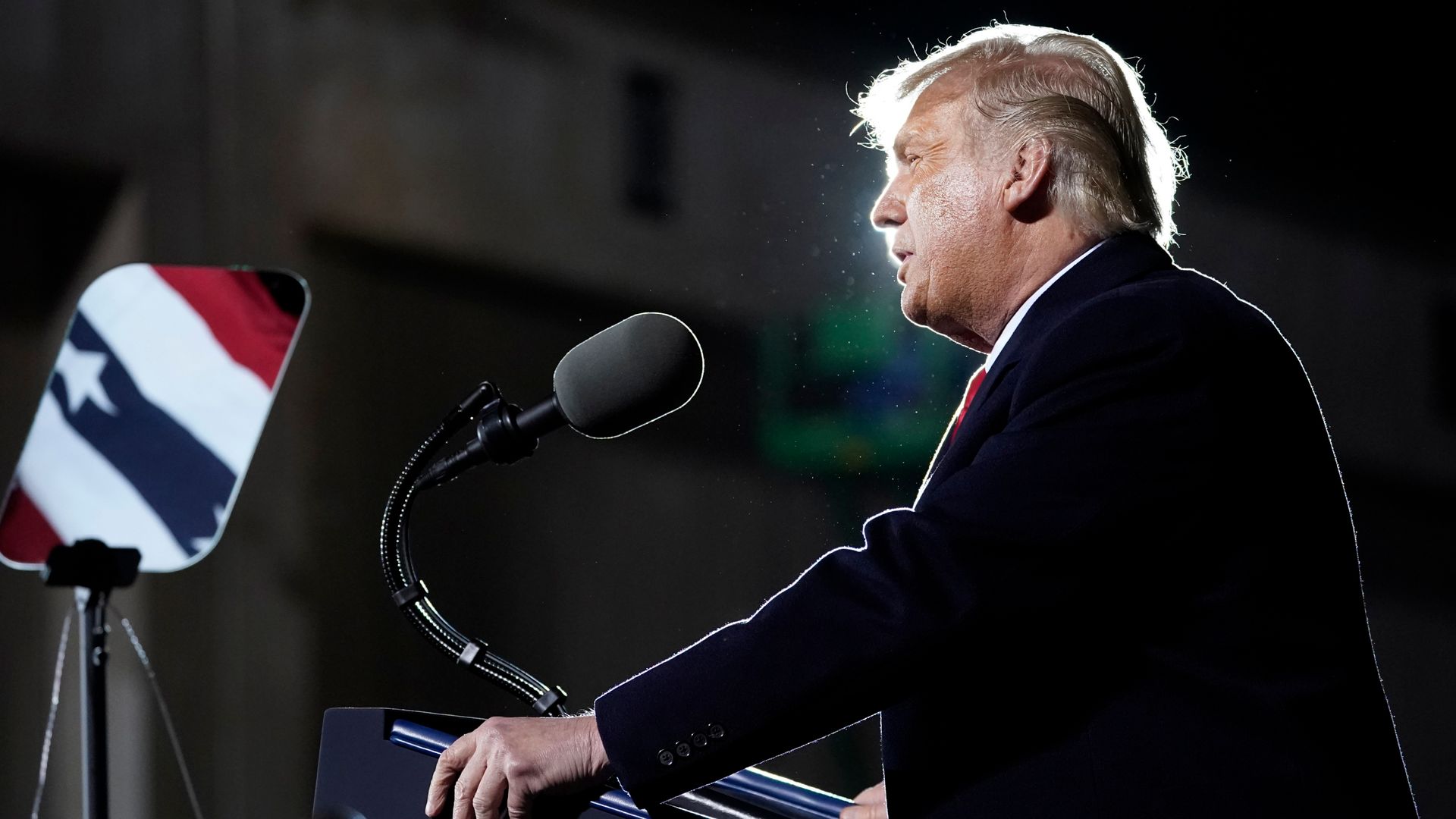
White House teleprompter operator Gabriel Perez used his access to Donald Trump’s speeches to win over $100,000 on the prediction market Kalshi, forcing the administration to place him on unpaid leave while exposing a massive regulatory blind spot in financial markets.
This is not a simple story of a rogue low-level staffer trying to clear a personal debt. It is the predictable result of a multi-billion-dollar prediction market industry operating faster than federal laws can adapt. Perez had intimate knowledge of the administration's messaging because he handled the text scrolling across the glass screens. He traded on that knowledge.
The Commodity Futures Trading Commission is currently negotiating a civil settlement with Perez. Federal prosecutors in Manhattan looked at the case and chose not to file criminal charges. That choice reveals a troubling reality. The legal framework governing insider trading applies clearly to corporate stocks, but it becomes murky when applied to political prediction markets.
The Mechanics of a White House Insider Trade
Perez was not guessing. He had operated Trump's teleprompters since the 2016 campaign, earning a salary of $175,000 a year and gaining the absolute trust of the president's inner circle. When Trump wanted last-minute edits, Perez made them. He was the final person to look at the text before the words became public record.
He took that advance knowledge straight to Kalshi’s "Mentions" market. These markets allow users to wager real money on whether a public speaker will utter specific words, phrases, or country names. If a user knows for a fact that the president will mention a specific economic statistic during the State of the Union, they can buy up contracts for pennies and collect a massive payout when the word is spoken.
Perez placed these wagers across more than a dozen high-profile speeches over a three-month period. His betting history included the December primetime address, the January speech at the World Economic Forum in Davos, and a March ceremony for the Medal of Honor.
The strategy was nearly flawless until human nature intervened. Trump frequently abandons his prepared remarks. When the president began skipping sections of text during live broadcasts, Perez panicked. Investigators discovered that Perez actually logged into his betting account during live speeches to modify or back out of his wagers when Trump went off-script.
That real-time trading pattern triggered the platform's internal automated alarms. Kalshi’s surveillance team noticed a user altering large financial positions in exact sync with Trump's spoken deviations. The platform froze the account, stopping Perez from withdrawing roughly $90,000 in profits, and immediately handed the data over to federal regulators.
The Regulatory Vacuum and the Manhattan Defection
The White House reacted with immediate public anger. Press Secretary Karoline Leavitt called the staffer's behavior a disgrace and confirmed that Trump personally ordered the unpaid leave. This response avoids the deeper question of systemic vulnerability.
Traditional insider trading laws rely on a clear breach of fiduciary duty to shareholders or a corporation. When a corporate executive buys stock before an earnings call, the law is clear. When a government employee uses a policy document or a speech to win a bet on a private derivatives platform, the statutory lines blur.
The Southern District of New York regularly prosecutes complex financial crimes. Yet prosecutors there walked away from a criminal case against Perez. This refusal highlights the severe difficulty of applying twentieth-century anti-fraud statutes to decentralized, event-driven prediction platforms.
Instead, the burden fell entirely on the Commodity Futures Trading Commission. The commission regulates Kalshi as a derivatives exchange, meaning it treats these contracts like oil futures or pork bellies. The agency can pursue civil penalties, demand the disgorgement of profits, and issue lifetime bans. It cannot put anyone in a federal prison.
This creates an environment where the potential reward outweighs the civil risk. A staffer with access to market-moving information faces termination and a fine, but no jail time.
The March Memo and Total Exposure
The administration cannot claim it was blindsided by the threat. In March, the White House distributed an internal memorandum specifically warning staff members against using non-public information to place bets on prediction markets. The warning focused heavily on sensitive foreign policy matters.
The policy failed to stop the behavior. White House internet networks block access to sites like Kalshi and Polymarket, but staffers simply use their personal cellular devices to bypass the restrictions. The ease of access makes enforcement nearly impossible without intrusive monitoring of employee phones.
The financial stakes extend far beyond a single teleprompter operator making small wagers. The words spoken by an American president can alter international trade, shift currency values, and move stock indices by hundreds of billions of dollars. If an operator knows that a speech contains a harsh new tariff proposal or a specific regulatory concession, the potential for massive secondary trading is immense.
The Perez case is a symptom of a much larger shift. Prediction markets are no longer niche playgrounds for internet hobbyists. They are institutional-grade platforms handling massive volume.
The Institutional Failure of Self Regulation
Platforms like Kalshi are stuck in a difficult position. They want to prove they are safe for institutional capital, which requires aggressive self-policing. In June, Kalshi added a rule requiring users to explicitly disclose their employers before placing certain political bets.
These disclosures depend entirely on user honesty. A motivated actor can easily lie or route trades through family members and shell accounts. Perez used his own account, showing a surprising lack of operational security for a long-time Washington insider. The next individual to exploit this vulnerability will not make the same mistake.
The industry’s rapid growth makes total oversight impossible. State-level attempts to curb or ban prediction markets have collapsed under legal challenges, leaving the federal government as the sole arbiter of an expanding frontier. Federal courts have repeatedly checked state power, ruling that platforms operating under federal derivatives licenses cannot be arbitrarily shut down by local regulators.
This leaves the executive branch completely exposed. Hundreds of low-level and mid-level government employees possess advance knowledge of economic data releases, military decisions, and diplomatic shifts. The temptation to monetize this data grows every time a platform lists a new contract.
The Failure of Current Ethics Rules
The administration's current approach relies heavily on traditional ethics pledges. Staffers sign documents promising not to profit from their official duties. These papers hold little weight when a single well-placed wager can equal a year’s government salary.
The White House must establish real-time monitoring and strict technical isolation for all staff handling sensitive texts. Passing out paper memos and issuing verbal condemnations after a breach occurs does nothing to protect the integrity of the office. The Perez incident proved that internal surveillance by private platforms is currently the only line of defense against government insider trading. That is an unsustainable model for a global superpower.
Government infrastructure must adapt immediately. The Commodity Futures Trading Commission needs explicit statutory authority from Congress to criminally prosecute individuals who abuse state secrets for prediction market gain. Until that happens, the system remains entirely vulnerable to anyone with a personal phone and an early copy of the president's remarks.