We think of the night sky as a painted ceiling. Eternal, fixed, and quiet. When we look up at the Milky Way smeared across a dark countryside, our bones register an ancient stillness.
Nothing could be further from the truth. Also making headlines recently: Carl Linnaeus Was Wrong About Naming Everything and Science Paid the Price.
Deep in the churning heart of our galaxy, hidden behind thick veils of cosmic dust, something is moving so fast it would cross the entire United States in the blink of an eye. Not a bullet. Not a jet fighter. A star.
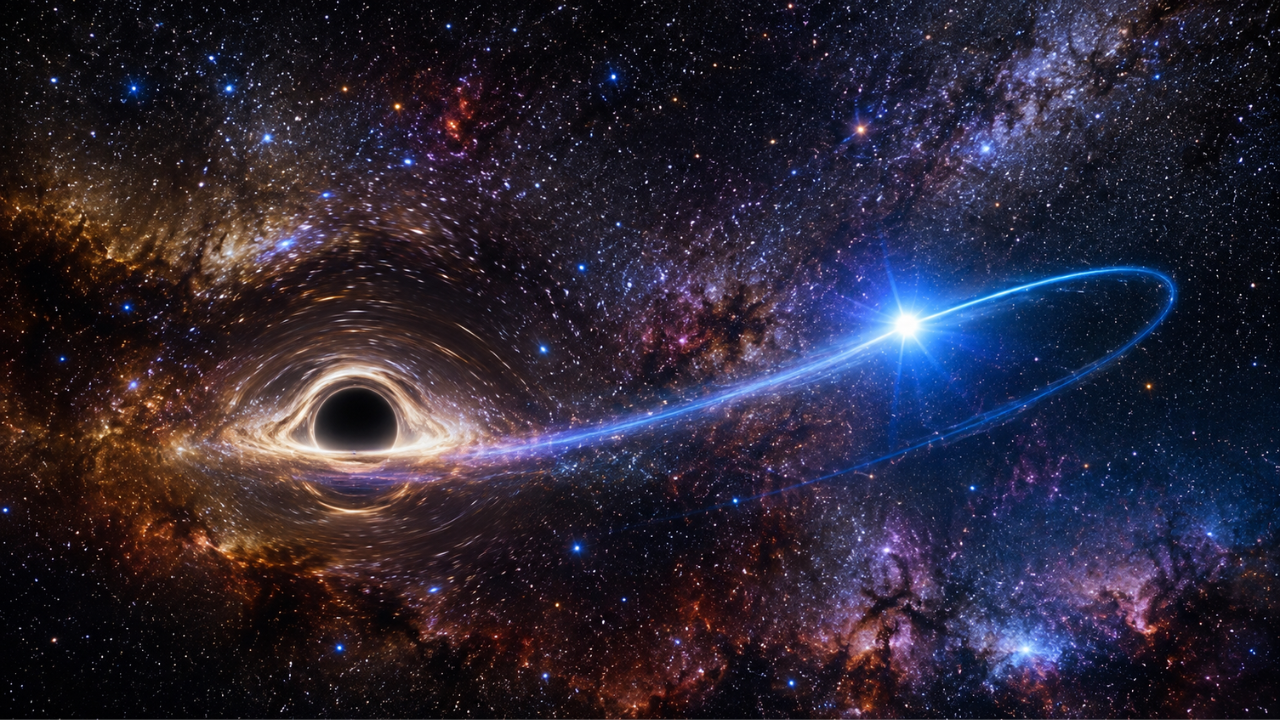
Astronomers call it S301. At its peak velocity, it rips through the void at fifteen thousand five hundred miles per second. That is over eight percent of the speed of light, roughly fifty-six million miles per hour. If you strapped yourself to its hull, you would circle the Earth four times before you could finish drawing your next breath. Further information regarding the matter are detailed by Science Magazine.
To understand why this matters, you have to stand in the control room of the European Southern Observatory's Very Large Telescope Interferometer in Chile. Picture the thin, high-altitude air freezing against the glass domes. Inside, researchers stare at screens capturing light gathered from four massive telescopes merged into a single, giant eye. They are looking at archival data stretching back through the years, hunting for a faint, unassuming main-sequence star that punches far above its weight class.
For decades, popular culture has taught us to fear black holes as cosmic vacuum cleaners, monsters waiting in the dark to swallow whole worlds. Sagittarius A*, the supermassive black hole reigning at the center of the Milky Way, tips the scales at about 4.3 million times the mass of our sun. By all rights, anything venturing too close should be shredded into atoms and devoured.
S301 breaks that script.
Its path is an extreme, highly stretched ellipse. For most of its 8.7-year orbit, the star drifts through the outer reaches of the galactic core, slowing down as it fights the immense gravitational pull. Then, gravity takes the wheel. The star plunges inward, diving toward the monster at the center. At its closest approach, it screams past Sagittarius A* at a distance roughly twelve times the span between Earth and the sun—close in astronomical terms, roughly matching the distance from Saturn to the sun.
Yet it does not fall. Its blistering velocity is its armor. The sheer momentum flings it back out into the dark, cheating the abyss over and over in a hypnotic, frantic loop.
Imagine watching a moth divebomb a blowtorch, except the moth is a sun, and the torch is a four-million-solar-mass engine of pure spacetime distortion.
This violent dance gives scientists something they have chased for generations. Albert Einstein predicted over a century ago that a massive, rotating body does not just sit in space; it drags the very fabric of spacetime around with it, like a spoon spinning through honey. This phenomenon, known as frame dragging or Lense-Thirring precession, warps the trajectories of anything unfortunate or lucky enough to pass close by.
Until now, proving this spin for Sagittarius A* felt like trying to measure the rotation of a distant carousel by squinting through a snowstorm from across a continent. Researchers assumed it would take decades of patient tracking across multiple stars to catch the subtle twisting of an orbit.
S301 changes the timeline.
Because it travels so fast and loops so tightly, its orbit acts like a sensitive needle on a geological seismograph. As the spinning black hole twists spacetime, it should subtly alter the orientation of the star's path. Researchers project that within the next decade, tracking S301 through its upcoming close passes will yield a direct measurement of the black hole's rotation.
We are standing on the precipice of answering how the core of our galaxy actually works.
Think about what it means to live under this canopy. We crawl across the crust of a quiet, rocky blue marble sitting safely in the peaceful suburbs of a spiral galaxy. We worry about traffic, rent, and the weather. Meanwhile, just twenty-six thousand light-years away, an anonymous star is running a marathon against eternity, whipped into a frenzy by an invisible giant, carving a path through the dark that will soon rewrite our textbooks.
The universe is not sleeping. It is sprinting. And for the first time, we have caught it in the act.