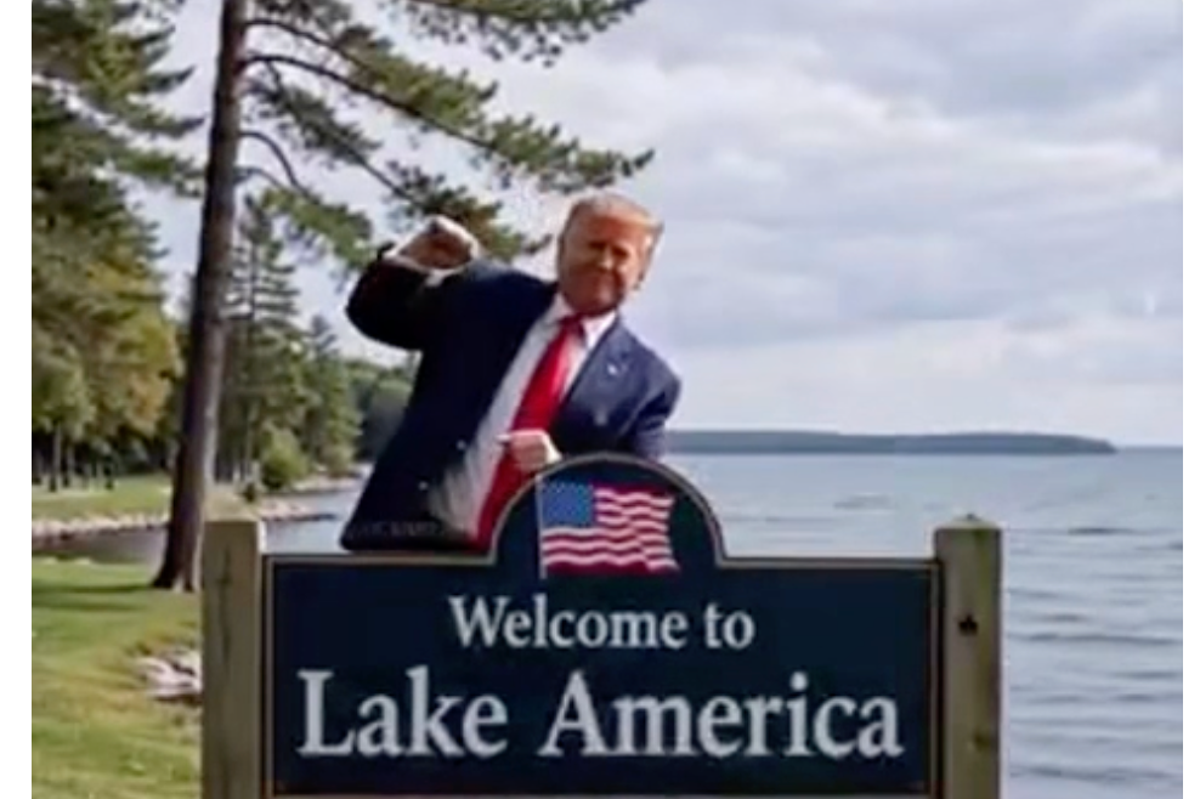
The screen glows blue in the basement. It is midnight, a Tuesday three weeks before the midterm elections, and thirty miles outside Washington, a twenty-four-year-old staffer named Leo is staring at a digital rendering of the President of the United States wearing a red cape, his jaw chiseled into granite, chest puffed out against a stylized American flag.
Leo’s eyes burn. He has consumed four cans of generic cola and twelve hours of continuous polling data that looks like a slow-motion car crash for his party. The numbers are stubborn things. Inflation is ticking upward, gas prices are biting into suburban budgets, and the traditional press briefings are met with the collective, deafening yawn of an exhausted electorate. Nobody reads the ten-page white papers on supply chain logistics. Nobody clicks the deep-dive policy analysis on agricultural subsidies.
So, Leo reaches for the cape.
He drops the image into an automated publishing queue alongside a caption that uses three emojis and a bold, declarative sentence designed to bypass the thinking brain and land directly in the gut. Within twenty minutes, the meme has crossed ten thousand shares. By morning, it is on cable news segments, dissected by furrowed-brow commentators who are entirely missing the point. They call it undignified. They call it a distraction.
They do not understand that the cape is the only language left that cuts through the noise.
Communication in the modern political arena has undergone a violent mutation. We used to trade in the currency of the printed editorial, the carefully modulated town hall, the measured cadence of the evening news anchor. Those were tools of an age when attention was an abundant resource, when citizens sat quietly in living rooms to absorb the day's events through a shared lens. That world is gone. It vanished somewhere around the advent of infinite scroll, replaced by an ecosystem of perpetual distraction where the human mind acts as a sieve, catching only the brightest, loudest, and most emotionally resonant fragments.
Consider what happens when a government agency shifts from drafting dense legislative summaries to commissioning viral digital artwork. This is not merely a stylistic choice. It is an adaptation mechanism, driven by the Darwinian pressures of the attention economy. When the White House social media channels flood feeds with superhero imagery, deep-fried filter effects, and hyper-stylized digital avatars of the commander-in-chief, they are not engaging in traditional public diplomacy. They are waging a guerrilla war for cognitive real estate.
To grasp the mechanics of this shift, look at how we process information on a biological level. The human brain is an ancient machine trapped in a futuristic environment. It evolved on the savannah, where survival depended on spotting the sudden twitch of a predator in the tall grass—a rapid, instinctual response system governed by the amygdala. Rational, deliberative thought handled by the prefrontal cortex is computationally expensive. It takes time, energy, and quiet.
Modern politics has made quiet an endangered species.
When a voter opens their phone during a crowded subway commute, their brain is saturated with sensory input: advertisements, text messages, work notifications, breaking news alerts of global catastrophe. Into this chaotic mental landscape drops an image of a political leader photoshopped into the body of an invincible comic book hero. It requires zero cognitive load to process. You do not need a degree in political science to understand a cape. You understand power. You understand protection. You understand the eternal, primordial narrative of good versus evil.
The opposition party stumbles because they treat these memes as a joke. They issue solemn press releases decrying the trivialization of democratic discourse. They demand seriousness. But seriousness is boring, and in the digital colosseum, boredom is a capital offense. While the critics are drafting their sternly worded condemnations, the meme has already bypassed the gatekeepers, wormed its way into group chats, and settled comfortably into the subconscious minds of millions of voters who could not name their congressional representative but instantly recognize the visual shorthand of political strength.
This is where the invisible stakes reveal themselves. When leadership is gamified, politics ceases to be about governance and becomes a matter of cinematic fandom. Voters stop asking whether a policy is fiscally sustainable or constitutionally sound; instead, they ask whether their chosen team is winning the aesthetic war. They wear their political affiliations like team jerseys, complete with custom lore, inside jokes, and digital totems.
I remember talking to an unaligned voter in Ohio last autumn, a man named Marcus who ran an auto repair shop and hadn't watched a full political debate in a decade. He was exhausted, working sixty hours a week, his knuckles permanently stained with grease and motor oil. When I asked him about the upcoming midterms, he shrugged, pulled out his phone, and showed me a TikTok video featuring a techno remix of a politician dodging a metaphorical bullet in slow motion.
"They're all full of it," Marcus said, wiping his hands on a rag. "At least these guys know how to put on a show."
That sentence should terrify anyone who cares about the republic. But it should also illuminate the exact battlefield upon which modern democracy is being fought.
The integration of meme culture into statecraft represents the final dissolution of the boundary between entertainment and reality. We have elected a reality where the tools of Hollywood scriptwriters are deployed by state actors to manufacture consent and project authority. Every press release is a trailer. Every policy announcement is a teaser drop. Every election cycle is an event horizon, engineered for maximum engagement and algorithmic velocity.
Leo knows this better than anyone. Back in the basement, the notifications on his dashboard are a cascading waterfall of green checkmarks and soaring engagement metrics. The senior communications directors will walk in at 8:00 AM, sip their lukewarm coffee, and look at the spike on the analytics screen with quiet satisfaction. They won't talk about policy. They won't talk about the nuances of the upcoming vote count. They will look at the reach, the impressions, the velocity of the share.
They have captured the room. Whether they can govern it once the credits roll remains entirely beside the point.