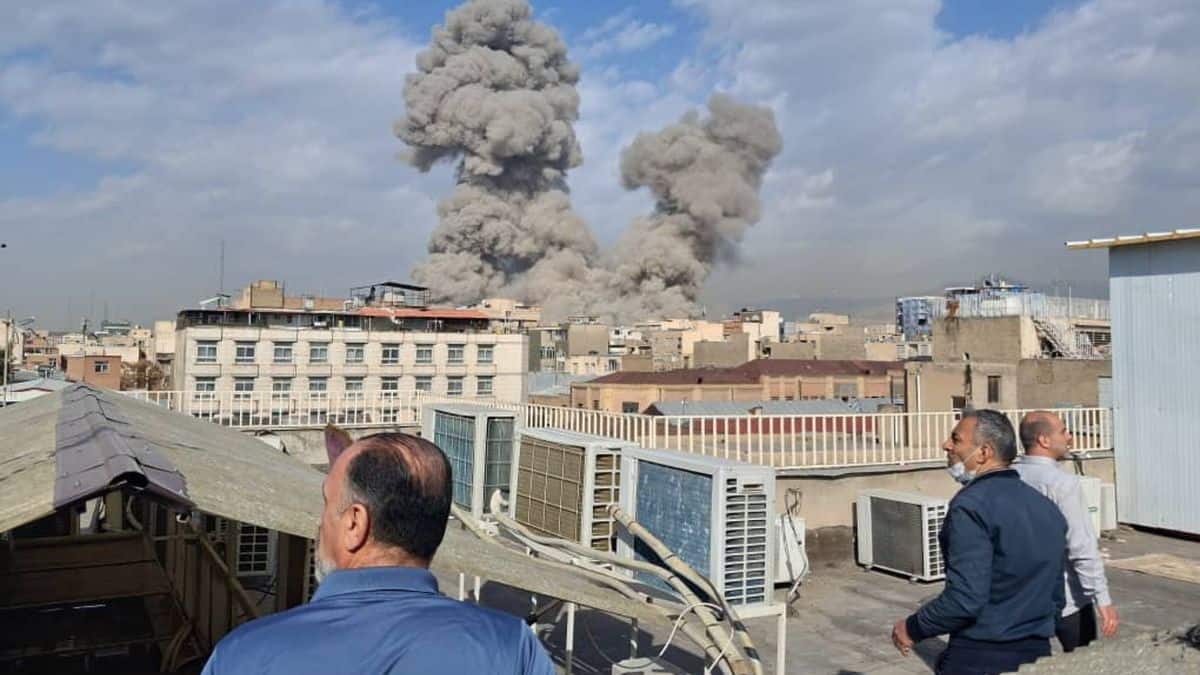
The lazy consensus loves a good historical parallel. It feels safe. It feels intellectual. Adrien Fontanellaz and the choir of cautious historians want you to believe that Donald Trump is reading from Vladimir Putin’s playbook, marching us toward an "uncontrollable war" with Iran. They paint a picture of a reckless Washington being led by the nose by Jerusalem into a Persian quagmire.
They are wrong. They are looking at the chessboard through a 19th-century lens while the game has moved to quantum computing.
The fear-mongering about an "uncontrollable" conflict ignores the fundamental reality of modern power dynamics: instability in Iran is not a bug of U.S. foreign policy; it is the feature. The assumption that a direct strike on Iranian nuclear infrastructure or a decapitation of the IRGC leads to World War III is a ghost story told by bureaucrats who are terrified of losing their relevance.
The Myth of the Rational Actor
Historians often fall into the trap of treating the Islamic Republic of Iran as a traditional nation-state with traditional red lines. This is a catastrophic miscalculation. I have sat in rooms where "experts" argued that the 2020 elimination of Qasem Soleimani would ignite a regional firestorm that would burn for a decade.
What actually happened? A performative missile strike on an empty base and a sudden, desperate attempt by Tehran to avoid a real fight.
The "Putin’s steps" argument suggests that Trump is seeking territorial expansion or a puppet state. That’s a fundamental misunderstanding of the transactional nature of the current U.S. administration. The goal isn't to occupy Tehran. It is to bankrupt the idea of the Resistance Axis. When you stop trying to "manage" a threat and start trying to delete it, the math changes.
The Logistics of Controlled Escalation
Let’s talk about the hardware. Critics argue that an Israeli-led strike on Natanz or Fordow would force a closure of the Strait of Hormuz, spiking oil prices to $200 a barrel and crashing the global economy.
This is 1970s thinking.
- Energy Independence: The U.S. is now the world’s largest producer of crude oil. The strategic leverage once held by OPEC+ has been diluted by Permian Basin fracking.
- Naval Dominance: Closing the Strait of Hormuz is easy to say in a speech; it is nearly impossible to maintain against a carrier strike group.
- Regional Realignment: The Abraham Accords weren't just a photo op. They were a defensive pact. For the first time in history, Arab capitals are more afraid of a nuclear Iran than they are of an aggressive Israel.
If the U.S. and Israel decide to dismantle the Iranian nuclear program, the "uncontrollable war" will likely be a forty-eight-hour demolition derby, not a thirty-year occupation.
The Hidden Cost of "Stability"
The "status quo" that Fontanellaz and his ilk want to protect is actually the most dangerous path available. By allowing Iran to reach "breakout" capacity while funding proxies from the Levant to the Gulf of Aden, we aren't avoiding war. We are subsidizing a slow-motion catastrophe.
Imagine a scenario where the U.S. continues to play the "de-escalation" game. Tehran achieves a deliverable nuclear warhead. Suddenly, the nuclear umbrella extends to Hezbollah. At that point, the cost of action doesn't just double; it becomes infinite.
The contrarian truth is that high-intensity, short-duration conflict now is a bargain compared to the existential bill that comes due in five years. We have seen what happens when "contained" threats are allowed to fester. Look at the millions spent on missile defense in the Red Sea just to keep shipping lanes open against a secondary proxy. It’s a losing game of whack-a-mole.
Why the "Putin Comparison" Fails
Comparing Trump to Putin is a reach that falls short of reality. Putin’s strategy in Ukraine is a war of attrition for land. The U.S.-Israeli strategy regarding Iran is a war of attrition for influence.
The U.S. doesn't want Iranian soil. It wants Iranian silence.
The strategy isn't about mimicking a Russian autocrat; it’s about applying maximum pressure until the internal contradictions of the Iranian regime become terminal. The Iranian economy is a house of cards. Inflation is a permanent resident. The youth population has zero interest in the revolutionary fervor of 1979.
A "war" in this context isn't just about dropping bombs. It’s about accelerating the inevitable collapse of a system that is already biologically dead.
The Disruption of the Military-Industrial Complex
One of the most annoying parts of the "uncontrollable war" narrative is the idea that it’s all a plot by defense contractors to sell more missiles.
Actually, the military-industrial complex hates this kind of disruption. They love long, grinding, expensive "interventions" that require twenty years of logistics and maintenance. They hate decisive, kinetic operations that end before the first invoice is cleared.
By shifting toward a policy of "break it and leave it," the U.S. actually disrupts the traditional business model of war. We are moving away from the "Nation Building" era into the "Threat Neutralization" era. It’s cleaner, it’s cheaper, and it’s far more effective.
The Iranian People: The Wild Card No One Mentions
The historians always talk about "Iran" as a monolith. They talk about the "regime's response."
What about the people?
The biggest risk to the Mullahs isn't a Tomahawk missile; it’s the fact that half their population would probably cheer if the IRGC headquarters were turned into a parking lot. This isn't Iraq in 2003. There is no grassroots insurgency waiting to defend the Supreme Leader. The disconnect between the ruling elite and the street is a chasm that the West should be exploiting, not fearing.
Address the Premise: Is War Ever "Controllable"?
People always ask: "Can you really control the outcome of a war?"
The honest answer is no. But you can control the intensity and the geography. By taking the fight to the source—Tehran’s nuclear and military infrastructure—you force the adversary to defend their home turf rather than exporting chaos to their neighbors.
The "uncontrollable" narrative is a psychological operation designed to keep the West paralyzed. It’s a form of strategic gaslighting.
The Execution Strategy
If you want to actually solve the Iranian problem, you don't do it with another round of "negotiations" in Vienna. You do it by:
- Targeted Infrastructure Deletion: Focus exclusively on the things the regime needs to survive—oil terminals and nuclear sites.
- Total Financial Decoupling: Anyone doing business with the IRGC is banned from the dollar ecosystem. Period.
- Direct Support for Dissidents: Not with speeches, but with Starlink terminals and cold, hard cash.
The downsides? Sure, there will be some blowback. Cyberattacks, maybe some maritime harassment. But compared to a nuclear-armed rogue state? It’s a rounding error.
The "experts" want you to stay afraid. They want you to believe that the world is a fragile vase that will shatter if we move too fast. But the vase is already broken. We are just the only ones willing to point at the shards on the floor.
Stop worrying about "Putin's steps." Start worrying about the cost of doing nothing while our enemies build the rope they intend to hang us with.
Go ahead. Call it "risky." Call it "uncontrollable."
I call it the only way out.