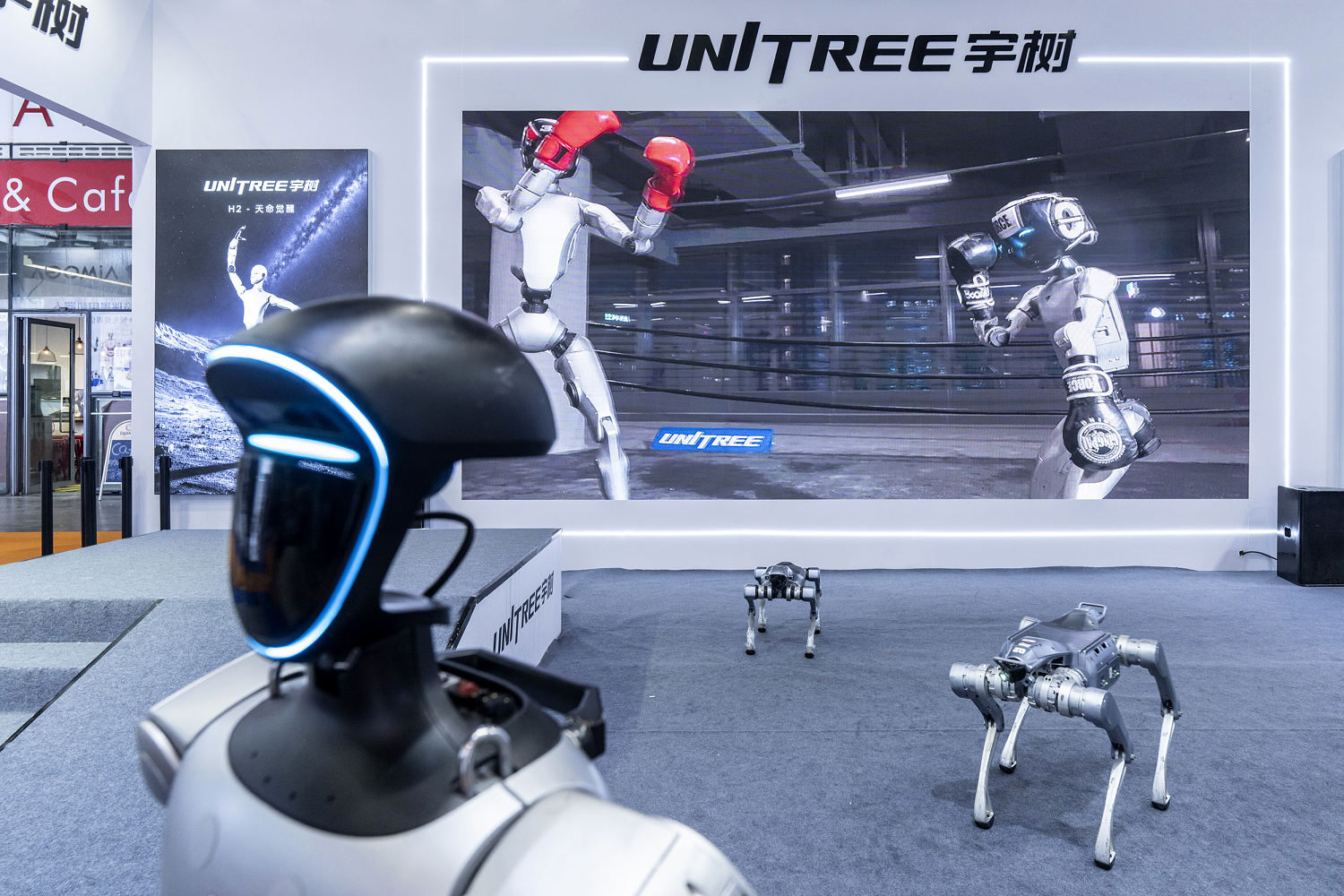
The stock market just witnessed a spectacle that felt more like a tech demo than a financial debut. Unitree Robotics hit the Shanghai exchange this week, and the numbers were staggering. Investors didn't just buy in; they fought for shares. The price soared over 600% on the first day, pushing the company’s valuation into the stratosphere.
You’ve likely seen the clips. Those viral videos of robots performing backflips, parkour, and high-speed sprints have captured the global imagination. But here is the reality check: investors aren't pouring billions into these companies because they think backflips are cool. They are betting on the fundamental shift in how physical labor will work in the coming decade. Meanwhile, you can explore other stories here: Why China Landing A Rocket Stage On Land Is Actually A Step Backward For Anyone Who Understands Economics.
The Shift Toward Embodied AI
We’ve spent years obsessing over software that can write emails or generate images. That was phase one of the AI frenzy. Now, we are entering the era of "embodied AI." This isn't just code living on a server; it’s artificial intelligence with a physical form capable of navigating the real world.
When you look at companies like Unitree, you aren't looking at a gimmick. You’re looking at a solution to a massive demographic problem. China is facing a shrinking workforce and a rapidly aging population. That’s a recipe for economic stagnation unless you find a way to make productivity gains elsewhere. To see the bigger picture, check out the detailed article by TechCrunch.
Humanoids are designed to fill that void. Unlike fixed industrial arms that can only perform one task on an assembly line, these new machines are built to be general-purpose. They are meant to walk into a factory or a warehouse and use the same tools a human would.
Why the Market Is So Bullish
The IPO frenzy for Unitree—where demand outstripped supply by over 8,000 times—tells you exactly what institutional investors are thinking. They see this as a necessary infrastructure play.
- Scalability: Unitree has already produced roughly 18,000 robots. That scale is unheard of in the niche world of advanced humanoid development.
- Integration: These firms are moving away from manual, line-by-line programming. They are now using vision-language-action models. This allows robots to see, reason, and react to their environment in real time.
- Government Backing: Beijing views robotics as a top-tier national priority. When the Ministry of Industry and Information Technology throws its weight behind an industry, capital follows.
It’s easy to focus on the flashy stunts. Sure, the "Superman" robot can jump two meters. But the real value lies in the data these machines collect as they move through complex spaces. Every hour of operation is a feedback loop that makes the underlying AI smarter.
Beyond the Hype
If you are looking at this from the outside, it’s worth asking if this bubble has room to breathe. Yes, the valuations are intense. Some might even call them irrational. But there’s a distinct difference between this sector and the dot-com era of speculation.
The manufacturing capability is already here. Companies are no longer selling just a vision; they are delivering hardware that functions. We are seeing major conglomerates—like Alibaba and Tencent—align themselves with these robotics firms because they know the future of e-commerce and logistics depends on automation that can move.
Don't ignore the geopolitical friction, though. The United States has already imposed restrictions, and Pentagon bans have hit some of these players hard. That doesn't stop the development, but it does change the market dynamics. It forces these companies to double down on self-reliance, creating a bifurcation in the global robotics supply chain.
What You Should Watch Next
If you’re trying to understand where the money is going, stop looking at pure-play software AI. Start watching the hardware integration.
- Look at the supply chain: The real winners won't just be the robot makers. They will be the companies supplying high-torque actuators, advanced sensors, and the specialized chips required for edge computing.
- Track the pilot programs: Watch which factories and service centers are actually deploying these units. You want to see "hours of operation" in non-controlled environments. That is the true metric of success.
- Ignore the "terminator" fear-mongering: Most of these units are being built for mundane, repetitive, or dangerous tasks. They are workforce multipliers, not sci-fi villains.
The backflips get the headlines. The massive orders from manufacturing partners get the results. If you’re waiting for these machines to become "useful," realize that for the companies buying them, that transition already started.
Focus on the shift in capital allocation toward physical automation. That is the only story that matters for the next five years. Watch the adoption rates in industrial hubs, not just the stock tickers. The robots are already on the factory floor, and they aren't going anywhere.