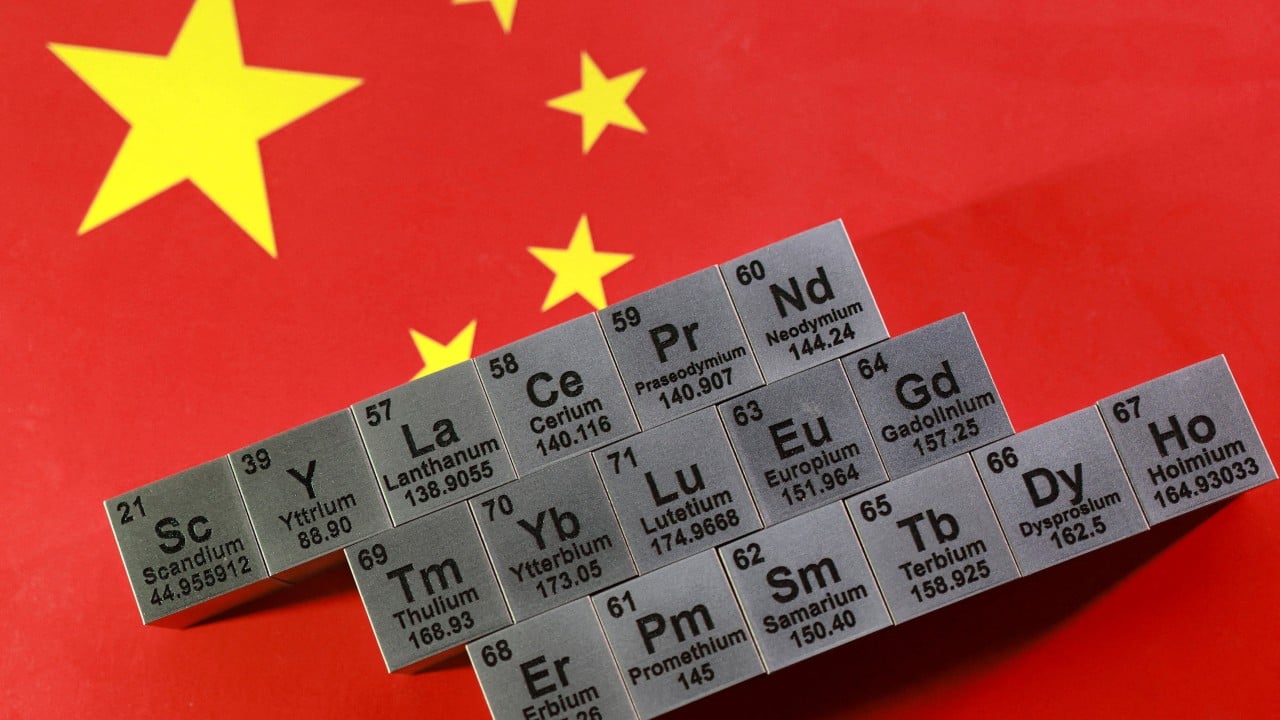
Beijing isn't just preparing for a trade war. It is finishing a decades-long project to ensure it can win one without firing a single shot. As the geopolitical friction between Washington and Beijing intensifies ahead of high-level diplomatic visits and shifting American administrations, China has moved from quietly accumulating resource wealth to loudly signaling its intent to use it as a strategic cudgel. The core of this strategy lies in the absolute dominance over critical minerals—the raw materials required for every piece of modern technology from F-35 fighter jets to the smartphone in your pocket.
China currently controls roughly 60% of global rare earth production and a staggering 90% of the refining capacity. While the United States and its allies have spent the last few years scrambling to open new mines, they are discovering that digging a hole in the ground is the easy part. The real power lies in the mid-stream processing, a sector where China holds a functional monopoly that would take at least a decade and hundreds of billions of dollars to replicate elsewhere.
The Illusion of Diversification
Western governments often point to new mining projects in Australia, Canada, and Africa as proof that the "de-risking" strategy is working. This is a dangerous oversimplification. Mining ore is a commodity business; refining that ore into high-purity metals and permanent magnets is a high-tech industrial feat.
China’s dominance isn't an accident of geography. It is the result of a deliberate, thirty-year industrial policy that prioritized long-term control over short-term environmental or financial costs. They were willing to endure the toxic byproduct of rare earth processing while Western companies shuttered their plants due to environmental regulations and low-cost Chinese competition.
Now, the trap is set.
Even if a mine in Mountain Pass, California, extracts neodymium and praseodymium, those concentrates often have to be shipped to Chinese facilities for processing. We are essentially handing them the ingredients and paying them to cook the meal, hoping they don't decide to starve us.
The Export Control Gambit
In recent months, Beijing has tightened the screws. They introduced new permit requirements for gallium and germanium—two niche but vital elements for semiconductors and radar systems. They followed this with restrictions on graphite, the primary material in electric vehicle (EV) batteries. These aren't just administrative hurdles. They are "test fires."
By requiring individual licenses for these exports, the Chinese Ministry of Commerce can effectively pick winners and losers in the global economy. They can reward a compliant European automaker with a steady supply of graphite while starving a defense contractor in the U.S. who they deem "unfriendly." This is the weaponization of the supply chain in its purest form.
Why Washington Can't Buy Its Way Out
There is a pervasive belief in some policy circles that a massive infusion of capital—a "Manhattan Project" for minerals—will solve the problem. This ignores the reality of industrial inertia.
Building a refinery involves navigating a thicket of environmental impact studies, securing specialized labor that hasn't existed in the West for a generation, and developing proprietary chemical processes that China has perfected through trial and error over thirty years. In the U.S., a new mine can take seven to ten years just to clear the permitting phase. China can build an entire industrial park in eighteen months.
Furthermore, China uses a "scorched earth" pricing strategy. Whenever a Western competitor gains traction, Chinese state-backed firms can flood the market, crashing prices and making the Western project economically unviable. This predatory pricing keeps private capital on the sidelines, as investors are terrified of pouring billions into a project that could be bankrupted by a memo from Beijing.
The Hidden Monopoly on Talent
We often talk about the minerals themselves, but we rarely talk about the people who know what to do with them. China has invested heavily in metallurgical engineering and material science programs. They have a deep bench of PhDs and technicians who understand the specific, finicky chemistry of separating rare earth elements.
In contrast, the West has largely pivoted toward software and finance. We have the best coders in the world, but we are running dangerously low on people who know how to manage a solvent extraction circuit. You cannot code your way into a magnet.
The Military Vulnerability Gap
The most pressing concern isn't the price of an EV; it’s the readiness of the military-industrial complex. A single Virginia-class submarine requires nearly 9,200 pounds of rare earth materials. Each F-35 Lightning II requires roughly 920 pounds.
If Beijing decides to halt the export of high-performance magnets tomorrow, the production lines for these platforms don't just slow down—they stop. There is no "Plan B" sitting on a shelf. The defense industry's reliance on a single, adversarial source for critical components is perhaps the greatest strategic failure of the post-Cold War era.
"The dependence on Chinese rare earths is a structural vulnerability that cannot be mitigated by stockpiling alone. Stockpiles run out. Production capacity is the only true security."
Reclaiming the Supply Chain
To break this cycle, the approach must shift from subsidizing mines to protecting the entire ecosystem. This means:
- Guaranteed Offtake Agreements: Governments must act as the "buyer of last resort" to protect new domestic refineries from Chinese price manipulation.
- Permitting Reform: The time it takes to approve a processing facility must be slashed without compromising safety.
- Multilateral Processing Hubs: Instead of every country trying to build its own end-to-end supply chain, allies should specialize. Japan has the magnet technology, Australia has the ore, and the U.S. has the demand.
The Graphite Squeeze
Graphite is the latest front in this war. While much of the world's focus has been on lithium, graphite makes up the bulk of an EV battery's weight. China produces about 90% of the world's anode-grade graphite.
By restricting exports of this specific material, Beijing is sending a clear message to the global automotive industry: your "green transition" happens on our terms. If you want the graphite, you need to keep your manufacturing bases within our reach, or at the very least, refrain from supporting trade barriers against Chinese EVs. It is a brilliant, if ruthless, use of leverage.
The Recycling Myth
Many analysts suggest that recycling will bridge the gap. While recycling is necessary, the math doesn't add up for the immediate future. The volume of minerals currently in the "circular economy" is a fraction of what is needed to meet projected demand for the energy transition. You cannot recycle what hasn't been built yet. We are at least two decades away from recycling being a primary source of these materials.
Strategic Resource Sovereignty
The era of "just-in-time" global supply chains, governed by nothing but the lowest price, is over. We have entered the era of Resource Sovereignty.
This isn't about isolationism; it's about survival. China has spent decades fortifying its position, and they are now using their mineral dominance to dictate terms to the rest of the world. They aren't just "touting" their dominance; they are exercising it. The West must decide whether it is willing to pay the "sovereignty premium" to rebuild its industrial base or if it will continue to trade its long-term security for short-term savings.
The leverage held by Beijing is not just a business challenge—it is a fundamental shift in the global balance of power. Every diplomatic mission, every trade talk, and every military maneuver is now shadowed by the reality that the ingredients of the future are locked behind a wall we helped build.
Stop looking at these minerals as commodities. Start looking at them as the ammunition of the 21st century.