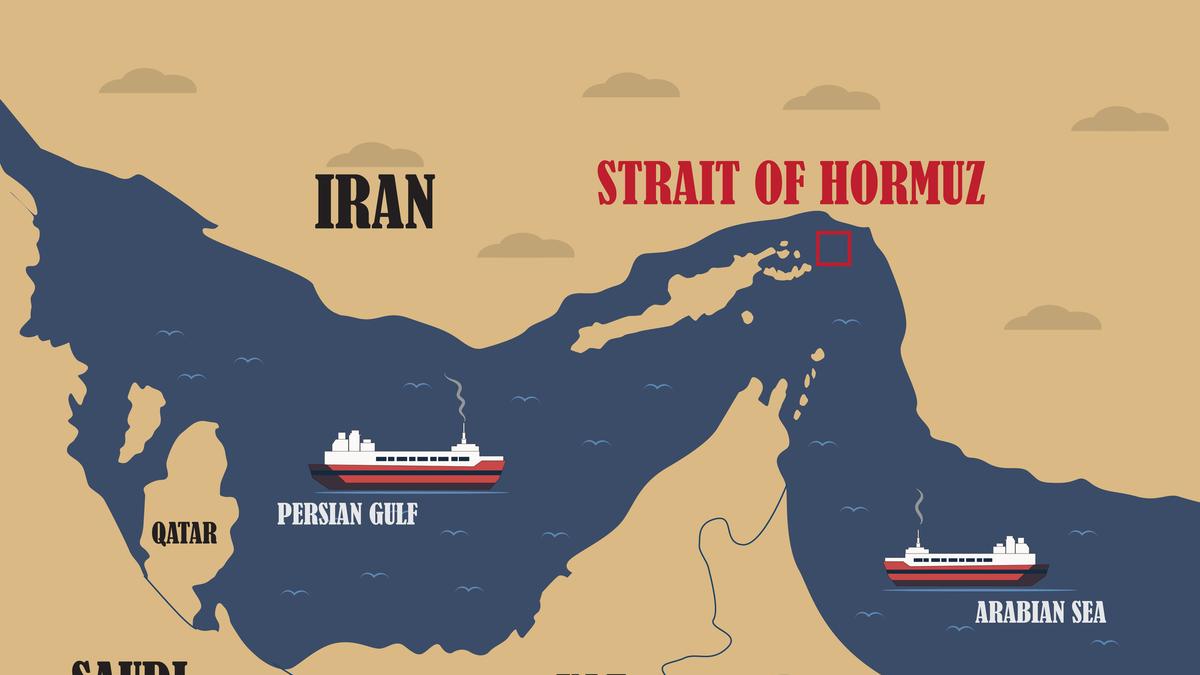
The water in the Strait of Hormuz does not look like a geopolitical fault line. On a calm morning, it is a thick, deceptive turquoise, heavy with salt and the oppressive humidity of the Persian Gulf. If you stand on the decks of a rust-streaked oil tanker wallowing in these swells, the world feels agonizingly slow. The engines thrum a low, bone-deep vibration. The air smells of sulfur, brine, and crude.
But beneath that stillness lies a terrifying mathematical reality. Meanwhile, you can explore other stories here: The Geopolitical Cost Function of Stalled Brinkmanship: Deconstructing the US-Iran Deadlock.
Through this narrow strip of water—just twenty-one miles wide at its tightest constriction—flows roughly a fifth of the world’s petroleum. It is the jugular vein of the global economy. If it constricts, lights go out in Tokyo. Factories idle in Europe. Gas prices at a pump in Ohio spike before the evening news can even broadcast the reason why. For decades, managing this fragile corridor was a delicate, tense dance of international maritime law, Western naval patrols, and shadow boxing.
Now, the rules of the dance have changed. Tehran has officially announced the creation of a dedicated, centralized body designed specifically to oversee, manage, and regulate the Strait of Hormuz. To understand the bigger picture, check out the excellent analysis by The New York Times.
This is not just another bureaucratic reshuffling in a distant capital. It is a calculated consolidation of leverage. To understand why this matters to someone who has never set foot in the Middle East, you have to look past the dry press releases and look at the chess board through the eyes of those who actually sail these waters.
The View from the Bridge
Consider a captain we will call Marcus. He is a veteran merchant mariner with twenty years of experience hauling crude from the loading docks of Ras Tanura down through the Gulf.
In the past, Marcus’s anxieties were predictable. He watched the horizon for fast-attack craft from the Islamic Revolutionary Guard Corps (IRGC). He monitored the radio for erratic warnings. He knew that the line between international waters and Iranian territorial seas was thin, but it was a line defined by international treaties. If an Iranian vessel approached, there was a protocol. There was a direct line of communication to the Western coalition warships patrolling nearby.
Under the new framework established by Iran, Marcus’s reality becomes far more complicated.
Tehran’s new regulatory body centralizes maritime authority, blending civilian maritime oversight with the hard tactical edge of the IRGC. Instead of dealing with fractured local commanders or standard international maritime protocols, a captain entering the Strait now faces a singular, unified entity that claims the right to dictate who passes, under what conditions, and at what cost.
It turns a fluid, contested international waterway into a highly regulated toll road controlled by a single, unpredictable gatekeeper.
For a shipping company executive sitting in an air-conditioned office in Singapore or London, this is a logistical nightmare. Insurance premiums for transiting the Gulf do not rise because of actual explosions; they rise because of uncertainty. A centralized Iranian authority capable of legally or physically detaining a vessel under the guise of "regulatory compliance" introduces a variable that cannot be factored into a standard business model.
The Mechanics of Pressure
Why now? The timing is not accidental.
Iran has spent years enduring crippling economic sanctions, navigating proxy conflicts, and watching its economic isolation deepen. Yet, it possesses one structural advantage that no amount of diplomatic pressure can erase: geography. The shipping lanes that handle millions of barrels of oil per day cut directly through Iran’s backyard.
Historically, Iran’s leverage over the Strait was binary. They could either leave it open, or they could threaten to mine it, attack ships, and shut it down. The latter option, however, is a catastrophic glass hammer. Pulling the trigger meant inviting a massive, conventional military response from the United States and its allies. It was an option of last resort, a mutually assured destruction for global trade.
The creation of this new management body introduces a middle ground. It is the institutionalization of gray-zone warfare.
By wrapping its control in the language of administrative oversight, environmental protection, and maritime security, Tehran can apply pressure incrementally. They do not need to sink a tanker to disrupt the global economy. They merely need to slow one down. They can tie a vessel up in administrative audits. They can demand compliance with newly minted environmental standards. They can create delays.
In the shipping world, time is money. A three-day delay for a supertanker carries a six-figure price tag. Multiply that across dozens of ships, and you have a silent, bloodless blockade that drains billions from global markets without a single shot being fired.
The Invisible Ripple
It is easy to compartmentalize this as a regional issue, a localized headache for the energy sector. That is a comforting illusion.
The global energy market functions like a single, massive swimming pool. If you pour water in one end, the level rises everywhere. If you block a pipe at the bottom, the entire system feels the pressure.
When uncertainty hits the Strait of Hormuz, the reaction is instantaneous. Commodities traders in Chicago and London react to the mere whisper of disruption. The cost of crude spikes. But the story does not end on the trading floor.
Consider what happens next:
The increased cost of fuel trickles down to the container ships carrying microchips from Taiwan, sneakers from Vietnam, and grain from the American Midwest. The cost of transport rises. Trucking companies pass those expenses onto retailers. Ultimately, a consumer standing in a grocery aisle three months from now will pay seven dollars for a gallon of milk, wholly unaware that the extra cost was set in motion by a regulatory decree signed in Tehran.
This is the true genius of the strategy. It exploits the fragility of modern, just-in-time supply chains. We live in a world optimized for efficiency, not resilience. We have stripped away the buffers to maximize profit margins. By creating a bureaucratic mechanism to disrupt the tightest bottleneck in that system, Iran has given itself a volume knob for global economic pain.
The Sinking Illusion of Total Control
There is a profound irony at the heart of this escalation. Iran’s new body is designed to project absolute sovereignty, to signal to the West that the Persian Gulf belongs to Tehran. But history suggests that absolute control over a chokepoint is a dangerous myth.
The more a nation tightens its grip on a vital global artery, the more it compels the rest of the world to find a way around it.
We are already seeing the early stages of this divergence. For years, regional powers have quietly invested in bypass infrastructure. Saudi Arabia has expanded its East-West Pipeline, capable of moving millions of barrels of crude across the desert to the Red Sea, bypassing the Strait entirely. The United Arab Emirates has utilized the Habshan–Fujairah pipeline to pump oil directly to the Gulf of Oman, outside the choke point.
These bypasses are expensive, inefficient, and currently incapable of handling the sheer volume that flows through the water. But they represent a shifting architecture. By forcing the world’s hand, Iran may find that its ultimate leverage point is slowly depreciating in value.
Furthermore, a centralized authority means a centralized point of accountability. In the past, when an anonymous limpet mine damaged a tanker, Tehran could claim plausible deniability, blaming rogue actors or accidents. With a formal, unified body managing the Strait, every delay, every seizure, and every regulatory extortion becomes an official act of state policy.
It removes the ambiguity. It forces a direct confrontation with the international community.
The Weight of the Horizon
Back on the water, the sun begins to set over the Iranian coast, casting long, dark shadows across the shipping lanes. On the bridge of Marcus's tanker, the radar screen blips with the steady, rhythmic signatures of surrounding vessels. Each dot represents millions of dollars, thousands of tons of steel, and crews of ordinary men and women just trying to make a living.
They look at the horizon, not with the grand strategic vision of diplomats or generals, but with the quiet, gnawing anxiety of people who know they are small pieces in a very large, very dangerous game.
The new body announced by Iran will not feature uniform-clad soldiers storming decks every morning. It will look like paperwork. It will look like radio transmissions demanding altered courses. It will look like new procedures, new fees, and new delays.
But the silence of this bureaucratic creep should deceive no one. The hand on the throat of global commerce just tightened its grip, and the world will feel the breath catch in its throat soon enough.