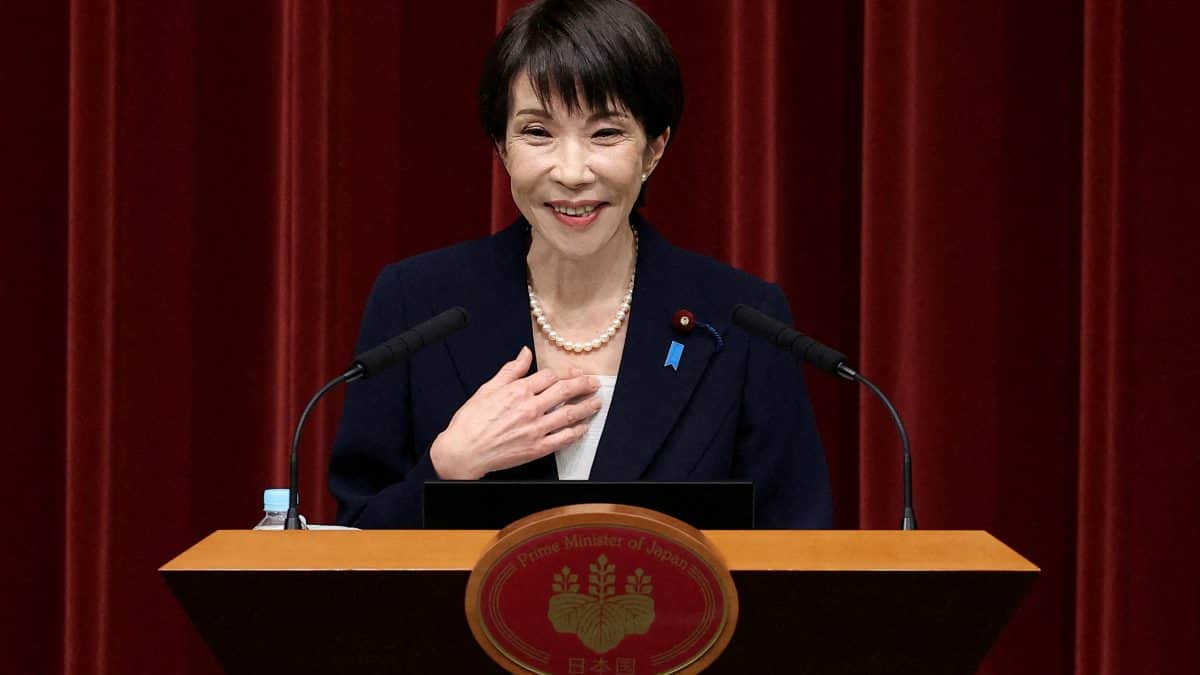
The air inside the Liberal Democratic Party headquarters in Tokyo doesn’t just smell like floor wax and old paper. It smells like the weight of sixteen centuries. To walk these halls as Sanae Takaichi is to carry a briefcase full of contradictions. She is a woman standing at the threshold of the highest office in Japan, a feat that would shatter a glass ceiling thicker than the walls of an ancient fortress. Yet, her platform is built on the preservation of a rule that keeps women firmly on the outside of the most sacred lineage on earth.
Sanae Takaichi wants to be Japan’s first female Prime Minister. But she does not want a woman to ever sit on the Chrysanthemum Throne.
To understand why a woman who has fought her way through the sharp-elbowed, male-dominated world of Japanese politics would deny that same path to a Princess, you have to look past the political polling. You have to look at the blood.
The Phantom of the 127th Emperor
In a quiet corner of the Imperial Palace, there is a biological ticking clock. Under the 1947 Imperial House Law, only a male descendant from a male line can ascend the throne. This isn't just a rule; for traditionalists like Takaichi, it is the soul of the nation.
Consider the hypothetical life of a young Princess in the modern era. Let’s call her Hanako. She grows up in the gilded silence of the palace, educated, refined, and deeply loved by a public that sees her face on every newsstand. But the moment Hanako falls in love with a commoner—a teacher, a lawyer, a jazz musician—she vanishes. Upon marriage, she is stripped of her royal status. She becomes a private citizen, her ties to the sun goddess Amaterasu severed by a legal wedding document.
For the modern observer, this feels like an archaic tragedy. If the Emperor has no sons, and his daughters are forced into exile by marriage, the line simply ends. It is a slow-motion collapse of a dynasty that claims to be the oldest continuous hereditary monarchy in the world.
Takaichi looks at this potential collapse and sees a different solution than the one the public demands. A recent poll showed that nearly 90% of the Japanese public would be perfectly happy with a reigning Empress. They see the young Princess Aiko, the only child of Emperor Naruhito, and they see a future. They see a leader.
Takaichi sees a risk to the "unbroken" chain.
The Bloodline Calculus
Her argument isn't based on a lack of faith in female leadership. That would be self-defeating for a woman aiming for the Premiership. Instead, she hinges her logic on a hyper-specific definition of "yasei"—the paternal lineage.
In Takaichi’s view, the moment a woman becomes the reigning Empress and has a child, that child’s father is a commoner. Therefore, the child belongs to the father's line, not the Imperial line. In the eyes of the traditionalists, the 2,600-year-old chain would snap.
"The weight of the male-line succession is something that has been protected by our ancestors without exception," Takaichi has argued in various forums.
But how do you protect a line that is running out of men?
There are currently only three heirs left: the Emperor’s brother, Crown Prince Akishino; his son, Prince Hisahito; and the Emperor’s elderly uncle, Prince Hitachi. The entire weight of a civilization rests on the shoulders of a single teenager, Hisahito. If he does not have a son, the system, as Takaichi defines it, reaches a dead end.
Takaichi’s counter-proposal is not to change the gender rules, but to reach back into the past and pull the dead branches of the family tree back to life.
The Resurrection of the Branches
In 1947, under the shadow of the Allied occupation, the Imperial family was drastically pruned. Eleven "collateral" branches—distant cousins of the Emperor—were stripped of their royal status to save money and reduce the Emperor’s influence.
Takaichi wants to bring them back.
She suggests that members of these former princely houses could be adopted into the current Imperial family or reinstated as royals. It is a logistical and emotional labyrinth. Imagine telling a man who has lived his entire life as a private citizen, perhaps working as an architect or a salaryman in Tokyo, that he must now move into the palace, follow rigid protocols, and provide a male heir to save the state.
It is a move that prioritizes the abstract concept of DNA over the living, breathing reality of the people currently wearing the crowns.
The friction here is palpable. On one side, you have a public that values the "humanity" of the royals. They watched the former Emperor Akihito break tradition to comfort disaster victims on his knees. They see the current Emperor and Empress as a modern couple. They want the family to look like Japan: evolving, inclusive, and resilient.
On the other side stands Takaichi, the guardian of the museum. For her, the Emperor is not a "celebrity" or even a "leader" in the political sense. He is a priest-king, a biological bridge to the divine. If you change the bridge's material, is it still the same bridge?
The Woman in the Mirror
The irony of Takaichi’s position is sharp enough to draw blood. She is a disciple of Margaret Thatcher. She rides motorbikes. She talks tough on national security and China. She is, by every definition, a modern, trailblazing woman who has defied every cultural expectation of what a Japanese woman "should" be.
Yet, she is the most vocal opponent of allowing another woman to do the same in the Imperial sphere.
This isn't just about sexism; it’s about a specific brand of Japanese conservatism that views the state as an organic body. In this worldview, the Prime Minister is the brain—logical, changing, responsive to the times. But the Emperor is the heart. And hearts, according to Takaichi, do not change their fundamental rhythm without the whole body dying.
The stakes are invisible until you realize they involve the very identity of Japan. If the law remains unchanged, and Hisahito does not produce a male heir, the monarchy will face an existential crisis that no amount of political maneuvering can fix.
Takaichi is betting that the Japanese people will value the "purity" of the line over the survival of the individuals they currently love. She is betting that the past is more important than the future.
The Silent Corridor
If you walk through the Imperial gardens on a Tuesday, the silence is heavy. It is the silence of a house that is slowly emptying.
The princesses continue to grow up. They continue to excel in their studies. They continue to represent their country with a grace that masks the reality of their situation: they are temporary residents. They are guests in their own history, waiting for the day a marriage certificate turns them into ghosts.
Sanae Takaichi stands at the podium, her voice steady, her resolve unshakable. She speaks of tradition and the sacred duties of the male line. She speaks as a woman who has claimed power for herself, while simultaneously arguing that some power is simply not for women to hold.
The sun sets over the palace moats, reflecting the grey stone and the ancient pines. Inside, the decisions are being made by those who believe that the only way to save the fire is to make sure the wood never changes, even if the forest is burning down around them.
The 127th Emperor sits on his throne, his daughter stands beside him, and the law stands between them like a sword.
Would you like me to analyze the historical precedents of reigning Empresses in Japan and how their reigns differed from the current "male-only" narrative?