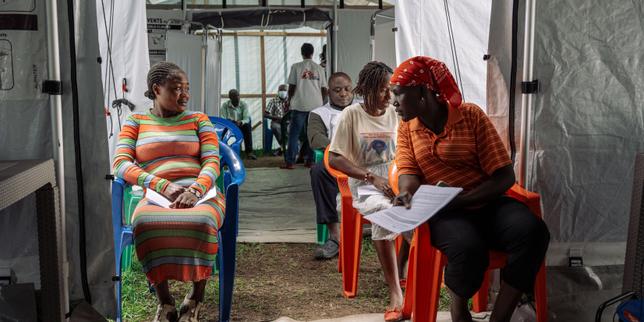
Launching clinical trials for Ebola treatments in an active outbreak zone does not automatically bend an epidemic curve; it shifts the primary constraint from pharmacological scarcity to field execution, diagnostic speed, and community trust. In eastern Democratic Republic of the Congo—specifically around Bunia in Ituri province during the 2026 Bundibugyo virus disease outbreak—initiating therapeutic trials signals scientific momentum, yet hope remains operationally fragile until trial infrastructure reaches rural transmission chains.
Standard outbreak reporting treats the start of a clinical trial as an inflection point where desperation gives way to solutions. That framing misses the mechanics of filovirus containment. Unlike outbreaks driven by a single concentrated source, a spreading Ebola epidemic behaves as a coupled system of viral replication, diagnostic lag, health-system capacity, and social behavior. A promising drug cannot alter population-level mortality if patients arrive late, if laboratory confirmation takes days, or if insecurity and stigma push symptomatic individuals away from treatment centers.
Deconstructing the Competitor Narrative
Coverage centered on "hope" around first treatment trials in the epicenter typically rests on three implicit assumptions:
- The Therapeutic Bottleneck Assumption: The narrative treats the absence of a proven antiviral or monoclonal antibody as the central barrier keeping case fatality high. While having no licensed Bundibugyo-specific therapy is a genuine scientific gap, clinical trials test safety and efficacy in enrolled patients rather than immediately supplying population-wide cure.
- The Epicenter Proxy Assumption: Reporting from a major urban hub such as Bunia often treats local progress as a proxy for regional control. Epidemics in eastern DRC routinely shift across health zones, meaning stabilization in one town can coincide with expansion in harder-to-reach rural districts.
- The Linear Progress Assumption: Framing trial launch as "renewed hope" implies a steady upward arc from enrollment to containment. In practice, early-stage outbreak trials face enrollment friction, protocol adjustments, security interruptions, and interim statistical uncertainty.
Replacing those assumptions requires examining the system through concrete structural frameworks rather than sentiment.
The Three Pillars of Outbreak Trial Effectiveness
A clinical trial inside an active epidemic succeeds or stalls across three interdependent operational pillars. Weakness in any single pillar degrades the others.
1. Diagnostic Throughput and Time-to-Isolation
Therapeutic trials depend on rapid, accurate identification of eligible cases. If suspected cases wait days for polymerase chain reaction or point-of-care confirmation, two failure modes occur simultaneously. First, patients who deteriorate rapidly may die or miss optimal treatment windows before enrollment or supportive stabilization occurs. Second, unconfirmed or waiting patients generate secondary transmission if isolation and infection-prevention protocols are strained.
Expanding decentralized laboratory capacity and shortening sample-to-result turnaround directly governs both clinical timing and trial accrual. Without fast diagnostics, even a well-designed trial filters a distorted subset of cases.
2. Randomized Design Under Field Constraints
Evaluating candidate therapeutics against standard supportive care requires rigorous randomization and follow-up so outcomes reflect true biological effect rather than selection bias or unequal nursing care. In a volatile outbreak setting, maintaining trial integrity is difficult. Staff rotations, supply chain friction, cold-chain or transport constraints, and sudden patient movements test protocol adherence daily.
Furthermore, trials targeting a specific ebolavirus species—such as Bundibugyo virus, which differs genetically and clinically from Zaire ebolavirus—cannot simply extrapolate historical efficacy data from prior outbreaks involving different species. Efficacy must be established empirically within the active trial arms.
3. Community Trust and Care-Seeking Velocity
No treatment trial can enroll patients who fear the facility delivering it. Care-seeking velocity—the time elapsed between symptom onset and arrival at an Ebola treatment center—is a critical determinant of survival and onward spread. When community deaths occur outside treatment units or families hesitate to bring sick relatives forward, cases are detected late or missed altogether.
Trust is built through transparent communication, respectful patient care, safe and dignified burial practices, and visible alignment between clinical research and local health needs. Without that social contract, clinical trials risk operating as isolated islands rather than integrated components of epidemic control.
The Cost Function of Delay and Fragmentation
Epidemiologists and operations planners can think of outbreak response costs through a practical cost function where total harm rises nonlinearly as response delays compound:
$$\text{Total Outbreak Cost} = C_{\text{care}} + C_{\text{transmission}} + C_{\text{epistemic}}$$
Here, $C_{\text{care}}$ represents the clinical burden of severe disease, supportive care, and preventable deaths; $C_{\text{transmission}}$ captures the secondary infections generated while cases remain undetected or unisolated; and $C_{\text{epistemic}}$ reflects the lost scientific learning when trials launch late, under-enroll, or face high loss to follow-up.
The cause-and-effect links are straightforward:
- Delayed case detection increases viral shedding time in the community, raising $C_{\text{transmission}}$, while late presentation worsens clinical prognosis, raising $C_{\text{care}}$.
- Fragmented coordination between surveillance teams, treatment centers, and trial investigators slows patient screening and data capture, inflating $C_{\text{epistemic}}$ and delaying definitive evidence on which therapies actually work.
- Insecurity and geographic dispersion across provinces force operational pauses and resource diversion, pushing all three cost components upward simultaneously.
Notice what this cost function clarifies about "hope." A trial reduces $C_{\text{epistemic}}$ by generating structured evidence on candidate drugs. It only reduces $C_{\text{care}}$ and $C_{\text{transmission}}$ at scale if proven treatments emerge and reach patients early within a functioning containment system.
What Is Known Versus What Remains Hypothesis
Separating established facts from educated hypotheses prevents overinterpreting early trial milestones:
- Known mechanism and operational reality: Bundibugyo virus disease lacks an approved specific antiviral or vaccine at the outset of outbreak trials, making supportive care, early isolation, contact tracing, and safe burial foundational to survival and containment. Randomized controlled trials are the standard method to test whether candidate therapeutics improve survival over standard care.
- Known structural friction: Eastern DRC outbreaks occur amid overlapping security challenges, mobile populations, and uneven rural health infrastructure, creating persistent gaps between urban trial hubs and peripheral transmission zones.
- Educated hypothesis on clinical impact: Candidate therapeutics under evaluation may reduce mortality or shorten viral clearance in enrolled patients, and faster diagnostic-to-treatment pathways should improve outcomes compared to delayed care—but neither effect is guaranteed until trial data mature and operational bottlenecks are cleared.
Tactical Execution Logic for Field Leaders
To translate a trial launch into measurable epidemic impact, response teams can execute a disciplined sequence rather than treating research and public health as separate tracks:
- Map the end-to-end patient journey and measure bottlenecks. Track median time from symptom onset to triage, laboratory confirmation, and treatment initiation. Target the longest delay first rather than adding generic capacity where queues do not exist.
- Synchronize surveillance with treatment and trial eligibility. Ensure community health workers, alert hotlines, and referral clinics use clear, consistent suspected-case criteria so eligible patients reach trial-capable centers safely without overwhelming isolation wards.
- Standardize supportive care across all arms. Guarantee uniform fluid, electrolyte, nutritional, and symptom management across trial groups so survival differences reflect investigational therapy rather than disparities in basic clinical care.
- Embed risk communication into daily operations. Pair every clinical or research update with clear explanations of trial procedures, side-effect monitoring, and community protection measures, adapting messaging rapidly to local rumors or questions.
- Protect data completeness under field stress. Assign dedicated data and follow-up leads at each site to prevent missing outcomes during security disruptions or patient transfers.
Limitations and Trade-Offs
Even well-executed clinical trials in an active outbreak carry hard trade-offs and no silver bullets:
- Sample size and statistical power: Outbreak dynamics can shift—cases may surge in remote areas or slow in initial hotspots—affecting enrollment speed and how quickly a statistically clear survival difference can be demonstrated.
- Ethical and logistical complexity: Randomizing severely ill patients when everyone hopes for a cure requires strict informed consent, independent safety monitoring, and clear communication so families understand that investigational drugs are being tested, not yet proven.
- Research versus immediate service strain: Integrating trial protocols, specialized storage, and extra documentation into busy treatment centers adds workload to frontline clinicians already managing high-acuity care and personal protective equipment demands.
Strategic Recommendation
Treat the launch of clinical trials in the epicenter as a time-bound evidence engine, not a standalone containment strategy. Pair every trial enrollment push with aggressive compression of diagnostic-to-isolation timelines and decentralized rural case detection so that if a candidate therapy proves effective, the health system already has the speed, trust, and logistics required to deliver it where transmission is actually happening.