The rain in Surrey doesn't just fall. It soaks into the chalk of the downs, turning the grass into a slick, deceptive emerald carpet that has broken the hearts of the finest thoroughbreds for over two centuries. To stand at the rails of the Epsom Derby is to stand inside a pressure cooker of wealth, lineage, and calculated risk.
But Simon Vance did not belong to the world of silk waistcoats and champagne tents.
Simon was a builder. His hands were mapped with the calluses of a man who spent his weeks wrestling with concrete mixers and stubborn brickwork. He understood load-bearing beams and the honest geometry of a plumb line. He did not understand horses. To him, the racing pages were an alien language written in fractions and pedigree jargon. Yet, on a damp afternoon that defied every law of probability, he found himself staring at a slip of paper that felt less like a bet and more like a dispatch from the dead.
Money is a strange beast. We pretend it is governed by logic, by spreadsheets, and by the sober analysis of form guides. But anyone who has ever stood in a betting shop knows the truth. It is governed by ghosts.
The Bones of the House
The story began three months earlier in the belly of an old Victorian terrace house in South London. Simon’s crew had been hired to rip out a rotting fireplace that had been boarded up since the Suez Crisis. It was filthy, back-breaking work. The air was thick with soot and the ghostly smell of coal fires burned a lifetime ago.
When the sledgehammer finally cracked through the hearth’s foundational brickwork, something shifted. It wasn't a structural collapse, but a small, metallic thud.
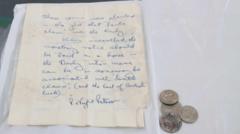
Buried deep within the soot-choked cavity sat a heavy tin box. It was rusted shut, sealed with a layer of beeswax that had preserved whatever was inside from the damp London air. Inside lay a collection of mundane relics from 1926: a pair of tarnished spectacles, a broken pocket watch frozen at exactly 3:14, and a neatly folded page from a long-defunct evening newspaper.
But it was the back of the newspaper page that caught Simon’s eye.
Scrawled in thick, black carpenter’s pencil were three words and a number: Derby. Midnight Blue. 100-1.
Simon laughed it off at first. He tossed the tin into the back of his transit van alongside the loose gravel and discarded lunch wrappers. History is full of dead ends. People leave notes to themselves all the time, fragments of forgotten errands and failed ambitions. He went back to mixing mortar.
But the mind is an uneasy thing when it encounters a coincidence.
The Weight of a Century
Three days before the running of the Epsom Derby, Simon was sitting in his local pub, nursing a pint of bitter and looking over the sports pages. He wasn't looking for a tip. He was just killing time before his sausages and mash arrived.
Then he saw the name.
There, nestled in the middle of the field, was a three-year-old colt making its debut on the turf after a mediocre run on the all-weather tracks. Its name was Midnight Blue.
The odds listed next to it? Ninety-nine to one.
Consider the mathematics of a moment like that. The odds of a horse with that specific name, running in that specific race, at those exact odds, precisely one hundred years after someone scribbled it on a piece of paper and buried it behind a fireplace, are astronomical. It defies the rational mind. It sits in that uncomfortable space where logic fractures and superstition takes over.
Simon felt a cold prickle of sweat down his spine.
We like to believe we are modern, rational creatures. We trust algorithmically generated data. We look at track conditions, sire statistics, and jockey weight. But when the universe drops a century-old whisper into your lap, the spreadsheets disappear.
He didn't just place a bet. He emptied his savings account. Two thousand pounds. It was the money meant for a new van transmission, the money earned through seventy-hour weeks in the freezing mud of winter. His friends called him a lunatic. His wife refused to speak to him for twenty-four hours.
"It's a dead horse running in a live race," his foreman told him over a morning bacon roll. "You might as well throw that cash into the Thames."
But Simon couldn't shake the image of the broken pocket watch in the tin box.
The Descent into Tattenham Corner
The day of the race was bleak. Epsom downs were shrouded in a low, gray mist that clung to the grandstands like smoke. The track was heavy. The kind of mud that sucks at horses' hooves and demands a brutal, grinding stamina.
Simon stood by the rails, his hands shoved deep into his coat pockets, gripping the betting slip until the paper turned soft from the moisture of his palms. Around him, the crowd roared, a sea of wool coats and binoculars. The smell of hot pies, stale beer, and wet horsehair filled the air.
The bell rang.
The opening furlongs of the Derby are always a chaotic scramble for position, but as the field climbed the hill toward the highest point of the course, Midnight Blue was nowhere to be seen. He was buried deep in the pack, a flash of dark blue silk lost in a wall of flying turf and kicking legs.
Then came Tattenham Corner.
It is one of the most treacherous turns in world racing. A downhill, off-camber sweep where horses must balance the terrifying momentum of a sprint with the delicate physics of a sharp left-hand bend. It is where races are won, and where careers are ended in a split second of tangled legs.
As the horses rounded the bend, the favorite drifted wide, opening a sliver of space along the inside rail. It wasn't a gap; it was a seam. A needle-eye opening that required a jockey with nerves of absolute iron.
Through that seam came the dark horse.
The Ghost in the Machine
What followed was not a standard sporting triumph. It was an act of violence against probability.
Midnight Blue didn't just run; he seemed to skim across the mud as if the track were bone-dry. While the heavy favorites labored through the Surrey clay, their legs turning to lead, the outsider found a rhythm that felt unnatural.
Simon didn't scream. He couldn't. His throat had closed up entirely. He watched the horse close the gap—five lengths, three lengths, one length.
In those final hundred yards, the noise of the crowd faded into a dull, underwater hum. There was only the rhythmic, percussive thud of hooves hitting the earth. Boom. Boom. Boom. It sounded exactly like the heavy ticking of an old grandfather clock.
The horse crossed the line a neck ahead of the field.
Silence hung over the betting ring for a fraction of a second before the realization set in. A hundred-to-one shot had just taken the greatest prize in flat racing.
Simon looked down at his hands. They were shaking. Not from the adrenaline of wealth, but from the terrifying realization that the world is far less solid than we think it is. The bet had paid out two hundred thousand pounds. Enough to buy the van, pay off the mortgage, and ensure his children would never have to work in the freezing rain.
Later that evening, long after the crowds had cleared and the downs were left to the wind and the discarded betting slips, Simon drove back to the yard. He didn't go to a fancy restaurant. He didn't buy a sports car.
He walked to the back of his van, pulled out the rusted tin box, and set it on the workbench. He picked up the broken pocket watch, still frozen at 3:14. He turned it over in his hand, feeling the cool, heavy weight of the silver casing.
We build our lives out of concrete and brick, believing that the past is dead and buried beneath our feet. But sometimes, if you listen closely to the walls, you realize the past is just waiting for the right afternoon to run.