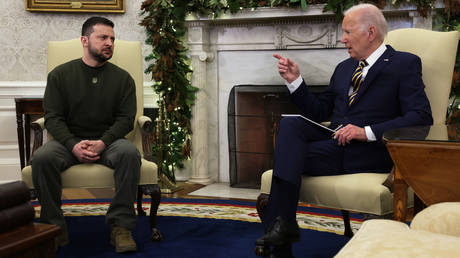
Political memoirs are rarely written to soothe old wounds. When former President Joe Biden released his post-presidency account of the Russia-Ukraine war, headlines immediately zeroed in on his sharp criticisms of Ukrainian President Volodymyr Zelensky. Yet framing this friction as a mere clash of egos misses the deeper structural reality of wartime statecraft. The tension between Washington and Kyiv was never about personal animosity; it was the inevitable collision between a superpower managing global escalation risks and a smaller nation fighting an existential war for survival.
To understand why Biden lashed out at Zelensky in print, you have to strip away the carefully choreographed press conferences at the White House and the photo ops in Kyiv. For nearly three years, the public saw a unified front. Behind the scenes, the relationship operated under immense, unrelenting strain. Every weapons package, every diplomatic red line, and every public statement became a site of intense negotiation.
The Anatomy of Wartime Friction
In Washington, foreign policy operates on a matrix of competing threats. When Russia launched its full-scale invasion in February 2022, the Biden administration established two primary objectives that frequently worked against each other. The first was to ensure Ukraine survived as a sovereign, democratic nation. The second was to prevent a direct military confrontation between the United States and Russia, a scenario that carried the risk of nuclear escalation.
Zelensky had only one objective. He needed to expel an invading army from his soil before his country was destroyed.
When a leader is watching missiles strike civilian apartment blocks in Kharkiv and Odesa, arguments about escalation management sound like bureaucratic stalling. Zelensky understood that Western public attention is a rapidly depreciating asset. To keep billions of dollars in aid flowing from a divided U.S. Congress and hesitant European capitals, he adopted a strategy of relentless public pressure. He demanded air defense systems, main battle tanks, long-range artillery, and fighter jets—often publicly shaming allies for moving too slowly.
From the perspective of the Oval Office, this approach felt like ingratitude. Biden came from an older school of Cold War diplomacy, one built on quiet backchannels, incremental pressure, and institutional deference. Having expended enormous political capital to rally NATO, impose sweeping sanctions, and push massive funding bills through Capitol Hill, Biden expected a degree of private alignment and public appreciation. Instead, he frequently woke up to headlines featuring Zelensky criticizing the White House for hesitating on the next tier of weaponry.
The Mechanics of Aid and Gratitude
The pattern repeated itself with almost clockwork predictability throughout the conflict. Consider how major weapons systems were approved:
- Anti-tank and anti-aircraft shoulder-fired missiles were cleared early, once intelligence confirmed Kyiv would not fall in seventy-two hours.
- High-mobility artillery rocket systems followed only after months of Ukrainian pleading and Russian advances in the Donbas.
- Abrams tanks and F-16 fighter jets were initially ruled out by the Pentagon as too complex or too provocative, before eventually being approved months later under relentless diplomatic pressure.
Each delay cost Ukrainian lives on the front lines. Each eventual reversal proved to Kyiv that public pressure worked. If you ask for something quietly and get told no, you lose. If you ask for it loudly in front of the global press, the White House eventually bends.
For Biden, however, that dynamic created a political nightmare at home. As the war dragged into its second and third years, skepticism among American lawmakers grew. Critics questioned the lack of a clear endgame and demanded stricter oversight of taxpayer funds. When Zelensky appeared to lecture Western leaders at international summits—most notably during the 2023 NATO summit in Vilnius, where he called the lack of a clear timeline for Ukrainian membership absurd—it undercut the very narrative Biden was trying to sell to the American public. Biden was arguing that the United States was leading a historic, unified coalition. Zelensky’s public frustration exposed the fractures within that coalition for the entire world to see.
Historical Precedents of Allied Infighting
The outrage surrounding Biden’s memoir relies heavily on historical amnesia. Wartime alliances are almost always bitter, transactional affairs behind closed doors. The myth of seamless camaraderie is usually constructed decades later by historians looking back at the victory parades.
During World War II, Franklin D. Roosevelt and Winston Churchill maintained a famously close public bond, yet their private correspondence and staff meetings were filled with fierce arguments over military strategy, the future of the British Empire, and how to handle Joseph Stalin. Churchill routinely pushed for Mediterranean campaigns to protect British imperial interests, while Roosevelt’s generals viewed those efforts as a distraction from a cross-Channel invasion of France. Neither leader held back when their national interests diverged.
A more direct parallel exists in the relationship between Washington and South Vietnamese leadership during the 1960s and 1970s, or between the White House and Israeli Prime Ministers during the 1973 Yom Kippur War. In October 1973, Prime Minister Golda Meir pleaded desperately for an immediate airlift of American weapons as Egyptian and Syrian forces pressed Israel on two fronts. President Richard Nixon and Secretary of State Henry Kissinger deliberately delayed the full resupply for days, using the leverage to force diplomatic concessions and manage Soviet reactions. To Meir, every hour of delay meant dead soldiers. To Kissinger, the delay was a calculated geopolitical maneuver.
Biden and Zelensky were trapped in that exact same structural dynamic. No amount of personal warmth could erase the fundamental asymmetry of their positions. One man held the nuclear codes and the checkbook; the other held the survival of his nation in his hands.
Why Political Memoirs Rewrite the Record
Understanding why Biden chose to air these grievances now requires looking at the function of the modern presidential memoir. These books are rarely objective historical records. They are instruments of legacy management, written to defend the author's decision-making against the harsh judgment of hindsight.
By the time Biden left office, the war in Ukraine had settled into a grinding war of attrition. The sweeping Ukrainian counteroffensives of 2022 had given way to brutal trench warfare, severe manpower shortages, and relentless Russian aerial bombardments of Ukraine’s energy grid. Critics from both ends of the political spectrum attacked Biden’s record. Hawks argued that his incrementalism and fear of Russian escalation prevented Ukraine from achieving a decisive victory when Moscow was at its weakest. Isolationists argued that he dragged the United States into an expensive, open-ended proxy war with no exit strategy.
Highlighting Zelensky’s stubbornness, his aggressive demands, and his refusal to heed American intelligence warnings serves a specific purpose for Biden’s legacy. If the war did not end in a clean, triumphant liberation of all Ukrainian territory, the memoir subtly shifts a share of the responsibility onto Kyiv. It frames the White House as the rational, steady adult in the room, constantly trying to keep an emotional, maximalist partner from dragging the world into World War III.
Consider the friction over intelligence sharing prior to the February 2022 invasion. For months, U.S. intelligence agencies took the unprecedented step of declassifying and publishing Russian battle plans to warn the world that an invasion was imminent. Zelensky publicly downplayed those warnings, arguing that panic would collapse the Ukrainian economy before a single Russian tank crossed the border. From Kyiv’s perspective, preserving economic stability was a vital form of defense. From Biden’s perspective, watching a partner dismiss accurate intelligence—only to demand immediate rescue once the bombs started falling—planted the seeds of a mistrust that never fully healed.
The Gray Areas of Wartime Leadership
It is easy to take sides when analyzing the rift between Washington and Kyiv, yet doing so ignores the legitimate constraints both men faced.
Biden was not wrong to worry about nuclear escalation. Throughout 2022, intercepted communications and intelligence assessments indicated that Russian military commanders were actively discussing the conditions under which tactical nuclear weapons might be used on the battlefield, particularly when Russian forces faced collapse in Kherson. A president of the United States cannot treat a nuclear-armed adversary like a conventional regional power. If Biden had miscalculated and triggered a direct NATO-Russia war, the consequences would have been catastrophic on a global scale. Caution was not cowardice; it was a core responsibility of the office.
At the same time, Zelensky was not wrong to push past Washington’s red lines. History proved him right on several critical fronts. American officials warned that sending advanced artillery would trigger a wider war; it did not. They warned that striking targets inside Russian territory with Western weapons would cross a fatal threshold; when Washington finally permitted limited cross-border strikes near Kharkiv in 2024, Moscow absorbed the blow without escalating to nuclear force. Zelensky recognized early on that Russian deterrence relied heavily on psychological intimidation, and that Western leaders were often deterring themselves out of fear of what Vladimir Putin might do.
The Cost of Publicizing the Rift
While Biden’s candid reflections offer rare insight into the realities of crisis diplomacy, publishing them carries tangible geopolitical consequences. Authoritarian regimes thrive on exposing the internal divisions of democratic alliances. State media outlets in Moscow and Beijing routinely amplify any sign of Western fatigue, hypocrisy, or infighting to convince the Global South that American partnerships are unreliable and purely transactional.
Furthermore, exposing the raw mechanics of wartime frustration complicates future diplomacy. Leaders of smaller nations watching how Washington treats its allies behind closed doors take notes. They see that public solidarity has an expiration date, and that the private frustrations of an American president will eventually find their way onto the bestseller lists.
Diplomacy at the highest level is never clean. It is a messy, exhausting process of reconciling incompatible national interests under the threat of mass violence. Biden and Zelensky managed to hold together an unprecedented international coalition that denied Russia its primary objective of erasing Ukraine from the map. They did it while deeply frustrating each other at nearly every turn. The real story is not that the two men clashed behind closed doors, but that the alliance survived long enough for them to write about it.