Chinese marine engineers have successfully adapted supercavitation—the same hydrodynamic phenomenon used to propel high-speed underwater torpedoes—to slash commercial cargo ship fuel consumption by 5 percent. By injecting micro-bubbles and controlled gas layers beneath a vessel’s hull, engineers create a low-friction vapor pocket that separates heavy steel from dense seawater. In an industry burning roughly 300 million tons of heavy fuel oil annually, a 5 percent efficiency gain translates into millions of dollars saved per ship over its operational lifespan, offering shipowners a mechanical shortcut around tightening global emissions mandates without waiting for expensive green fuels.
Maritime shipping runs on razor-thin margins and brutal physics. Water is roughly 800 times denser than air. Pushing a 400-meter container vessel through the Pacific Ocean requires overcoming immense skin friction drag, the relentless resistance created when water molecules cling to and rub against a ship’s submerged hull. For decades, naval architects fought this drag with toxic anti-fouling paints, bulbous bows, and minor propeller tweaks. Those incremental fixes hit a wall years ago.
Now, researchers in China have pulled a page directly from Cold War naval weapons development to break that hydrodynamic bottleneck.
The Physics of Riding on Air
To understand how a commercial freighter borrows tricks from an underwater missile, look at the Soviet VA-111 Shkval torpedo. Developed during the height of the Cold War, the Shkval achieved underwater speeds exceeding 200 knots—more than four times faster than conventional torpedoes. It did not achieve this through brute engine power alone. It cheated the water.
When an object moves through liquid fast enough, pressure drops behind its nose, causing the water to vaporize into a gas bubble. If that gas envelope grows large enough to encase the entire body of the vessel, the object no longer travels through water. It flies through a self-generated tunnel of gas inside the ocean. Naval engineers call this supercavitation.
Commercial cargo ships, however, do not travel at 200 knots. They lumber along at 14 to 20 knots. At those sluggish speeds, natural cavitation destroys propellers rather than aiding propulsion. You cannot rely on velocity to boil the water away from a container ship's hull. You have to force the gas there manually.
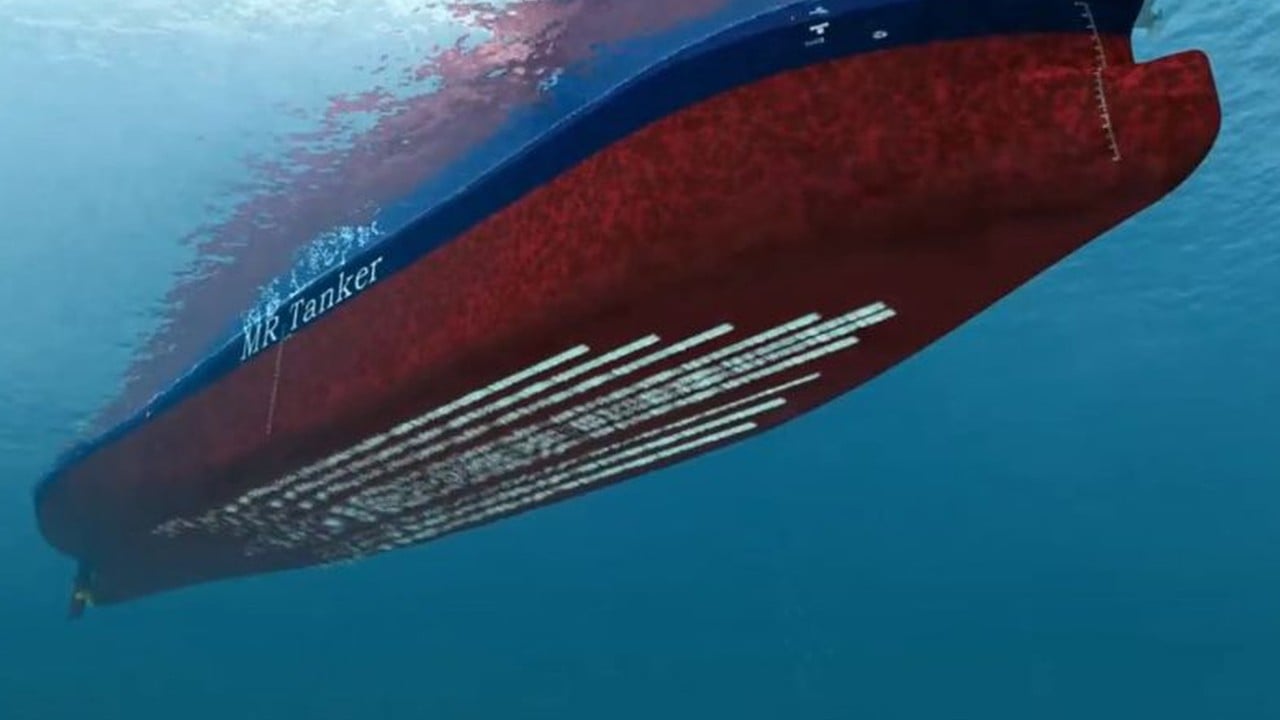
Chinese naval engineering teams solved this speed problem through ventilated partial cavitation and advanced air lubrication systems (ALS). Instead of waiting for speed to create a vapor pocket, high-powered compressors pump ambient air through precision-engineered nozzles and recessed cavities built directly into the flat bottom of the ship’s hull.
The geometry of those hull recesses is where the torpedo research pays off. Early air lubrication prototypes suffered from a fatal flaw: bubbles escaped too quickly. Turbulence ripped the air layer apart, sending bubbles rising harmlessly up the sides of the hull before they could reduce drag along the stern. By applying fluid dynamics models originally designed to stabilize gas cavities around high-speed underwater projectiles, Chinese engineers reshaped the hull cavities to trap a stable, continuous sheet of air beneath the keel.
The ship effectively hydroplanes on a captive cushion of compressed air. Water never touches the flat bottom plates. Skin friction plummets.
Why 5 Percent Changes Everything
Outside the maritime sector, a 5 percent efficiency gain sounds like a rounding error. Inside a shipping line’s boardroom, it is the difference between solvency and bankruptcy.
Fuel accounts for anywhere from 50 to 60 percent of a commercial vessel’s total operating costs. A single Ultra Large Container Vessel (ULCV) burns upwards of 150 to 200 tons of marine fuel every single day at sea. At standard bunker fuel prices, a 5 percent reduction saves thousands of dollars per day, every day, for twenty-five years.
More importantly, the timing of this engineering breakthrough aligns directly with regulatory panic across the global shipping fleet.
The International Maritime Organization (IMO) has trapped shipowners in a regulatory vise. Under the Carbon Intensity Indicator (CII) and the Energy Efficiency Existing Ship Index (EEXI), vessels are graded annually on how much carbon they emit per ton of cargo carried. Ships that score poorly face severe operational restrictions, higher port fees, and eventual banishment from major trade routes.
For years, executives bet on alternative fuels like green methanol, ammonia, and liquefied natural gas to save their fleets. That transition has stalled. Green fuel production remains nowhere near commercial scale, bunkering infrastructure at major ports is practically nonexistent, and retrofitting existing engines costs tens of millions of dollars per ship.
Torpedo-derived hull lubrication bypasses the fuel supply chain entirely. It does not care whether a ship burns heavy fuel oil, marine gasoil, or bio-methanol. By reducing the mechanical resistance of the hull, the ship requires less shaft horsepower to maintain its cruising speed. Less horsepower means lower fuel burn, which immediately drops the vessel's carbon intensity score without touching the main engine block.
The Engineering Catch Nobody Mentions
Every hydrodynamic miracle comes with a thermodynamic tax. Pumping massive volumes of air beneath a ship floating twenty meters deep in the ocean requires immense energy.
Hydrostatic pressure increases by roughly one atmosphere for every ten meters of water depth. A deep-draft cargo ship loaded with twenty thousand containers sits low in the water. Overcoming the crushing water pressure beneath that keel forces onboard air compressors to work at maximum capacity around the clock.
Those compressors run on electricity generated by the ship’s auxiliary diesel engines. If the compressors consume 3 percent of the ship's total energy budget just to save 5 percent on the main propulsion engine, the net gain shrinks to a fragile 2 percent.
Achieving a true net 5 percent reduction—meaning the fuel saved at the propeller outweighs the fuel burned by the air pumps by a wide margin—requires ruthless efficiency in nozzle design and cavity pressure management. Chinese research institutes achieved this margin by pulsing the air injection rather than running compressors at a continuous static blast. Using real-time sensors that read hull pressure and sea state, the system modulates airflow dynamically, feeding the cavity only enough gas to prevent collapse.
Still, the system remains vulnerable to the ocean's worst moods.
In calm seas, a captive air layer behaves predictably. In heavy weather, physics turns hostile. When a cargo ship pitches violently in six-meter swells, the bow rises out of the water and slams back down. That motion breaks the seal of the hull cavities. Trapped air escapes in massive, chaotic bursts. The compressors scream to rebuild the cushion while hull drag spikes erraticly, creating uneven loads on the propeller shaft.
For routes across the stormy North Atlantic or the winter North Pacific, real-world fuel savings rarely match the clean numbers recorded during calm-water sea trials.
The Structural Gamble of Retrofitting
Installing cavitation hardware on a brand-new ship in a drydock in Shanghai or Dalian is straightforward. Naval architects simply design the double-bottom ballast tanks to accommodate air piping and recess the keel plates during assembly.
Retrofitting the existing global fleet of over 50,000 merchant ships is an entirely different beast.
Cutting holes into the bottom hull plating of a fifteen-year-old bulk carrier gives maritime classification societies nightmares. The bottom shell of a ship is its primary structural spine, bearing immense longitudinal bending stresses as waves pass beneath it. Every air injection manifold welded into that steel represents a potential stress concentration point—a place where metal fatigue cracks can start and propagate under the relentless pounding of ocean waves.
Furthermore, running high-pressure air pipes through existing ballast tanks sacrifices cargo capacity or ballast stability. Shipowners must pull the vessel out of active service for weeks of expensive drydock labor, losing hundreds of thousands of dollars in charter revenue before the system saves a single drop of fuel.
To make the math work on older vessels, engineers have had to modularize the cavitation chambers into bolt-on external pods or shallow blister plates that minimize structural penetration. Even then, corrosion remains an invisible enemy. Warm, oxygenated air pumped constantly across bare or coated steel accelerates oxidation. If the anti-corrosion coatings inside the air cavities fail, accelerated rust can eat through hull plates from the outside in, turning a fuel-saving device into a catastrophic maintenance liability.
Dual-Use Shadows Over Commercial Shipyards
You cannot separate Chinese commercial shipbuilding from Chinese naval strategy. They share the same drydocks, the same state-backed research universities, and the same fluid dynamics laboratories.
The institutions perfecting drag-reducing cavitation layers for bulk carriers and container ships—such as the China State Shipbuilding Corporation (CSSC) and naval engineering departments in Harbin and Wuhan—are the exact same entities designing hulls and propulsion systems for the People's Liberation Army Navy.
In the defense sector, supercavitation and air-layer drag reduction are not about saving money on bunker fuel. They are about acoustic stealth and raw tactical speed.
A conventional submarine or surface warship generates massive hydrodynamic noise as water rushes over its hull and collapses off its propeller blades. Enveloping a hull in a controlled layer of micro-bubbles changes its acoustic signature, dampening machinery noise and disrupting active sonar returns. Simultaneously, reducing hull drag allows naval vessels to sprint faster or extend their operational range without refueling at sea.
By deploying and refining these systems across hundreds of commercial merchant vessels, Chinese marine engineers gain something no military budget can easily buy: millions of hours of real-world operational telemetry across every ocean basin on Earth. Every commercial voyage feeds data back into hydrodynamic models—showing how air layers behave in varying water temperatures, salinity levels, and sea states.
Western shipbuilders and naval architects watching these developments face an uncomfortable reality. While European marine equipment suppliers pioneered early air lubrication systems over a decade ago, China’s sheer shipbuilding dominance allows it to iterate and deploy the technology at a scale no competitor can match. China currently builds more than half of the world's commercial tonnage. When Chinese yards make cavitation cavities a standard hull feature on newbuild tankers and container ships, they establish the global baseline for maritime efficiency.
The Maintenance Reality at Sea
Down in the engine room, far removed from press releases and fluid dynamics simulations, chief engineers care about one thing: reliability.
Modern merchant ships operate with skeleton crews. Twenty-two seafarers routinely manage a vessel worth $150 million. Those crew members do not have spare hours to babysit finicky experimental hardware.
Air lubrication systems introduce dozens of new failure points below the waterline. Seawater carries silt, plastic debris, and marine organisms. When a ship sits idle at anchor in warm tropical ports like Singapore or Santos, barnacles, tubeworms, and algae colonize every submerged surface within days.
If marine biofouling clogs the microscopic air nozzles or alters the smooth contour of the cavitation recesses, the entire hydrodynamic effect collapses. Instead of gliding on air, the hull drags rough, barnacle-encrusted cavities through the water, actually increasing fuel consumption above baseline levels.
Keeping those cavities clean requires specialized ultrasonic antifouling transducers or frequent underwater cleaning by commercial divers—another recurring operational expense that eats directly into the promised 5 percent fuel savings.
Where the Math Actually Works
Despite the mechanical headaches and heavy-weather limitations, the economics of torpedo-inspired hull lubrication are undeniable for specific corners of the shipping industry.
The technology shines brightest on long-haul, steady-speed vessels with wide, flat bottoms. Ultra Large Container Vessels operating on fixed pendulum routes between Asia and Europe, Very Large Crude Carriers (VLCCs) crossing the Indian Ocean, and massive Capesize ore carriers hauling iron ore from Brazil to China offer the exact hull geometry and predictable speed profiles needed to keep gas cavities stable.
On these routes, ships spend weeks steaming in straight lines at constant RPMs. The flat bottom area represents up to 70 percent of the vessel's wetted surface. Covering that massive steel expanse in a thin film of compressed air yields immediate, measurable drops in fuel flow meters on the bridge.
For smaller feeder vessels, coastal ferries, or ships operating in rough, short-sea environments, the capital expenditure and compressor energy penalties rarely justify the installation.
Shipowners evaluating this technology no longer treat it as futuristic speculation. The hardware is welded onto active hulls right now, cutting bunker bills and buying aging fleets another decade of regulatory compliance. In an industry where alternative zero-carbon fuels remain trapped in pilot projects and powerpoint presentations, forcing air under the keel remains one of the few engineering solutions that delivers hard, verifiable savings the moment the ship leaves port.