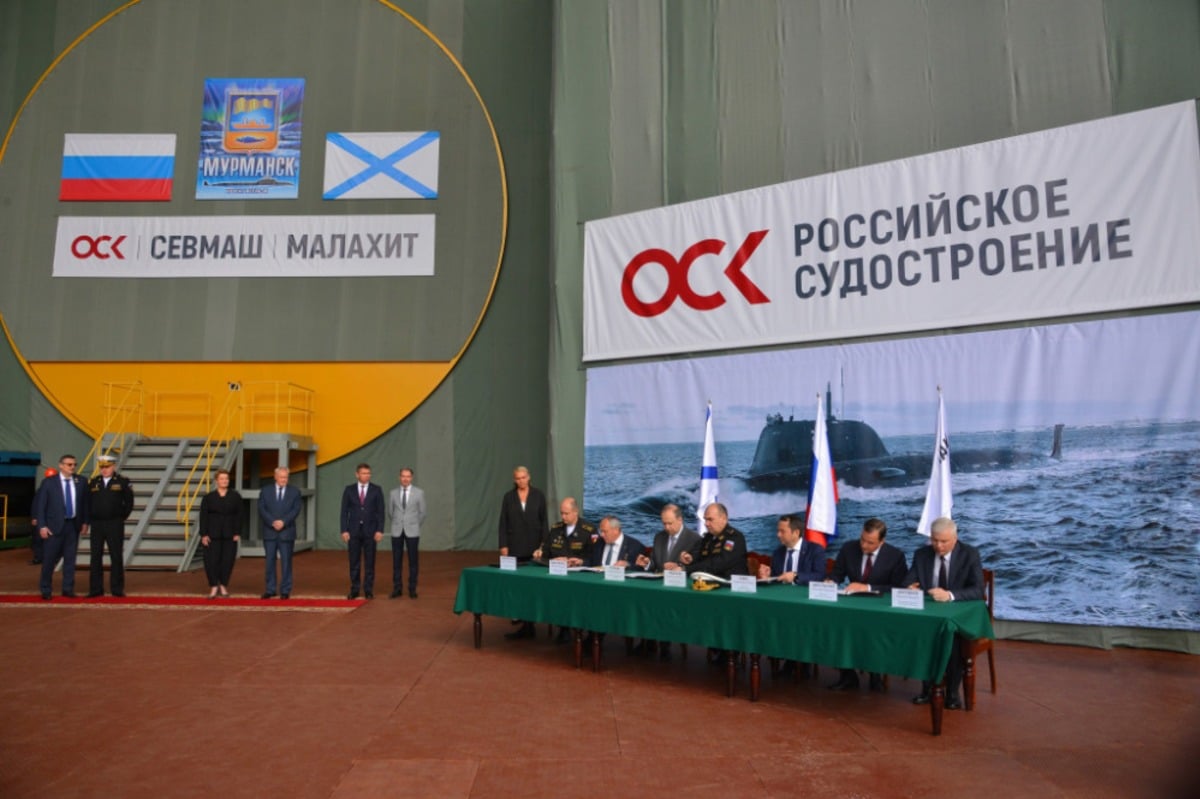
The air inside the Sevmash shipyard in Severodvinsk does not taste like the sea. It tastes like ozone, burnt iron, and the heavy, damp cold of the Russian north. Outside, the White Sea freezes into jagged sheets for months out of the year. Inside the massive fabrication halls, the temperature is barely any warmer, but the sparks flying from automated welding rigs create a false, flickering warmth.
Men and women in heavy canvas coats move like ants around a mountain of black steel. They are building a shadow. Also making news lately: Why the Outcry Over Jailed Baloch Leaders Misses the Real Crisis in Quetta.
When the ceremonial brass plate was bolted to the keel section of the Perm, it marked a quiet milestone. It was the ninth time Russia had laid down a Yasen-M class nuclear-powered attack submarine. To a casual observer browsing naval defense blogs, it was just another line in a spreadsheet of global military expenditures. A routine update in a multi-year procurement cycle.
But talk to the engineers who spend their lives calibrating the acoustic dampening tiles on these hulls, and the perspective shifts. This is not just a piece of military hardware. It is a terrifyingly complex ecosystem designed to vanish into the pitch-black depths of the Atlantic, carrying enough firepower to level cities, all while remaining entirely undetected. Further insights regarding the matter are covered by TIME.
The true weight of this moment lies in the silence it buys.
The Anatomy of an Invisible Threat
To understand why naval strategists from Norfolk to London spent their morning analyzing satellite imagery of a shipyard near the Arctic Circle, you have to understand the evolution of submarine warfare.
For decades, Soviet and Russian submarine design followed a predictable philosophy: speed and depth over everything else. The old titanium-hulled Alfas could outrun torpedoes, but they roared through the water like freight trains. Western sonar operators could hear them coming from hundreds of miles away. It was a game of cat and mouse where the mouse wore bells.
The Yasen-M class changed the rules.
These vessels are hybrids. They combine the traditional role of an attack submarine—hunting other ships and tracking ballistic missile subs—with the devastating long-range strike capability of a cruise missile platform. Beneath the hydrodynamic casing sits a KTP-6 monoblock nuclear reactor. It uses a natural circulation cooling system for low-power operations, meaning the noisy pumps that usually give away a submarine's position can be turned completely off.
Think of it like a luxury sports car idling in a dark alleyway. You do not hear the engine. You only know it is there when the headlights flick on.
For a sonar technician aboard an American Virginia-class submarine, searching for a Yasen-M in the open ocean is an exercise in psychological torture. You are listening for a sound that is quieter than the ambient noise of the ocean itself. You are trying to distinguish the faint, rhythmic hum of a distant auxiliary pump from the clicking of shrimp, the songs of humpback whales, and the grinding of tectonic plates.
The Human Toll of the Depths
We often talk about these machines as if they operate themselves, guided by cold algorithms and satellite downlinks. They do not.
Inside the pressurized hull of the ninth Yasen-M, roughly ninety crew members will live for months at a time. They will exist in a world completely devoid of natural light, where time is measured solely by the glowing numbers on digital bulkheads. Space is a premium. The air they breathe will be recycled, scrubbed of carbon dioxide, and enriched with oxygen, leaving a permanent, metallic aftertaste on the tongue.
Imagine waking up in a bunk that is stacked three high, with less than two feet of clearance above your chest. You slide out of your rack, careful not to wake the man sleeping inches away, and step into a narrow corridor painted in soft, institutional greens designed to prevent psychological breakdown.
Your entire world is roughly 400 feet long and 40 feet wide.
Every person on board carries a crushing burden of responsibility. A single dropped wrench on a steel deck can send an acoustic shockwave through the water, lighting up the sonar screens of an enemy hunter-killer sub. A minor valve failure in the reactor compartment can turn the vessel into a steel coffin at the bottom of the Mariana Trench.
The pressure outside the hull is immense, pushing inward with hundreds of pounds per square inch. But the psychological pressure inside is far greater. These sailors are the hidden variable in the geopolitical calculus. They are the ones who must execute the orders when the world hovers on the brink of madness.
The Invisible Chessboard
The laying of this ninth keel is not happening in a vacuum. It is a direct response to a changing global architecture. As the ice caps melt, the Arctic Ocean is transforming from an impassable frozen wasteland into the world’s most contested highway. Shipping lanes that once required heavy icebreakers are opening up, promising faster trade routes between Europe and Asia.
Beneath that ice lies a fortune in untapped oil, natural gas, and rare earth minerals. Russia views this backyard as its sovereign territory. The Yasen-M class is the iron fist designed to enforce that claim.
Consider the strategic placement of these vessels. Stationed primarily with the Northern and Pacific Fleets, they are positioned to slip through the GIUK gap—the naval choke point between Greenland, Iceland, and the United Kingdom—and enter the deep waters of the North Atlantic. Once there, they can position themselves within striking distance of the American eastern seaboard or European capital cities without ever being detected.
The missiles they carry, including the hypersonic Zircon, travel at speeds that render traditional missile defense systems obsolete. It is a weapon system designed for a first strike, or a devastatingly absolute second strike.
This is the reality that keeps naval commanders awake at night. The balance of power at sea is not measured by the number of aircraft carriers floating on the surface. Carriers are massive, loud, and easily tracked by satellites. True dominance belongs to the nation that controls the dark, silent spaces beneath the waves.
The Final Weld
Back in the Sevmash shipyard, a welder lowers his mask. The blue light of the arc reflects off the thick steel plate of the ninth hull. He knows his work must be flawless. Every seam, every joint, every bead of molten metal must withstand the unimaginable violence of the deep ocean.
When this ship is eventually launched, rolled out of the massive hall into the freezing waters of the Dvina River, there will be speeches. Flags will wave. National anthems will echo off the concrete walls.
But the true birth of the machine happens in the quiet moments before the fanfare, in the steady, methodical accumulation of steel and intent. The ninth whale is taking shape, piece by piece, rib by rib. It will eventually slide into the dark, a monument to human engineering and human animosity, waiting for a command that everyone hopes will never come.