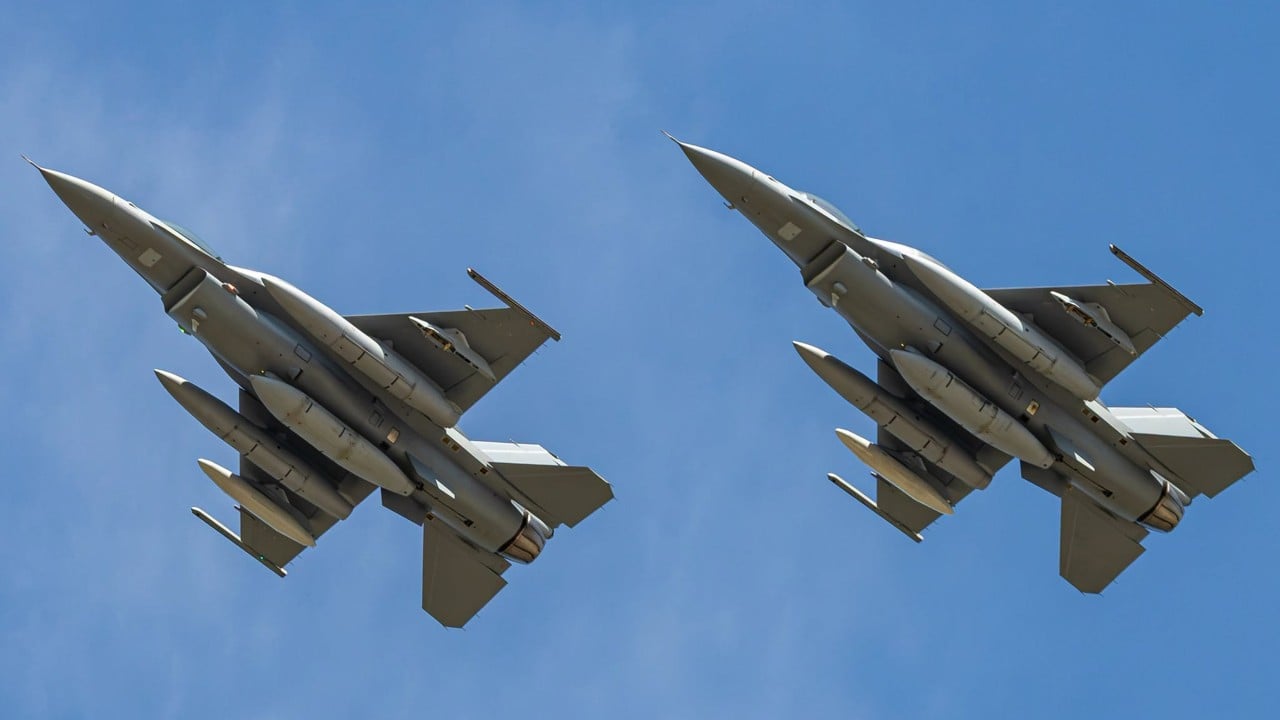
Every defense pundit with a keyboard and a Wikipedia subscription loves asking the same lazy question. Can Taiwan's newly acquired F-16V block 70 fighters level the playing field against the People's Liberation Army Air Force and their J-20 stealth jets? The question dominates think-tank panels, military blogs, and cable news segments.
It is also fundamentally broken from the first word. If you found value in this post, you might want to read: this related article.
Asking whether a fourth-generation-plus Viper can beat a fifth-generation low-observable interceptor in a dogfight is like asking whether a high-end sports car can outrun a missile. It completely misunderstands the geometry of modern air combat, the realities of the Taiwan Strait, and what an air force actually does when its home bases are buried under a mountain of conventional ballistic steel.
I have spent years analyzing defense procurement and aerospace supply chains. I have watched analysts obsess over kinetic specs while ignoring the logistics, infrastructure, and command-and-control realities that actually decide air wars before the first jet even taxis onto a runway. For another angle on this development, see the recent update from ZDNet.
Here is the brutal truth: Taiwan is not building an air force to win dogfights over the strait. Winning air superiority in a traditional sense is off the table, and pretending otherwise is dangerous theater.
The Dogfight Fallacy
Let us clear up the core misconception immediately. Radar cross-section matters, but air combat is rarely a clean duel between two jets spotted on an infrared screen over the ocean.
The J-20 is designed as a long-range air dominance and strike fighter. It carries heavy internal fuel loads, utilizes advanced active electronically scanned array radar, and pairs with very long-range beyond-visual-range missiles like the PL-15. When analysts pit the F-16V against the J-20, they picture a Top Gun style merge where pilots test their situational awareness and turn rates.
That scenario belongs in a Hollywood writer's room.
In reality, a conflict across the Taiwan Strait will not feature F-16s hunting J-20s in the clouds. The PLA does not need its stealth fighters to dogfight. It uses them to blind radars, target airborne warning and control systems, and hunt tankers. Meanwhile, the sheer mass of the PLAAF's non-stealth fleet—J-16s and Su-35s—carries the heavy load of missile delivery.
Focusing on the F-16 versus J-20 matchup treats an entire theater campaign like a mixed martial arts bout with weight classes. Air combat is a systems-level attrition contest.
The Runway Problem Nobody Talks About
Ask any armchair general about Taiwan's air defense, and they will point to the active inventory numbers. Taiwan is getting 66 new F-16V jets, upgrading its existing fleet, and boosting its interceptor capacity. On paper, that sounds respectable.
Now look at the real estate.
Taiwan has a handful of primary airbases. Hsinchu, Taichung, Chiayi, Tainan, Hualien. Most of these facilities sit within minutes of flight time from mainland missile batteries.
Imagine a scenario where the opening hours of a conflict involve thousands of precision-guided ballistic and cruise missiles raining down on these concrete ribbons. Even with hardened aircraft shelters and rapid runway repair kits, sortie generation rates will plummet. You can have the most advanced APG-83 radar bolted into the nose of an F-16V, but if the jet is trapped inside a collapsed hangar or staring at a cratered taxiway, it is an expensive paperweight.
The defense establishment loves to talk about the plane's avionics, its electronic warfare suites, and its datalinks. They rarely talk about the concrete. If the runways go down, the fighter count becomes completely irrelevant.
Why the F-16V Upgrade Was Actually Necessary
If the F-16 cannot stop the J-20 in a fair fight and cannot protect its own bases indefinitely, why did Taipei spend billions upgrading and expanding its Viper fleet?
Because the F-16V is not meant to achieve air supremacy. It is meant to raise the cost of aggression to an intolerable level.
The upgraded Viper brings an AESA radar, modern mission computers, Joint Helmet-Mounted Cueing Systems, and compatibility with advanced munitions like the AIM-120D and AGM-84 Harpoon. This transforms the jet into a multi-role missile truck capable of maritime strike and air defense suppression.
When the PLA considers crossing the strait, planners calculate the attrition they will suffer. They do not worry about the F-16s winning an air war; they worry about those jets surviving the first strike, dispersing to highway strips or underground hangars, and launching anti-ship missiles at amphibious invasion fleets.
A fleet of F-16Vs acts as a flying insurance policy. It ensures that any landing force must cross a narrow, heavily contested strip of water while dodging smart munitions fired from platforms that refuse to die.
The Dangerous Obsession with Symmetry
Military analysts love symmetric comparisons because they are easy to chart. You can put specs in a spreadsheet: speed, combat radius, radar detection range, missile payload.
Warfare does not care about your spreadsheet.
Taiwan's true defense strategy relies on asymmetric resilience. Mobile air defenses like the Tien Bow and Tien Kung surface-to-air missile systems, coastal defense cruise missiles scattered across civilian trucks, electronic jamming, and distributed command nodes matter far more than matching the enemy jet for jet.
When you ask whether F-16s can level the playing field against J-20s, you are asking for a symmetric answer to an asymmetric problem. You are asking how David can build a bigger slingshot to match Goliath's modern armor, instead of asking how David can avoid a direct fight altogether.
Stop looking at the tail numbers. Stop counting stealth coatings. Look at survivability, dispersal, and magazine depth.
The next time someone tells you Taiwan needs fifth-generation fighters to survive the skies, tell them they are looking at the wrong war.
The game is not about owning the sky. It is about making sure the other guy bleeds out before he ever hits the beach.