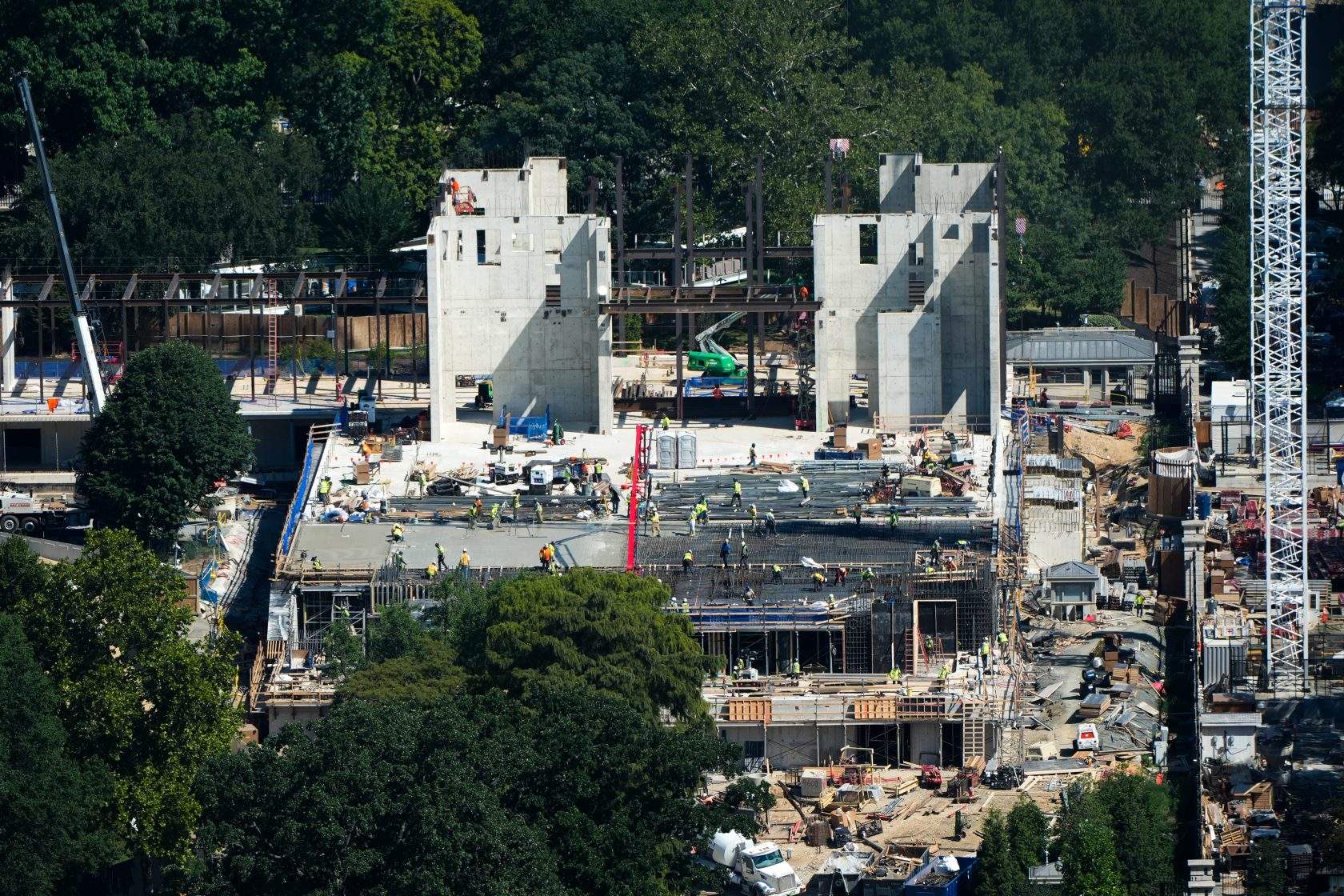
The heavy machinery operating on the grounds of 1600 Pennsylvania Avenue does not care about injunctions, statutory checks, or the finer points of administrative law. While federal appellate benches write measured opinions on the limits of executive power, concrete is poured, steel frames rise where the East Wing once stood, and a multi-hundred-million-dollar project races toward a fait accompli.
The legal battle over the White House ballroom construction has officially reached the highest court in the nation. Chief Justice John Roberts issued a temporary administrative stay allowing work to proceed, short-circuiting a lower-court mandate that would have silenced the jackhammers. Yet framing this conflict merely as a dispute over architectural aesthetics or historic preservation misses the structural earthquake happening underneath the executive mansion. This is a high-stakes constitutional collision over who actually controls federal property: an elected president acting with unilateral velocity, or a co-equal legislative branch whose authorization was bypassed entirely.
The Demolition of Precedent
Long before the Supreme Court docket filled up, the physical reality of the executive compound changed forever. The decision by the Trump administration to bulldoze the historic East Wing without congressional appropriation or formal consultation established a radical blueprint for executive action.
Traditional Washington architecture relies on an intricate web of oversight. Agencies like the National Capital Planning Commission and the Commission of Fine Arts exist precisely to prevent executive overreach on federal land. By sidestepping these bodies, the administration treated federal statutes as optional administrative inconveniences.
The National Trust for Historic Preservation stepped into the breach, filing a lawsuit that argued no occupant of the Oval Office holds the deed to alter the people's house fundamentally. The D.C. Circuit Court of Appeals agreed, noting in a sharp 2-1 decision that each president is a temporary tenant rather than an absolute monarch. The appeals panel emphasized that the Constitution grants Congress the power of the purse and explicit control over federal property.
The administration’s counter-strategy relied on an aggressive legal pivot. As legal pressure mounted, the justification for the 90,000-square-foot ballroom evolved. What began as a venue for state dinners and official galas was swiftly integrated with an expansive subterranean military complex.
Invocation of national security changed the judicial calculus. Government lawyers argued that halting the project jeopardizes the safety of the president, continuity of government operations, and the structural integrity of integrated defense assets. Security claims act as a powerful legal shield, but they also expose a troubling reality. When national security justifications are fused with personal presidential vanity projects, drawing a clear line of judicial review becomes nearly impossible.
The Race Against the Docket
Time operates as a weapon in administrative warfare. While legal briefs circulate among clerks, a rotating crew of hundreds works around the clock, pushing the construction past the sixty-five percent completion threshold.
The administration’s argument before the Supreme Court carried an unmistakable air of inevitability. Officials essentially told the justices that physical reality outpaces judicial remedies. Once a five-story underground bunker and a reinforced, drone-proof above-ground ballroom are deeply embedded into the landscape of the South Lawn, unbuilding them becomes a logistical absurdity.
This strategy places federal courts in an uncomfortable corner. Judges are designed to assess the legality of actions before they occur, not to act as retroactive demolition foremen. By accelerating construction past the point of practical reversal, the executive branch effectively nullifies the judicial branch's ability to render a meaningful remedy. Even if the Supreme Court eventually rules that the president violated separation-of-powers principles, the physical structure will likely stand completed.
The Broader Blueprint for Executive Fiat
The ballroom fight is not an isolated architectural caprice. It represents a broader doctrine of administrative acceleration, where bold physical transformations are executed before slow-moving legal opposition can mobilize.
Other proposals floating through the capital—such as massive monuments and infrastructural overhauls that bypass standard environmental and historical reviews—follow the exact same playbook. The underlying theory posits that possession is nine-tenths of constitutional authority. If an administration creates enough physical facts on the ground, the courts will flinch from ordering a costly teardown.
This dynamic leaves historic preservation laws severely bruised. Statutes like the National Environmental Policy Act and the Administrative Procedure Act were designed precisely to prevent this type of unilateral disruption. Yet when confronted with the executive branch claiming emergency defense needs, these statutes often fold.
The Constitutional Fallout
The Supreme Court’s eventual ruling on the merits will determine far more than the fate of a single social hall and its underground bunker. It will establish a modern baseline for executive overreach.
If the high court validates the administration's approach, future executives will possess a clear roadmap for bypassing Congress entirely on major capital projects, provided they tie those projects to defense infrastructure. Conversely, a ruling against the administration would reassert congressional dominance over federal funds and property, drawing a sharp boundary around executive expansion.
For now, the cranes remain active. The legal questions are dense, but the concrete is dry. The physical transformation of the executive mansion continues to outpace the theoretical debates of the judiciary, leaving the separation of powers scrambling to catch up.