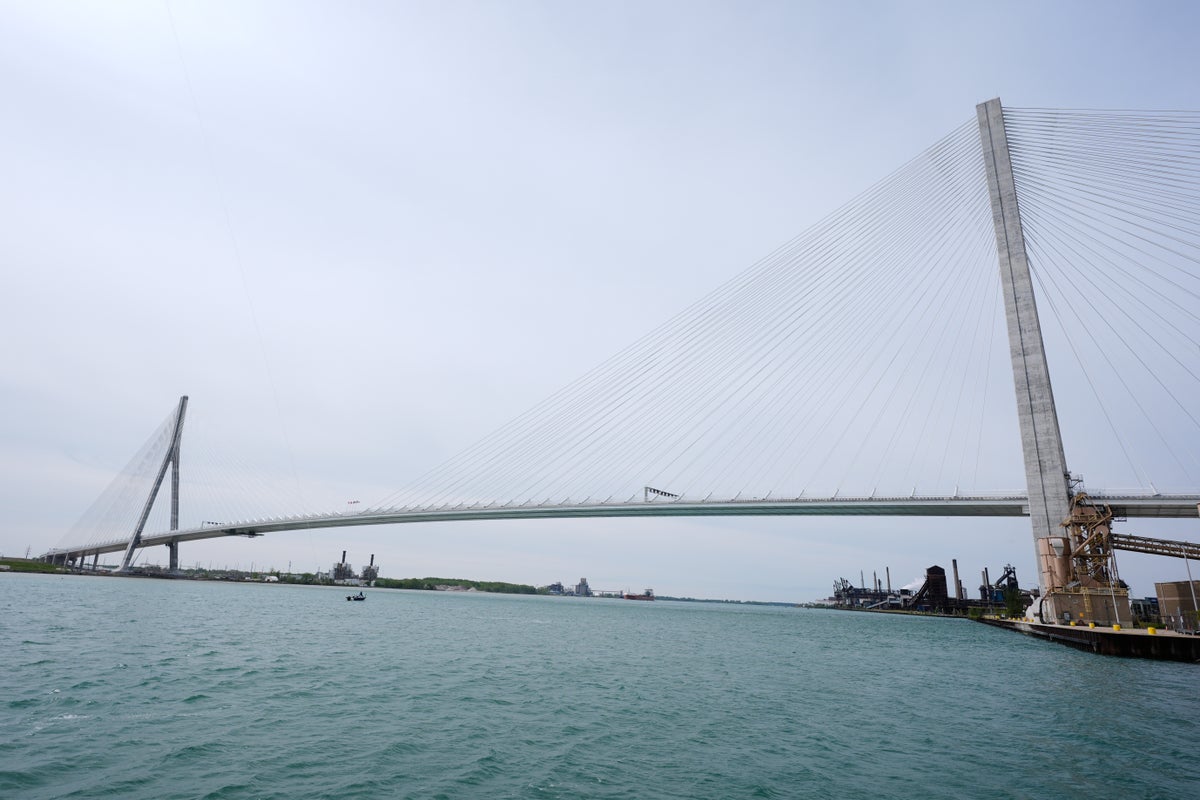
The border is an abstraction until you try to cross it. To a bird flying south, the ribbon of water separating the United States from Canada is just a place to catch a fish. To the long-haul truckers idling on the asphalt below, it is a crucible of clock cycles, customs manifests, and exhaust fumes. For years, thousands of people looked up at the sky and watched two massive arms of steel and concrete reach toward each other from opposite banks of the river. They were supposed to meet. They were supposed to heal a logistical fracture that costs millions of dollars every single day.
Then, the machines went quiet. Meanwhile, you can explore related developments here: The Mechanics of Economic Attrition inside the Strait of Hormuz.
For months, the project hung in midair, a multi-billion-dollar cliffhanger. The public was treated to standard bureaucratic explanations: scheduling conflicts, supply shortages, administrative adjustments. But behind closed doors, a quiet tug-of-war between two federal governments kept the final connection from locking into place. Now, internal sources confirm that the gridlock has finally broken. The bridge is on track to open by late July.
To understand why this matters, you have to look past the press releases and stand in the mud of the border towns. To understand the full picture, check out the excellent analysis by BBC News.
The Cost of the Idle Engine
Consider a hypothetical truck driver named Marcus. For a decade, Marcus has hauled automotive components from factories in Ontario to assembly plants in Michigan. His livelihood depends entirely on a predictable schedule. Under normal conditions, a smooth border crossing means his family sees him for dinner. A bad day means he spends six hours trapped in a cabin that smells of stale coffee and diesel, watching his driving hours evaporate under federal regulatory limits.
When the new bridge project was announced, it felt like a lifeline for thousands of drivers like Marcus. The existing crossings, aging and overwhelmed, had become bottlenecks. The new span promised to bypass the local choke points, funneling commercial traffic directly onto the major interstate networks. It was a masterpiece of modern engineering designed to handle tens of thousands of vehicles a day without blinking.
But a bridge is more than engineering. It is a treaty made manifest in stone.
When international relations stutter, construction stops. The delay that pushed the opening into the heart of the summer heat was not caused by a lack of cement or a shortage of ironworkers. It was born in the quiet rooms where lawyers and diplomats argue over jurisdictions, safety inspections, and cost-sharing agreements. While the politicians debated, the steel sat catching rust in the humid river air.
The economic toll of an idle bridge does not appear all at once. It trickles down. A delay in a bridge opening means an auto plant in Ohio has to slow its assembly line because a shipment of specialized gaskets is trapped in a three-mile backup on the old suspension crossing. It means grocery stores pay slightly more for produce that sat in a refrigerated trailer forty minutes longer than it should have. The invisible stakes of infrastructure are measured in pennies per mile, multiplied by millions of trips.
The Invisible Friction
Every international border is an exercise in mutual suspicion balanced by mutual need. The United States and Canada share the longest undefended border in the world, a phrase politicians love to repeat at ribbon-cutting ceremonies. What they omit is that "undefended" does not mean unobstructed.
The friction that caused the recent delay centered on the complex web of border security infrastructure and regulatory oversight. Building a bridge across a domestic river is difficult enough. Building one that functions as a international portal requires reconciling two entirely different legal systems, environmental standards, and security protocols. Who pays for the customs plazas? Whose police force has jurisdiction if an incident occurs precisely in the center of the span? Which country’s environmental agency regulates the runoff water from the deck?
These are not trivial questions. They are the friction points that turn a three-year timeline into a five-year marathon.
For months, negotiations bogged down over the precise implementation of screening technologies and the sharing of biometric data at the border plazas. One side demanded stricter physical inspections; the other favored a rapid, automated flow to protect the bottom lines of logistics giants. The result was a stalemate that left the physical bridge completed but legally unusable. It was a monument to administrative inertia.
The breakthrough came only when the financial pressure became too great for either capital to ignore. Trade associations, local governors, and provincial leaders began a quiet campaign of intense pressure. They pointed out the obvious: every week the bridge remained closed was an unforced error in the economic ledger of both nations.
The Architecture of Reconciliation
Walk out onto the banks of the river today, and the atmosphere has shifted. The silence has been replaced by the high-pitched whine of industrial grinders and the deep thrum of heavy machinery. Workers are laying down the final layers of specialized asphalt, installing the crash barriers, and wiring the complex network of sensors that will monitor the structural integrity of the span for the next century.
The physical reality of the structure is staggering. It arches over the water with a clean, sweeping grace that belies the millions of tons of pressure running through its cables. But its true beauty lies in its utility.
When the gates open in late July, it will not just be a victory for the engineering firms or the politicians who will inevitably claim credit under the midsummer sun. It will be a victory for the people who live in the shadow of the border. It will mean shorter wait times, cleaner air for the neighborhoods situated near the old, congested plazas, and a return to predictability for the regional supply chain.
The true test of the new crossing will not happen on opening day, amid the speeches and the ceremonial scissors. It will happen three months later, at three o'clock on a rainy Tuesday morning, when a line of freight trucks rolls up to the customs booths, passes through without a hitch, and accelerates onto the highway under a dark sky.
The concrete arms have finally met. The paperwork has been signed. The river is still there, but the distance between the two sides has just become a little easier to cross.