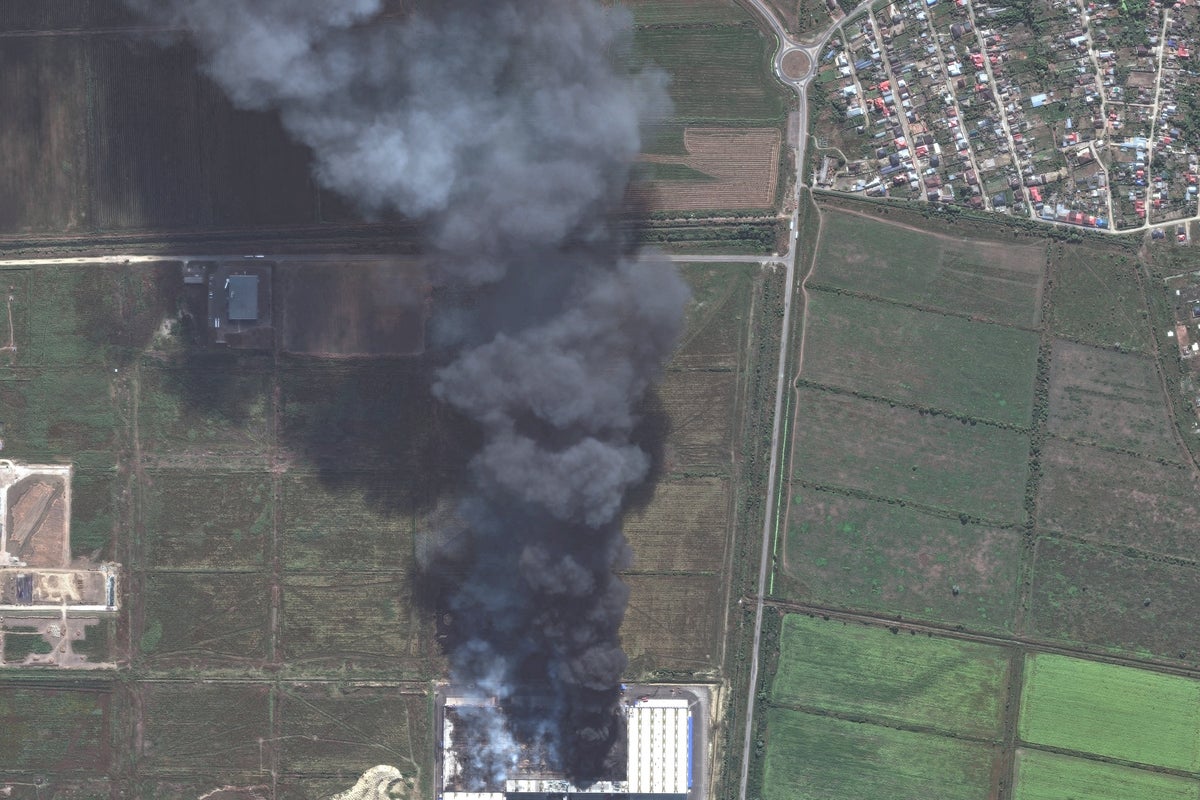
The morning air outside Voronezh smells of diesel exhaust and damp corrugated cardboard. Inside Distribution Hub 4, row upon row of high-bay shelving stretches into the gray gloom, holding twenty thousand pallets of canned milk, winter boots, and imported household electronics. To an inventory manager, this warehouse is an equation of turnover rates and SKU optimization. To the men and women who drive the forklifts beneath these towering steel beams, it is simply a paycheck, a climate-controlled sanctuary from the freezing mud outside.
Then the horizon hums.
A low, buzzing frequency, like an angry hornet trapped inside a tin cup, cuts through the drone of the refrigeration units. Everyone looks up. They know the sound. In the third year of a grinding continental war, the sky has become a theater of invisible reckonings. A long-range drone, fiberglass and two-stroke engine components assembled thousands of miles away, drops out of the low clouds. It strikes the loading dock with a concussive roar that turns plate glass into diamond dust and ignites a wall of plastic wrap.
Fire. Smoke. Panic.
That is the kinetic reality on the ground. But the shockwave of that explosion reaches far beyond the shattered concrete of the loading bay. It travels straight to Moscow, landing on the heavy mahogany desk of a bureaucrat reading a newly drafted decree.
The Stroke of a Pen in the Kremlin
Laws are written in quiet rooms to manage loud chaos. When the state looks at a burning logistics park, it does not merely see ruined inventory or injured workers. It sees a systemic vulnerability.
Vladimir Putin recently signed a piece of legislation that changes the fundamental relationship between private commerce and state survival. Under this new legal framework, the Russian government grants itself the extraordinary power to seize commercial retail warehouses and distribution centers if those facilities face or are threatened by Ukrainian drone attacks.
Let that sink in.
Your warehouse. Your inventory. Your logistics network. Built with private capital, managed by corporate supply chain experts, optimized for consumer retail—commandeered overnight.
(Note: While the specific statutory mechanisms of emergency requisition have historical precedents in wartime mobilization acts, applying this directly to modern commercial warehousing during active drone campaigns represents a stark escalation in state control over private economic assets.)
To understand why this happens, we have to look at how modern war consumes space. Frontlines are no longer clean lines drawn on a topographic map by generals with grease pencils. They are porous, jagged vectors stretching hundreds of miles behind the physical trenches. Every factory floor, every grain silo, every retail distribution hub is a potential node in a logistical nervous system. If the army needs staging grounds, vehicle repair bays, or secure underground storage for military hardware away from frontline artillery, where do they look?
They look at the vast, sprawling concrete boxes built by multinational supermarket chains and e-commerce giants.
When Retail Becomes the Battlefield
Imagine you are Elena, a supply chain director for a major domestic retail conglomerate. You spent fifteen years perfecting a just-in-time delivery model. You know the exact dwell time of a pallet of pasta. You know how to minimize shrinkage. You sleep with your phone on your pillow, tracking transport trucks moving through the night across eleven time zones.
You never planned for requisition.
One Tuesday afternoon, an official in a dark suit walks into your glass-walled corporate office. He doesn't carry a clipboard; he carries an executive order. He points to your flagship automated fulfillment center—the one with the high-speed sorting belts and the multi-million-dollar robotics installation.
"The state is taking possession," he says. Not asks. Takes.
"On what grounds?" you ask, your voice tight.
"National security. Drone debris was recovered twenty kilometers north. The facility is designated a strategic staging area."
What happens to your twenty thousand suppliers? What happens to the millions of consumers expecting fresh produce on store shelves in three days? The cold calculus of retail commerce collides with the brutal physics of national survival. In that collision, market economics shatter into dust.
This is the hidden cost of protracted conflict. The boundary between the civilian economy and the military apparatus dissolves entirely. Every economic asset becomes a dual-use hazard.
The Logistics of Desperation
Why target warehouses at all? Why are these massive tilt-up concrete structures suddenly on the frontline of strategic anxiety?
The answer lies in the nature of modern aerial warfare. Long-range unmanned aerial vehicles are cheap to build and hard to intercept with expensive air defense missiles. They fly low, hugging river valleys, guided by satellite navigation systems that bypass traditional radar nets. When they strike deep into sovereign territory—hundreds of miles behind the border—they target energy grids, fuel depots, and yes, massive distribution nodes.
A burning warehouse is not just a commercial loss; it is a psychological blow. It tells a populace watching the evening news that safety is an illusion, that the war has a long reach.
By passing a law to legally seize these facilities, the state is attempting two things simultaneously:
- It secures physical infrastructure for its own wartime logistics, repurposing civilian loading docks for military staging, equipment repair, or alternate supply stockpiles.
- It legally insulates the government from liability and resistance when corporate owners protest the commandeering of their multi-million-dollar investments.
Consider the ripple effects across the market. If private warehouse owners know their facilities can be seized at a moment's notice, capital investment freezes. Who builds a state-of-the-art automated fulfillment center if it might be turned into a military motor pool tomorrow? Insurance underwriters pull back, premiums skyrocket into unpayable territory, and foreign investment evaporates completely. The very laws enacted to manage the crisis begin to accelerate the structural decay of the commercial sector.
The Human Cost Behind the Ledger
Back at Distribution Hub 4, the smoke has cleared, but the workers have not returned.
Mikhail, a fifty-two-year-old forklift operator with grease-stained knuckles and a quiet demeanor, stands across the chain-link fence, watching soldiers in unmarked uniforms unload green metal crates from a military truck where pallet jacks used to roll. He worked this warehouse for eight years. He knew every aisle, every quirky sensor on the conveyor belts, every coworker's birthday.
Now, the building belongs to an abstract concept of national necessity.
He shoves his hands into his coat pockets against the biting wind. He has no stock options to lose. He has no corporate board seat to defend. He just has a vanished livelihood and a skyline punctuated by the silent, watchful silhouettes of air defense batteries mounted on nearby rooftops.
The decree is signed. The trucks keep rolling. But the ground beneath the entire economy has shifted beneath everyone's feet, leaving behind a landscape where no warehouse is just a warehouse anymore, and no supply chain is safe from the long shadow of the state.
The horizon hums again.
Mikhail doesn't look up. He turns his collar against the cold and walks down the road toward home, leaving the concrete fortress behind him to whatever the next siren brings.