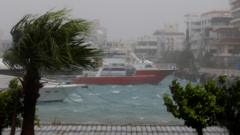
When two tropical cyclones strike the same landmass within a seven-day window, the resulting damage is not additive; it is multiplicative. The arrival of a second typhoon represents a compounding systemic shock that exploits the structural, hydrological, and logistical vulnerabilities left exposed by the first. Media reports frequently treat sequential storms as isolated weather events occurring in close chronological proximity. This view miscalculates the true risk profile. To accurately quantify the impact of back-to-back landfalls—such as the sequential typhoons striking China's southeastern seaboard—analysts must evaluate the phenomenon through a framework of compounding vulnerabilities.
The core operational challenge of sequential typhoons rests on three distinct operational pillars: hydrological saturation thresholds, structural fatigue lifecycles, and logistical recovery deficits. When a region is subjected to a secondary meteorological shock before the primary shock cycle has concluded, standard disaster mitigation models fail. This analysis deconstructs the mechanics of these twin atmospheric events, establishing a predictive framework for infrastructure survival and supply chain resilience. Don't forget to check out our previous coverage on this related article.
Hydrological Saturation and the Ground Priming Effect
The primary determinant of flash flooding and systemic drainage failure during a secondary typhoon is the soil moisture active layer. Under baseline conditions, regional soil acts as a natural buffer, absorbing initial precipitation through infiltration processes. However, a major tropical cyclone typically deposits between 200mm and 500mm of rainfall, completely saturating the upper soil horizons and elevating the local water table to the surface.
This state of baseline saturation introduces a critical structural bottleneck for any subsequent weather system arriving within 168 hours: If you want more about the history of this, BBC News offers an excellent breakdown.
- Zero Infiltration Capacity: With the soil matrix fully saturated, the infiltration rate drops to zero. Every millimeter of rainfall delivered by the second typhoon immediately converts into surface runoff.
- Accelerated Hydrograph Peaks: In a standard meteorological event, the time lag between peak rainfall and peak river discharge is lengthened by the time it takes water to travel through the soil. In a sequential storm scenario, the hydrograph peaks almost instantly, causing rapid, unpredictable urban and riverine flooding.
- Civil Engineering Strain: Drainage infrastructure, pumping stations, and retention basins are designed based on historical recurrence intervals that assume empty or partially empty systems at the onset of a storm. When the second storm hits, these systems are already operating at or near maximum capacity, leading to immediate hydraulic backflow.
This hydrological priming explains why a weaker secondary storm frequently causes far more severe flooding and landslide activity than a more powerful initial system. The secondary event does not need to break atmospheric records; it merely needs to displace water into an environment that has run out of physical storage space.
Structural Fatigue and Material Degradation Cycles
Civil infrastructure—ranging from residential high-rises to power transmission grids and coastal seawalls—is engineered to withstand extreme lateral wind loads and hydrostatic pressure. However, engineering tolerances are generally calculated based on the assumption of a single peak load event, followed by a prolonged period of inspection, maintenance, and structural stabilization.
When the temporal gap between two major storms shrinks to a few days, structures are subjected to sustained cyclic loading that alters their material properties.
Seawalls and Coastal Defense Integrity
The first typhoon inflicts severe hydrodynamic scour along the base of coastal defenses, washing away the foundational substrate. Even if the seawall remains standing, its structural integrity is compromised. When the second storm arrives, generating a renewed storm surge, the weakened defenses experience rapid mechanical failure due to the loss of subterranean support.
Wind Load Fatigue on Electrical Substructures
High-voltage transmission towers and utility poles experience micro-fractures and material yielding during sustained high-wind events. The structural dampening systems and guy wires stretch or loosen. A secondary wind vector, even at lower velocities, acts upon already deformed components. This significantly increases the probability of cascading grid failures, as the threshold for mechanical snapping is drastically lowered.
Saturated Building Foundations
In rural and peri-urban areas, prolonged immersion of building foundations in moving floodwaters induces soil liquefaction and differential settlement. The structural framework of these buildings becomes misaligned. Consequently, the lateral wind forces of the second typhoon are distributed unevenly across the structural load paths, triggering structural collapses at wind speeds that the buildings were theoretically rated to survive.
The Logistical Recovery Deficit
Disaster response and supply chain remediation operate under strict resource constraints. The efficiency of a recovery effort is governed by the deployment rate of heavy machinery, utility repair crews, medical assets, and emergency provisions. A second typhoon striking within a week disrupts the fundamental math of disaster logistics by trapping recovery assets in a compounding feedback loop.
[Initial Shock: Typhoon 1] ──> [Asset Deployment & Depletion] ──> [Supply Lines Compromised]
                                                                        │
                                                                        ▼
[Compounded Failure] <── [Zero Operational Buffer] <── [Secondary Shock: Typhoon 2]
The second storm effectively paralyzes the recovery apparatus through three main operational bottlenecks:
- Supply Chain Depletion: Emergency stockpiles of food, potable water, medical supplies, and temporary sheltering materials (such as tarpaulins and sandbags) are heavily drawn down during the initial 48 hours post-landfall. Restocking these reserves requires functional transport corridors, which are frequently severed by landslide activity or structural failures along rail and highway networks.
- Personnel Exhaustion and Stranding: Civil defense units, municipal workers, and specialized utility engineers operate under high-stress, sleep-deprived conditions during the first response wave. The arrival of a second storm eliminates the window required for personnel rotation. Furthermore, crews deployed to remote areas to clear debris from the first storm risk becoming trapped or cut off as rising waters isolate entire sub-regions.
- Asset Immobilization: Heavy equipment, such as excavators, mobile generators, and water pumps, cannot operate safely in sustained gale-force winds or deep floodwaters. The secondary storm forces a mandatory stand-down of all recovery operations, leaving half-cleared drainage channels and partially repaired levies highly vulnerable to immediate failure.
Industrial and Macroeconomic Disruptions
The geographic zone impacted by these sequential landfalls—primarily China's eastern and southern maritime provinces—serves as a critical node in global manufacturing and maritime logistics. The economic friction generated by a double-typhoon event extends far beyond localized property damage; it introduces prolonged volatility into international supply chains.
Port Operations and Maritime Congestion
Major shipping hubs along the Yangtze River Delta and southern coast require specialized container cranes and automated loading systems to move global freight. These cranes must be locked down and secured when wind speeds exceed specific operational thresholds (typically around 20 meters per second). A second storm within a week effectively doubles the duration of port closures. Ships are forced to alter their routes or wait in open anchorages, causing sharp spikes in regional container dwell times and disrupting just-in-time manufacturing schedules across Europe and North America.
Semiconductor and High-Tech Manufacturing Vulnerabilities
Modern high-tech fabrication facilities rely on an uninterrupted supply of industrial gasses, ultra-pure water, and highly stable electrical grids. While these facilities maintain localized backup systems, these contingencies are built for short-term mitigation. A prolonged multi-day grid failure, compounded by regional transportation blockages that prevent the delivery of industrial consumables, forces facility shutdowns. The recalibration of precision manufacturing equipment post-power fluctuation introduces additional operational delays that can last for weeks.
Predictive Modeling Limitations
Evaluating sequential meteorological events highlights the structural limitations within current commercial catastrophe models. Most predictive frameworks utilized by insurance, reinsurance, and state planning agencies rely on independent probability distributions. They calculate the likelihood and impact of "Storm A" and "Storm B" as discrete variables.
This approach introduces a systematic underestimation of risk. To correct this analytical error, models must transition toward dynamic dependency mapping. This requires integrating real-time soil moisture telemetry, structural health monitoring arrays on critical infrastructure, and dynamic asset-allocation algorithms that account for the real-time depletion of emergency reserves. Without these integrated inputs, economic loss projections will consistently fail to predict the non-linear cost curves associated with multi-event clusters.
Strategic Operational Recommendations
To mitigate the compounding risks identified in this framework, industrial operators, supply chain managers, and municipal authorities must move away from reactive disaster planning. The following protocols should be integrated directly into regional risk management playbooks:
- Establish Dynamic Inventory Thresholds: Manufacturing facilities located within 100 kilometers of the coastline must institute a "Sequential Event Buffer." If a tropical system makes landfall within the region, the baseline safety stock of critical components and alternative power fuel must be immediately increased by 40%, assuming a secondary logistical disruption will occur within a 10-day window.
- Implement Decoupled Infrastructure Zones: Municipal power grids and water treatment networks must feature automated decoupling mechanisms. In the event of localized structural failure or flooding during the initial storm, affected segments must be isolated instantly to preserve the baseline operational integrity of adjacent nodes before the arrival of a secondary system.
- Mandate Runoff Velocity Reductions: Urban engineering guidelines must prioritize the construction of deep subterranean stormwater storage vaults paired with pervious, high-volume overflow plains. These systems must be designed to mechanically retain and slowly discharge water during the second phase of a multi-storm sequence, bypassing saturated surface soils entirely.
The strategy cannot rely on the hope that consecutive storms will weaken prior to landfall. Resilience lies in engineering systems that acknowledge the first storm is merely a prelude to a altered, far more volatile operational environment.

.webp)