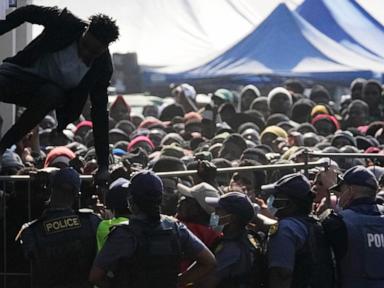
When the South African Police Service (SAPS) petitions a High Court to prohibit an anti-immigration march, the state is attempting to resolve an acute operational failure through preemptive judicial restraint. Standard news reporting frames this maneuver as a binary clash between free speech and public safety. That framing misses the structural mechanics driving the litigation. A court interdict against a protest does not eliminate the underlying socio-economic grievances, nor does it expand police tactical capacity. Instead, it shifts the legal threshold for state intervention from reactive crowd management to preventative enforcement, trading immediate operational relief for long-term constitutional and legitimacy costs.
To understand why law enforcement resorts to judicial bans—and why those bans frequently fail to contain civil unrest—requires deconstructing the intersection of South Africa’s statutory protest framework, police force-allocation economics, and the spatial dynamics of urban vigilantism.
The Statutory Architecture of Protest Restriction
South Africa’s constitutional order establishes an unusually high barrier against prior restraint. Section 17 of the Constitution guarantees every person the right, peacefully and unarmed, to assemble, demonstrate, picket, and present petitions. Operationalizing this right falls under the Regulation of Gatherings Act 205 of 1993 (RGA), a post-apartheid statute deliberately engineered to strip local authorities of arbitrary veto power over political dissent.
Under the RGA, organizers do not apply for permission to march; they submit notice to a municipal "responsible officer." The state cannot ban a gathering simply because the message is unpopular, inflammatory, or economically disruptive. Prohibition is legally permissible only under Section 5 of the Act, which requires credible information on oath that the gathering will result in serious disruption of vehicular or pedestrian traffic, injury to participants or other persons, or extensive damage to property—and crucially, that the police and traffic authorities will not be able to contain this threat.
This final clause represents the structural vulnerability in SAPS litigation. When police approach a court to ban a march organized by groups such as Operation Dudula or allied anti-immigrant coalitions, they are effectively submitting an affidavit of operational incapacity. The state must argue that its own Public Order Policing (POP) units cannot guarantee containment without infringing upon the rights of third parties, specifically foreign nationals and informal traders.
The Threshold of Imminent Harm vs. Hate Speech
Courts evaluate these applications along two distinct legal axes:
- Operational Uncontainability: Whether the physical logistics of the route—such as narrow high-density commercial corridors in Johannesburg’s central business district or Durban’s beachfront—create a tactical bottleneck where crowd dispersion becomes impossible without lethal force.
- Constitutional Disqualification: Whether the stated objective of the assembly crosses from protected political expression into unprotected incitement to imminent violence or advocacy of hatred based on nationality or ethnicity under Section 16(2) of the Constitution.
Anti-immigration organizers routinely exploit the ambiguity between these two axes. By framing marches around formal regulatory demands—such as auditing municipal trading bylaws, inspecting undocumented labor compliance, or petitioning the Department of Home Affairs—organizers construct a facially lawful veneer. When SAPS seeks a blanket ban, defense counsel argues that the state is penalizing lawful assembly based on speculative intelligence rather than verified criminal intent. Courts, bound by the constitutional presumption in favor of assembly, frequently narrow the relief: rather than banning the march outright, judges issue conditional interdicts prohibiting participants from entering specific streets, inspecting identification documents, or closing foreign-owned shops.
The Force-Allocation Deficit in Public Order Policing
The turn toward judicial intervention is driven less by shifting legal doctrine than by severe resource constraints within SAPS. Effective crowd management relies on specific force-to-crowd ratios, intelligence penetration, and rapid-response mobility. When those variables degrade, litigation becomes a substitute for boots on the ground.
Public Order Policing units across South Africa operate under chronic structural deficits:
- Personnel Attrition and Dilution: POP units are routinely diverted from specialized crowd control to routine crime prevention, VIP protection, and static infrastructure guarding. This dilution erodes unit cohesion and leaves commanders with insufficient personnel to cordon off multi-block urban protests.
- Intelligence Blind Spots: Modern anti-immigration mobilization rarely relies on centralized, hierarchical command structures. Mobilization occurs across encrypted messaging groups and hyper-local WhatsApp networks. Without reliable human intelligence inside these decentralized cells, police commanders cannot accurately forecast crowd size, geographic dispersion, or the presence of armed agitators.
- The Marikana Doctrinal Constraint: Following the 2012 Marikana tragedy and the subsequent Farlam Commission recommendations, SAPS crowd-control doctrine underwent strict demilitarization. Commanders face acute legal and career liability if containment operations escalate into lethal engagements. When tactical options are constrained by strict use-of-force protocols and insufficient non-lethal crowd-control inventory, commanders exhibit strong risk aversion toward physical confrontation.
Seeking a High Court interdict alters the tactical calculus. Once a court order is granted, the legal status of the assembly changes instantaneously. Participants are no longer exercising a constitutional right subject to proportionate policing; they are in contempt of court and participating in an unlawful gathering. This lowers the procedural threshold for preemptive arrests, perimeter blockades, and the dispersal of staging areas before a crowd reaches critical mass.
The Three-Stage Escalation Mechanism of Anti-Immigration Mobilization
Standard media coverage treats an anti-immigration march as a discrete event with a clear start and end time. In practice, urban xenophobic mobilization follows a repeatable, three-stage operational sequence. A court ban typically disrupts only the second stage, leaving the first and third untouched.
Stage 1: Digital Framing and Grievance Aggregation
Organizers anchor their recruitment in acute, verifiable local failures—youth unemployment, municipal service collapse, illicit drug markets, and overburdened public clinics. By attributing these systemic governance failures exclusively to undocumented migration, organizers convert diffuse economic frustration into a targeted, actionable narrative. This stage occurs entirely online and in community halls, well outside the scope of a street-march interdict.
Stage 2: The Territorial March and "Audit"
This is the visible spectacle that triggers police litigation. Groups assemble in commercial hubs, ostensibly to deliver a memorandum to state officials. In reality, the march functions as a show of territorial dominance. Participants march past foreign-owned spaza shops, salons, and wholesale depots, demanding business licenses and immigration papers. This informal enforcement usurps state authority and relies on implicit intimidation: shopkeepers close their shutters not because of a formal municipal order, but to prevent looting or assault.
Stage 3: Decentralized Vigilante Enforcement
When a High Court bans the Stage 2 march, mobilization does not evaporate; it fragments. Unable to gather in a single high-profile column, activists pivot to decentralized, small-group operations. Teams of five to fifteen individuals conduct unannounced "inspections" of neighborhood businesses, clinics, and schools outside the central business district.
This fragmentation creates a severe asymmetric policing problem. A single march of 1,000 people requires one concentrated POP deployment. Fifty simultaneous, unannounced groups of twenty people operating across sprawling townships require a level of precinct-level patrol saturation that SAPS does not possess. A court ban solves the spectacle problem while exacerbating the enforcement problem.
The Cost Function of Judicial Prior Restraint
Relying on the judiciary to manage street-level political conflict introduces three distinct institutional costs that compound over time.
First, it accelerates the politicization of the courts. When SAPS repeatedly uses High Court interdicts to block anti-immigration protests, protest leaders frame the judiciary as an active participant in suppressing working-class grievances to protect foreign nationals. This narrative corrodes public trust in judicial impartiality—a critical vulnerability in a constitutional democracy where courts rely on voluntary compliance rather than their own enforcement arm.
Second, unenforceable court orders damage state deterrence. A court interdict is only as effective as the state’s capacity to enforce it on the morning of the scheduled march. If SAPS obtains an urgent interdict on a Friday afternoon, serves it on organizers via social media, and then lacks the personnel on Saturday morning to prevent 500 people from marching down a major arterial road, the state suffers a double defeat. Not only does the disruption occur, but the visible defiance of a High Court order signals state impotence, emboldening organizers for subsequent actions.
Third, preemptive bans create a perverse incentive structure for protest organizers. Groups that comply with the Regulation of Gatherings Act—submitting notices, attending Section 4 planning meetings with police and municipal officials, and appointing marshals—become visible targets for SAPS court interdicts. Groups that bypass the statutory notification process entirely and launch spontaneous "flash" demonstrations evade preemptive litigation because police lack the lead time to draft affidavits and approach an urgent court roll. The legal mechanism thus penalizes procedural compliance and rewards clandestine mobilization.
Systemic Alternatives to Preemptive Bans
Because judicial bans address symptoms rather than operational bottlenecks, sustainable public order management requires shifting resources from reactive litigation to structural enforcement.
Reclaiming Regulatory Monopoly
Anti-immigration groups gain popular legitimacy by stepping into a regulatory vacuum. When municipal bylaws regarding zoning, health inspections, and business licensing go unenforced, vigilante groups position themselves as community defenders restoring order. Neutralizing this appeal requires visible, consistent, and legally compliant enforcement by state agencies—specifically municipal bylaw units, the Department of Employment and Labour, and the Border Management Authority. When the state visibly enforces labor and commercial regulations across all businesses regardless of owner nationality, it strips vigilante groups of their primary justification for street mobilization.
Targeted Conspiracy Prosecution Over Blanket Bans
Rather than seeking broad civil interdicts that infringe on assembly rights and strain police resources, law enforcement must utilize targeted criminal intelligence. Under the Riotous Assemblies Act and common-law principles of incitement and extortion, police can build criminal dockets against specific ringleaders who orchestrate shop closures, demand protection money, or incite violence online. Arresting five key organizers on substantive criminal charges days before a planned event disrupts command and control far more effectively than serving a civil interdict on a loosely defined crowd.
Granular Route Engineering
Where marches proceed under constitutional protection, SAPS and municipal authorities must shift from binary ban-or-allow decisions to strict spatial engineering. Under Section 4 of the RGA, authorities have broad latitude to impose binding conditions on routes, buffer zones, and assembly points. Routing demonstrations away from dense commercial corridors and restricting them to designated civic squares—backed by pre-positioned physical barriers rather than human police lines—reduces the personnel required for containment while preserving the constitutional right to petition.
The Strategic Trajectory
The reliance on High Court interdicts to halt anti-immigration marches is a lagging indicator of institutional stress. As long as municipal governance deficits, high youth unemployment, and porous administrative enforcement persist, street-level nativist mobilization will remain an attractive political vehicle for local actors. SAPS cannot litigate its way out of a structural capacity deficit. If law enforcement continues to treat court bans as a primary crowd-control tool without pairing them with targeted criminal prosecutions and visible municipal bylaw enforcement, organizers will simply abandon formal marches in favor of decentralized, hyper-local intimidation—a mode of conflict that no court order can interdict and no single police deployment can contain.


