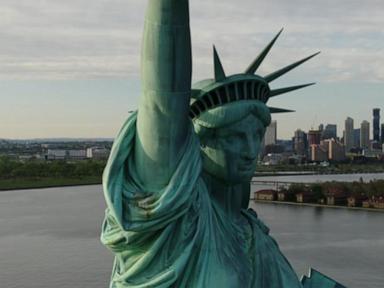
The salt air off the Upper New York Bay does something brutal to iron. It eats it. If you stand on the deck of the ferry rocking toward Liberty Island on a biting January morning, the wind feels like a slap, and the water looks like churning slate. Most tourists are looking up, eyes glued to the green skin of the colossus rising ahead of them. But if you look closer, down at the framework holding those three hundred sheets of pounded copper together, you begin to see the true story. It is not a story about a statue. It is a story about a massive, desperate, near-failing gamble funded by pennies from people who would never live to see her finish standing.
We treat her like an ancient monument, an eternal fixture of the American skyline. She feels like she has always been there, a permanent sentinel. Building on this topic, you can find more in: The Route of Smoke and Spice That Central Asia Left Behind.
She hasn't.
In 1885, she was nothing more than a giant, expensive jigsaw puzzle packed into 214 wooden crates, sitting on a dock, waiting for a country that wasn't entirely sure it even wanted her. Analysts at The Points Guy have also weighed in on this situation.
The Dinner Party That Sparked an Obsession
The idea did not start with an American. It started in a grand dining room in France, around 1865. Édouard René de Laboulaye, a political thinker and abolitionist, was hosting a dinner party. The American Civil War had just ended. Slavery was abolished. The union had held. To Laboulaye and his prominent French guests, America had achieved the impossible: it had proven that democracy could survive its own worst demons.
Laboulaye wanted to build a monument to celebrate this bond, a shared devotion to freedom. But he had a hidden motive. France was slipping back into authoritarian rule under Napoleon III. By praising American liberty, Laboulaye was subtly criticizing his own government. It was a dangerous, brilliant piece of political theater.
Sitting at that table was a young sculptor with a flair for the theatrical. Frédéric-Auguste Bartholdi.
Bartholdi did not just want to make art. He wanted to make something that could alter the horizon. He envisioned a monument that would rival the ancient Colossus of Rhodes. He traveled to Egypt, pitching a massive statue of a female fellah holding a torch to guard the entrance of the Suez Canal. The Egyptian government looked at the price tag and said no.
Dejected but fired up by Laboulaye’s vision, Bartholdi turned his gaze toward America.
When he sailed into New York Harbor in 1871, he saw Bedloe’s Island. It was an oval patch of land used for a military fort. Bartholdi looked at that island and knew instantly. This was the gateway to the New World. This was where his giant had to stand.
A Skeleton of Iron, Skin of Coin
Building a statue that stands 151 feet tall from base to torch is an engineering nightmare. If you build it out of solid stone, it collapses under its own immense weight. If you build it out of solid cast iron, it sinks into the mud.
Bartholdi needed a genius. He hired Alexandre-Gustave Eiffel, years before the world would know his name because of a tower in Paris.
Eiffel understood something profound about nature. You cannot fight the wind. If you fight it, you lose. Instead, you must yield to it.
Eiffel designed a massive internal skeleton. A central iron pylon, supported by flexible steel framework. The copper skin of the statue would not be bolted rigidly to this frame. Instead, it would hang from it using an intricate web of iron straps called "saddles." This allowed the statue to move. When a fierce Atlantic gale hits New York Harbor, the Statue of Liberty does not stand perfectly still. She sways. She shifts three inches. Her torch sways five.
She survives by bending.
The skin itself is a marvel of human sweat. It is made of copper, hammered out by hand in a Parisian workshop using a technique called repoussé. Craftsmen took sheets of copper just two. Point. Five. Millimeters. Thick. That is roughly the thickness of two pennies placed together. They hammered these sheets into wooden molds, shaping the curves of her robe, the strength of her jaw, the knuckles of her hands.
When you look at the statue today, you are looking at a shell thinner than the skin of an apple relative to her size.
The Empty Pedestal and the Forgotten Pennies
By 1884, the French had done their part. They had built the statue. They had paid for it entirely through donations from ordinary citizens, lottery tickets, and entertainment galas. The agreement was simple: France would build the statue, and America would build the pedestal to put it on.
America, it turned out, was terrible at keeping its end of the bargain.
Congress refused to appropriate funds. New York State refused to vote for the money. Wealthy elites in Boston and Philadelphia looked at the project and sneered, viewing it as a New York vanity project. The American committee tasked with raising the funds ran completely dry. Construction on Bedloe's Island ground to a screeching halt. The pedestal was only half-built, a jagged concrete stump rising from the fort.
The crates containing the statue arrived in New York in June 1885. There was nowhere to put them. It was a national humiliation.
Enter Joseph Pulitzer.
Pulitzer was an immigrant who had arrived in America with nothing, sleeping on park benches before building a newspaper empire. He ran The New York World. He saw the unfinished pedestal not just as a tragedy, but as a symptom of a deeper rot. The wealthy millionaires of the Gilded Age were spending thousands on yachts and mansions but refused to give a single dollar to the symbol of the country that gave them their wealth.
Pulitzer bypassed the rich. He used his newspaper to launch an unprecedented crowdfunding campaign.
He promised to print the name of every single person who donated to the pedestal fund, no matter how small the amount. The response was an avalanche.
A young girl named Jersey City wrote in, enclosing sixty cents she had saved from chores. A lonely widow sent a single dime. A group of children in an orphanage pooled their pennies together to send a dollar. Sweatshop workers, sailors, clerks, and immigrants who had just passed through the harbor sent what little they could spare.
In just five months, Pulitzer raised over $100,000. The average donation was less than one dollar.
The pedestal was built by the poor, for a symbol of freedom they desperately needed to believe in.
The Color of Change
When the statue was finally dedicated on October 28, 1886, she did not look like she does now.
She was a brilliant, shining, fiery red-orange. She gleamed like a newly minted coin in the autumn sun.
For the first few decades of her life, New Yorkers watched a slow, chemical drama play out in the harbor. The copper began to react with the damp, salty air and the sulfur dioxide from coal-burning factories. First, she turned a dull, dark brown. Then, a muddy black.
By 1920, the oxidation was complete. A green film called patina covered her entirely.
There was a massive panic. Politicians demanded she be painted. The War Department, which managed the island at the time, actually drew up contracts to have her coated in white paint. The public protested. Scientists stepped in and explained that the green patina was not a sign of decay. It was a protective shield. The oxidation process had created a weatherproof barrier that sealed the underlying copper, stopping the corrosion in its tracks.
Her green coat was the very thing keeping her alive.
The Shift in the Wind
The most remarkable transformation of the Statue of Liberty, however, was not physical. It was spiritual.
Laboulaye and Bartholdi never intended for her to be a symbol of immigration. She was meant to celebrate the abolition of slavery and the triumph of liberty. If you look at her feet, she is not standing still. Her left foot is lifted, stepping forward. She is breaking free from a heavy shackle and chain that lie shattered across her toes.
But as millions of immigrants crowded onto the decks of steamships entering New York Harbor in the late nineteenth and early twentieth centuries, they didn't know about Laboulaye's dinner party. They didn't care about French politics. They saw a colossal woman rising from the mist, holding a torch to light their way into a new life.
A poem written by Emma Lazarus to raise money for that forgotten pedestal cemented this shift forever. Her words, cast in bronze and placed inside the pedestal in 1903, gave the statue a new voice.
"Keep, ancient lands, your storied pomp!" cries she
With silent lips. "Give me your tired, your poor,
Your huddled masses yearning to breathe free..."
The statue ceased to be a monument to political theory. She became the Mother of Exiles.
Consider what happens next when you stand at her base today. You look up at those three hundred sheets of copper, hammered by forgotten hands in Paris, supported by an iron skeleton designed to bend in the wind, paid for by the pennies of orphans and factory workers. She is a monument built out of sheer, stubborn human will. She stands in the harbor not because governments decreed it, but because people who possessed almost nothing decided she belonged there.