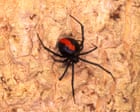
Nature is frequently absurd, rarely merciful, and occasionally bent on absolute operational efficiency. Among the most brutal manifestations of this evolutionary drive is the male redback spider, a creature that performs a literal backflip directly into the jaws of a much larger female during intercourse. This suicidal somersault is not a malfunction of biology or an accidental slip. It is an intentional, highly calculated act of reproductive self-immolation.
Scientists have debated the precise evolutionary calculus behind this behavior for decades. While the standard narrative suggests a simple case of mate guarding or forced paternal investment, a closer look at the physics of arachnid mating and female physiological manipulation reveals a much darker reality. The male redback does not just give his body away; he turns his entire carcass into a weaponized biological lock to ensure his genetic lineage survives.
Understanding why a male spider actively invites his own consumption requires abandoning human notions of survival and looking squarely at the cold mathematics of natural selection.
The Anatomy of a Fatal Backflip
To comprehend the redback strategy, one must examine the physical mismatch of the species. Female redbacks, scientifically known as Latrodectus hasselti, are up to four times larger and vastly heavier than their male counterparts. They are apex predators in their micro-habitats, equipped with potent neurotoxic venom designed to subdue struggling prey.
When a male enters a web, he approaches a female with extreme caution. His primary objective is fertilization, achieved via two specialized organs called palps that transfer sperm. However, the female redback possesses two separate genital openings, meaning a successful mating sequence requires insertion into both sides.
During the process, the male executes his signature move. He stands on his head and flips his abdomen directly over the female's mouthparts. This is the self-sacrificial somersault.
Instead of pulling away to fight another day, the male actively positions himself inside the danger zone. In many cases, the female begins consuming him while mating is still actively underway. The behavior seems counterintuitive from an individual survival standpoint. Why throw away the opportunity to find multiple partners?
The Paternity Payoff
Evolutionary biologists spent years testing the hypothesis that self-sacrifice was a form of extreme paternal investment. The theory suggested that by allowing himself to be eaten, the male provided a nutritious meal that helped the female produce healthier eggs.
Lab experiments delivered a startling truth. The nutritional boost argument does not fully hold up. Females fed on alternative insect diets can produce just as many eggs as those that consume their mates. The true benefit is entirely about sperm priority and fertilization duration.
When a male performs the somersault, his consumption takes time. This delay physically blocks subsequent males from mating with the female. A cannibalized male remains attached to the female’s genitalia for a significantly longer duration than a male that escapes.
Furthermore, the act of being eaten triggers a muscular reflex in the male’s remaining genitalia, forcing a more complete transfer of sperm. The dead or dying male effectively locks himself into position. This anatomical hijacking ensures that up to sixty-five percent of the eggs in the subsequent egg sac are fertilized by that specific male.
Evolution does not care if the organism lives to see tomorrow. It cares only whether genes are passed to the next generation. For the male redback, dying during sex yields a higher reproductive return than surviving.
The Evolutionary Gamble of Monandry
This dynamic forces a radical shift in how we view sexual conflict in the animal kingdom. Most species rely on a balance between male persistence and female coyness. In the redback world, that balance is utterly shattered by extreme sperm competition.
Female redbacks frequently mate with multiple partners if given the opportunity. If a male survives and escapes, he faces a high probability that a rival male will arrive later and displace his sperm. By destroying his own mobility and sacrificing his life, the male eliminates future competition. He invests his entire life savings into a single, high-stakes gamble.
Consider the alternative. If a male survives an encounter, his chances of finding a second female are remarkably low. Redback webs are sparsely distributed, and traveling across open ground exposes males to predators like birds, lizards, and wasps. The energy expended in search of a second mate rarely pays off.
Nature calculates that a bird in the bush is worth zero if you die on the way. The male redback maximizes his fitness by cashing out immediately.
The Physiological Arms Race
The mechanics of this sacrifice suggest an intense physiological arms race between the sexes. Females did not evolve cannibalism merely out of malice or hunger; it became an integrated part of the mating ritual. In fact, laboratory studies show that some female redbacks actually prefer being flipped over by males that are more aggressive in their positioning.
Yet, males have counter-strategies. Younger, smaller males are often more likely to be eaten entirely before finishing both insertions. Older, more experienced males sometimes manage to perform partial somersaults or escape if the female is already sated from a recent meal.
This variability proves that behavior is not purely hardwired clockwork. It is a flexible tactic deployed based on environmental cues, age, and nutritional status. When food is scarce and females are hungry, the sacrifice rate spikes. When prey is abundant, males occasionally manage to walk away from the table.
The Broader Lesson on Biological Cost
The redback spider challenges our anthropomorphic projections about life, love, and reproduction. We tend to view self-sacrifice through a moral lens, associating it with heroism, altruism, or tragic accident.
In the web of the redback, sacrifice is cold, hard economics. It is a transactional ledger where flesh and blood are traded for genetic immortality. The male spider does not die for love. He dies because his species found a mathematical shortcut to maximum gene propagation.
Every time a male executes that fatal twist, he demonstrates that biology recognizes no sacred boundaries. Survival is a secondary concern when compared to the absolute imperative of replication. The redback sacrifice stands as a stark reminder that life on earth is driven by mechanisms far stranger and more ruthless than mere survival of the fittest.