The Weight of Air
Bronze is supposed to be forever. We build our monuments out of it because we are terrified of vanishing, because we want some heavy, unyielding proof that we were once here, standing in the sunlight, arguing about beauty and meaning.
Picture a quiet afternoon along the Potomac. The air carries that distinct, heavy humidity of a Washington afternoon, the kind that makes your shirt cling to your back. Walk up to the grounds of the John F. Kennedy Center for the Performing Arts. For years, your eyes would have snagged on a massive, vivid splash of sapphire against the concrete and green grass. It was a sculpture named Blue. It did not try to blend in. It demanded attention. It commanded the space.
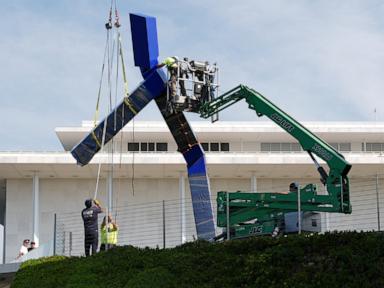
Then came the morning the cranes arrived.
Bolts were unthreaded. Cranes hoisted the monumental structure into the empty sky. The empty footprint left behind looked less like a missing art piece and more like a missing tooth in a familiar smile.
We rarely think about the physical vulnerability of art until it is being unbolted. We treat statues as permanent fixtures of geography, as natural to the landscape as the oak trees or the riverbeds. But art on public display is a living, breathing negotiation between the object, the weather, and the institution tasked with its protection.
Consider what happens when a massive outdoor installation reaches a crossroads. Maintenance becomes a ghost story. Rust creeps in where sealant fails. The sheer physics of weathering outdoors in a mid-Atlantic climate—the freezing winters, the brutal summers, the relentless moisture—wage a quiet, microscopic war against the artist's original vision.
The Kennedy Center did not just take down a sculpture. They triggered a complex, often invisible machinery of conservation, ownership, and public space curation.
The Anatomy of Removal
Let us step back into the meeting rooms where decisions of this magnitude are forged.
No one issues a press release about art removal with joy. There are memos. There are structural integrity reports. There are anxious phone calls between curators, conservators, and legal teams.
When a large-scale piece like Blue is disassembled, it is an engineering ballet performed in reverse. Every weld is a point of stress. Every panel must be cataloged.
(Note: While the exact operational logistics mirror industrial deconstruction, the emotional gravity is entirely unique to the cultural sector.)
Imagine standing on that plaza as the metal shifts. The sound is a dull, metallic groan—the noise of history being packed away into crates. Visitors stop in their tracks. Tourists with cameras tilt their heads, confused by the sudden absence of a landmark they had mapped into their afternoon stroll.
Why do we care so much about public objects? Because they anchor us. When a familiar sculpture vanishes, our mental map of the city fractures just a little bit. We realize that our environment is entirely provisional.
The removal sparks a cascade of questions that institutions rarely answer easily. Who owns the narrative of public space? Is a sculpture meant to endure forever in one spot, or does its life include a chapter of retreat, repair, and potential rebirth elsewhere?
The Invisible Architecture of Custodianship
We love the grand unveiling. We despise the quiet departure.
Culture teaches us to celebrate the birth of a masterpiece, but it gives us no vocabulary for its dismantling. We view removal as failure, as a loss, as an erasure. But art conservation is often an act of emergency medicine.
Let us look at the broader behavioral pattern here. Public art across the nation faces an unprecedented crisis of aging infrastructure. The materials chosen decades ago—sometimes experimental alloys, sometimes standard industrial metals—are meeting modern environmental extremes that outpace their creators' expectations.
When Blue came down, it exposed the hidden friction between ambition and endurance. An artist dreams of permanence. Reality offers erosion.
Think of the conservator wiping down a metal seam, checking for microscopic fractures. This is not glamorous work. There are no red carpets in a conservation warehouse. There is only harsh fluorescent lighting, chemical solvents, and the quiet pressure of preserving something that millions of people remember experiencing in a specific, sunlit moment of their lives.
When a major cultural hub like the Kennedy Center alters its landscape, it forces us to confront our own relationship with permanence. We project our memories onto physical objects. We remember the first date on that plaza, the afternoon we sat beneath the sculpture eating ice cream, the moment we felt small in the best possible way.
When the metal goes away, the memory remains untethered.
The Silence Left Behind
The cranes have long since left the Potomac banks. The concrete pad where the sculpture once commanded attention is washed clean by the rain, bearing only faint ghost-marks of where the anchors once bit into the stone.
People still walk that path. They still look toward the spot where the blue used to catch the afternoon glare. For a split second, their eyes search for the color, hit the empty air, and adjust.
That brief hesitation is the true legacy of the artwork. It is a reminder that beauty requires care, that permanence is an illusion we construct together, and that sometimes, the only way to save a piece of our shared culture is to watch it disappear into the back of a truck, hoping against hope that it will return to us changed, healed, and ready to stand against the weather once more.