The water of the South Pacific does not belong to any single flag. To the people who live among its scattered archipelagos, it is known as the "blue continent." It is an expanse of deep, shimmering azure that represents livelihood, history, and a hard-won sanctuary. Since the 1986 Treaty of Rarotonga, this vast stretch has been designated a nuclear-free zone. It is a place where the horizon is supposed to promise peace.
But on a quiet Monday morning, that peace was shattered by a mechanical roar.
Deep beneath the surface of the South China Sea, a nuclear-powered Chinese submarine surged. A steel cylinder broke through the surface, igniting a trail of fire that cut through the clouds. It was a submarine-launched ballistic missile—likely the state-of-the-art JL-3. It carried a simulated, non-nuclear dummy warhead.
It traveled over 7,300 kilometers. It arched high over the Philippines and hurtled through the atmosphere. Finally, it plunged back to earth, splashing violently into the international waters squeezed tightly between the exclusive economic zones of Nauru, Tuvalu, and the Solomon Islands.
It landed precisely in the heart of the blue continent.
The Sound of Friendship
To understand the weight of this splash, consider a hypothetical observer: let’s call him Tevita. Tevita is a fisherman from a small outer island in the Pacific. He relies on the migratory patterns of tuna and the predictable rhythm of the tides. To Tevita, the ocean is not a highway for superpowers. It is his backyard. It is his grocery store. It is his home.
When a ballistic missile tears through the sky above your home, the geopolitical explanations offered by distant capitals feel hollow.
Imagine a neighbor who knocks on your door, smiles, hands you a generous gift, and then casually fires a warning shot directly into the narrow strip of grass between your property lines. When you flinch, he tells you not to over-interpret the gesture. He tells you it was just a routine test of his new security system.
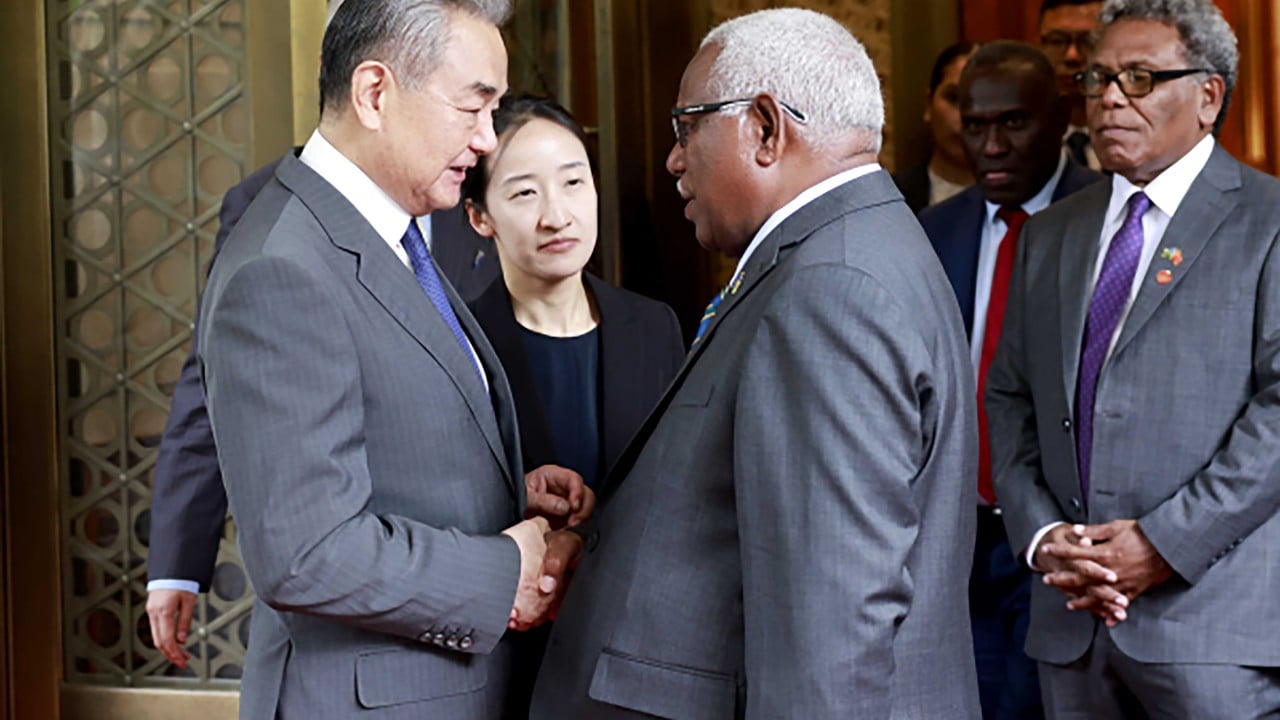
This is the exact tension currently rippling through the Pacific. Only days after the launch, China’s foreign ministry stood on a stage in Beijing to reassure the region. Meeting with Solomon Islands Foreign Minister Rick Houenipwela, Chinese Foreign Minister Wang Yi declared that Beijing does not seek a "sphere of influence" in the Pacific. He insisted that China’s partnerships come without political strings. He argued that these independent island nations are not the "backyard" of any Western power.
But the rhetoric of partnership is brushing up against the reality of raw military projection.
Even leaders who have spent years cultivation close, lucrative ties with Beijing found themselves unable to stay silent. Solomon Islands Prime Minister Matthew Wale, who has championed his nation's security pacts with China, delivered a blunt assessment of the launch:
"China is a good friend of Solomon Islands. But this is not something a friend does."
The Invisible Stakes
For decades, the South Pacific has been treated as a blank canvas by global powers. Decades of atmospheric nuclear testing by Western nations left a legacy of displaced populations and irradiated coral reefs. Because of this painful history, the region's resistance to militarization is not just political. It is deeply emotional. It is a matter of survival.
Palau President Surangel Whipps pointed out the chilling geometry of the missile's flight path. It did not land in the vast, empty expanses of the far north Pacific. Instead, it threaded the needle, dropping into a narrow corridor of international waters right between the island nations’ protected maritime zones.
"We have missiles going right into the heart of the Pacific, unannounced," Whipps warned.
The timing of the test was a masterclass in silent intimidation. The missile splashed down on the exact same day that Australia and Fiji signed a mutual defense pact. While diplomats in Suva were shaking hands and signing papers to bring their nations closer together, the skies were being crossed by a weapon designed to penetrate continental defenses.
A New Kind of Rain
For China, the test was a highly successful technical milestone. Historically, Beijing has tested its long-range missiles within its own land borders, firing into the remote deserts of Xinjiang. This ocean strike was only the second time since 1980 that China has launched a long-range ballistic missile into open international waters, and the very first time it has publicly demonstrated a strategic nuclear strike capability launched from a submerged submarine.
Strategists call this a "second-strike" capability. It is the ultimate insurance policy. If a country’s land-based silos are wiped out in a first strike, its silent, roaming submarines can still retaliate from the depths.
By pushing this capability into the open waters of the Pacific, Beijing is signaling that its nuclear triad is complete. It can now target the continental United States directly from the deep basins of the Western Pacific.
But as the military theorists celebrate their successful telemetry data, the people of the blue continent are left looking at the sky. They are left wondering if their quiet ocean is destined to become the stage for a theatrical rehearsal of the end of the world.
Beijing asks the world not to over-interpret the fire in the sky. But when you live on a fragile ring of coral in the middle of a vast ocean, a missile is never just a test. It is a shadow. And shadows have a habit of growing longer just before the sun goes down.