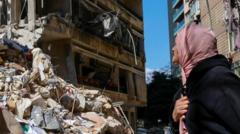
The coffee in Beirut is never just coffee. It is a thick, silty ritual consumed amidst the sound of glass being swept into piles. In a small apartment in the Bachoura district, an elderly man named Malik—a name that means "king" though he owns little more than a transistor radio—sits by a window that no longer has a pane. He listens to the static. He is waiting for a word that seems to have vanished from the modern lexicon: khalas. Enough.
But the word coming from the marble halls of government is not khalas. It is "conditions."
Lebanon is currently a nation held in a state of suspended animation. The air is heavy with the smell of scorched earth and the metallic tang of adrenaline. While the world watches digital maps with shifting red zones, the reality on the ground is a grueling stalemate of pride and survival. The Lebanese government has made its stance clear, carved into the granite of geopolitical necessity: there will be no negotiations with Israel until the sky stops falling. A ceasefire must come first.
The Geometry of a Siege
Imagine a house on fire. The neighbors are standing on the lawn, arguing about the future property lines and who gets to use the driveway once the embers are cold. The homeowner, trapped in the cellar, screams that the hoses must be turned on before he discusses the deed. This is not a metaphor for a simple property dispute; it is the literal architecture of the current diplomatic crisis.
Israel seeks a "new reality" on its northern border. They want guarantees, buffer zones, and the assurance that the rockets which have turned their northern towns into ghost cities will never fly again. From a military perspective, they see momentum. They see a lever. Why stop the pressure before the concessions are signed in ink?
Lebanon, however, views the prospect of negotiating under fire as a form of diplomatic surrender that no sovereign state can endure. For the Lebanese leadership, discussing the terms of a long-term peace while drones hum like angry wasps over downtown Beirut is an impossibility. It is a demand to negotiate with a knife to the throat.
The logic is circular. The violence continues because there is no agreement, and there is no agreement because the violence continues.
The Invisible Stakes of the South
South of the Litani River, the landscape is a patchwork of ancient olive groves and fresh craters. This is the land that everyone is talking about but few are currently seeing. To the diplomats in New York or Paris, this is "Area 1701," a reference to the UN Resolution that was supposed to keep the peace after the 2006 war. To the people who live there, it is simply home.
Resolution 1701 was a masterpiece of ambiguity. It called for the area to be free of any armed personnel or assets except those of the Lebanese state and UNIFIL. For eighteen years, that ambiguity was the floor everyone walked on. Now, the floor has fallen through.
The current demand from the Israeli side is not just a return to 1701, but "1701-plus"—a version with teeth, with enforcement, with the right to strike if the terms are breached. For Lebanon, this "plus" is a subtraction of their own sovereignty. They see it as an invitation for perpetual intervention.
But look closer at the human cost of this legalistic tug-of-war. Over a million people in Lebanon have been displaced. They are sleeping in schools, in public squares, and on the rocky beaches of the Mediterranean. When a government says "ceasefire first," they aren't just playing a tactical card. They are responding to a humanitarian catastrophe that has outpaced the ability of the state to function. A country that was already reeling from an economic collapse that saw its currency lose 98% of its value cannot sustain a war of attrition.
The Ghost of 2006
History in this part of the world doesn't repeat; it rhymes with a haunting, rhythmic cruelty. Those who remember 2006 see the same patterns emerging, but the stakes have shifted. Back then, the infrastructure was destroyed and rebuilt with Gulf money. Today, the coffers are empty. There is no Marshall Plan waiting in the wings for Lebanon.
This creates a desperate kind of bravery in the diplomatic halls. When the Lebanese Prime Minister insists on a ceasefire before talks, he is leaning on the only thing he has left: the international community’s fear of a total regional meltdown. If Lebanon collapses into a failed state entirely, the resulting vacuum won’t just be a problem for Beirut. It will be a hurricane that draws in every neighbor, every proxy, and every superpower.
Consider the psychological weight of this standoff. For an Israeli mother in Kiryat Shmona, the "human element" is the desire to take her children to school without checking the sky for suicide drones. For a Lebanese father in Tyre, it is the desire to know if his home still has a roof. Both are trapped by the high-level chess game where the pieces are made of flesh and bone.
The Fallacy of the "Quick Fix"
There is a temptation in Western capitals to believe that a few more days of "targeted pressure" will break the deadlock. This is a misunderstanding of the Levantine psyche. Pressure doesn't always lead to a break; often, it leads to a hardening.
The Lebanese government knows that if they agree to talk while the bombs are falling, they lose the support of their own disillusioned populace. They would be seen as puppets. Conversely, the Israeli government faces a public that is tired of "half-measures" and wants a definitive end to the threat from the north.
So we are left with the "Priorities of Peace."
- The Immediate Halt: Lebanon’s red line. The belief that no honest word can be spoken over the roar of an F-16.
- The Security Guarantee: Israel’s red line. The belief that a ceasefire without a new enforcement mechanism is just a countdown to the next war.
- The Sovereignty Gap: The space between what the UN can do and what the Lebanese army is actually capable of doing.
It is a gap filled with shadows.
The Silence of the International Community
While the United States sends envoys and France issues statements of "deep concern," the reality is that the world is distracted. There are other wars, other elections, other tragedies. This leaves Lebanon and Israel in a dark room together, each waiting for the other to blink.
The "standard" news report will tell you that "tensions remain high." That is a sterile phrase. Tensions aren't high; they are vibrating. They are the sound of a heart beating too fast in a chest that has forgotten how to breathe deeply.
We often talk about "geopolitics" as if it were a game played on a board. We forget that the board is made of soil that people farm, and the pieces are people who have names, birthdays, and favorite songs. When we say "negotiations are stalled," we are saying that the killing continues. When we say "conditions must be met," we are saying that the displacement continues.
The Litmus Test of Sovereignty
The true tragedy of the "ceasefire first" demand is that it highlights the fundamental weakness of the Lebanese state. A strong state doesn't have to beg for a ceasefire; it commands one through its own strength or its own alliances. Lebanon is asking the world to act as a shield because its own shield was shattered years ago by corruption, neglect, and internal strife.
Yet, there is a stubborn dignity in the demand. It is a claim to the right to exist as a nation, not just a battlefield. By insisting on a ceasefire before talks, Lebanon is trying to assert that it is still a partner in the conversation, not just a victim of the circumstances.
But time is a luxury they don't have. Every day the diplomacy stalls, another neighborhood is reduced to gray dust. Every night the talks are delayed, another generation of children learns that the "international order" is a myth told to people who live in safer ZIP codes.
The Final Calculation
Back in the apartment in Bachoura, Malik turns the dial on his radio. He hears the voices of men in suits in distant cities. They use words like "framework," "implementation," and "contingency."
He looks at his hands. They are shaking, just a little. Not from fear—he moved past fear sometime in the 1980s—but from the sheer, exhausting weight of waiting. He doesn't care about the "plus" in 1701. He doesn't care about the strategic depth of the Galilee. He wants to buy a pane of glass. He wants to sit in the sun without wondering if the shadow passing over his building has wings and a payload.
The standoff between Beirut and Jerusalem is described in the press as a matter of policy. It isn't. It is a matter of life. Until the diplomats realize that the "conditions" for peace are not found in the wording of a treaty, but in the ability of a man to fix his window, the cycle will remain unbroken.
The fire is still burning. The neighbors are still arguing. And the house is slowly becoming a memory.