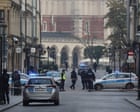
Reclassifying a localized shooting from an ordinary violent crime to a terrorism investigation alters the entire architecture of state power, judicial oversight, and national security response. When Polish prosecutors opened a formal terrorism investigation into the Kraków shooting, they triggered a specific set of statutory mechanisms under the Polish Penal Code and the Act on Anti-Terrorist Activities. Understanding this escalation requires separating the immediate kinetic event from the legal thresholds that govern counterterrorism prosecution in Central Europe.
Standard media coverage treats a terrorism designation as a rhetorical label applied to severe violence. In practice, it is a precise procedural switch. Under Article 115 § 20 of the Polish Penal Code, an act of a terrorist nature is defined not merely by the lethality of the weapon or the casualty count, but by the specific intent behind the act and its capacity to destabilize public order. By invoking this classification, the National Prosecutor’s Office (Prokuratura Krajowa) assumes jurisdiction from regional district prosecutors, unlocking extended pre-trial detention powers, specialized surveillance authorities, and cross-border intelligence-sharing protocols.
The Statutory Threshold for Terrorist Classification
To elevate a firearms offense to a terrorism investigation, prosecutors must establish a dual-pronged evidentiary foundation. The first prong is the objective gravity of the act—specifically, that the offense carries a maximum statutory penalty of at least five years of imprisonment. A shooting in an urban center like Kraków easily clears this baseline through charges related to attempted homicide, grievous bodily harm, or illegal possession and use of a firearm.
The second prong is subjective intent, which separates a standard criminal dispute from a national security threat. Polish law requires evidence that the perpetrator acted with one of three specific objectives:
- Intimidation of a large number of people. The violence must be designed to project fear beyond the immediate physical targets to the broader civilian population.
- Compulsion of a public authority. The act must aim to force a domestic government body, local administration, or international organization to perform or abstain from a specific action.
- Destabilization of foundational structures. The violence must seek to seriously disrupt the constitutional, political, economic, or social order of the state.
In the Kraków case, the transition to a terrorism inquiry indicates that preliminary forensic and digital evidence pointed toward at least one of these three intent markers. Because the specific evidentiary details remain sealed under prosecutorial secrecy (tajemnica śledztwa), analysts must distinguish between known procedural facts and investigative hypotheses. Known facts include the transfer of jurisdiction to specialized departments dealing with organized crime and terrorism, as well as the deployment of the Internal Security Agency (ABW). The primary working hypothesis in such transitions is the discovery of ideological manifestos, encrypted communications with foreign or domestic extremist networks, or target selection aimed at symbolic public infrastructure rather than personal vendettas.
Institutional Mechanics and Jurisdictional Transfer
When a shooting occurs in a major Polish municipality, the initial response follows a standard municipal policing model. Local police secure the perimeter, emergency services triage victims, and the regional prosecutor’s office initiates an inquest under standard criminal procedure. The pivot to a terrorism framework fundamentally alters this chain of command through three operational shifts.
The first shift involves prosecutorial centralization. Ordinary violent crimes are handled by local units (Prokuratura Rejonowa or Okręgowa). Once the terrorist intent threshold is met, the case moves to the Department for Organized Crime and Corruption within the National Prosecutor’s Office. These specialized units operate with direct liaison channels to national intelligence services and possess budgets designed for multi-jurisdictional forensic accounting and digital exploitation.
The second shift activates the operational mandate of the Internal Security Agency (Agencja Bezpieczeństwa Wewnętrznego, or ABW). Under the 2016 Act on Anti-Terrorist Activities, the Head of the ABW coordinates the analytical and operational response to terrorist threats. Unlike regular criminal investigators who build a case backward from the crime scene to secure a conviction, ABW operatives work forward to map network contagion. Their objective is to identify co-conspirators, logistical facilitators, weapons suppliers, and radicalization pipelines before secondary attacks can materialize.
The third shift alters the evidentiary rules and detention timelines available to the state. Standard criminal procedure imposes strict time limits on holding a suspect without formal charges and requires high judicial thresholds for intrusive surveillance. Under anti-terrorist statutes, authorities gain expanded latitude to conduct operational control—including wiretapping, metadata harvesting, and covert searches—against foreign nationals and domestic suspects linked to the investigation. Pre-trial detention periods can be extended more readily by courts when prosecutors demonstrate that releasing a suspect risks compromising ongoing intelligence operations or tampering with transnational networks.
Threat Vector Taxonomy in Urban European Environments
Analyzing the Kraków shooting within the broader European security environment requires categorizing the potential threat vectors that prompt a terrorism designation. Modern counterterrorism frameworks in Poland and the wider European Union classify urban firearms incidents across four distinct operational profiles.
- Ideologically Motivated Violent Extremism (IMVE): Perpetrators act on coherent political, religious, or ethno-nationalist doctrines. In Central Europe, this encompasses both far-right accelerationist networks and radicalized religious actors. These actors typically leave a digital footprint of ideological consumption prior to the kinetic event.
- State-Sponsored Sabotage and Proxy Operations: Given Poland’s geopolitical position bordering Ukraine, Belarus, and the Russian exclave of Kaliningrad, intelligence services maintain heightened vigilance against hybrid warfare tactics. Foreign intelligence services increasingly recruit local criminals or ideological sympathizers via encrypted messaging platforms to execute low-cost, high-visibility violent acts designed to sow domestic panic and strain state security resources.
- Fixated Persons and Grievance-Driven Actors: Individuals motivated by personal grievances, mental instability, or fame-seeking behavior who adopt the aesthetic and tactical playbook of terrorist organizations without formal organizational ties. Prosecutors frequently open terrorism investigations into these actors initially because their target selection—such as crowded public squares or transit hubs—mimics classic terrorist operational design.
- Transnational Organized Crime Spillover: While traditional organized crime avoids terrorism designations to prevent state crackdowns, certain high-level trafficking syndicates employ public, indiscriminate violence to intimidate state prosecutors or rival networks. If the violence targets judicial officials or public infrastructure, it crosses the statutory line into terroristic compulsion.
Determining which profile applies to the Kraków incident dictates the long-term strategic response. A lone actor driven by personal grievance requires domestic threat-assessment protocols and mental health intervention frameworks. Conversely, a state-sponsored proxy or an organized extremist cell necessitates diplomatic retaliation, border hardening, and counterintelligence sweeps.
The Forensic Bottleneck in Establishing Intent
The central challenge facing Polish prosecutors in the Kraków investigation is bridging the gap between physical evidence and psychological intent. Ballistics, DNA, and closed-circuit television footage establish the mechanics of the shooting—who fired the weapon, the trajectory of the rounds, and the sequence of events. None of these physical artifacts independently prove terrorist intent.
Establishing intent requires deep digital forensics and behavioral reconstruction. Investigators must extract and decrypt mobile devices, cloud storage accounts, and router logs to map the suspect’s information diet in the weeks preceding the attack. The forensic bottleneck occurs when perpetrators utilize end-to-end encrypted platforms, ephemeral messaging applications, or anonymous cryptocurrency transactions to acquire firearms.
If the suspect operated without leaving a clear manifesto or explicit communications declaring a political or intimidating objective, prosecutors face a strategic dilemma. Pursuing a terrorism conviction under Article 115 § 20 requires proving subjective intent beyond a reasonable doubt. If the evidentiary chain for intent is weak, defense attorneys can challenge the terrorism enhancement during trial, potentially undermining the prosecution's credibility even if the underlying firearms charges remain solid.
To mitigate this risk, Polish prosecutors utilize a tiered charging strategy. They secure immediate detention based on indisputable physical offenses—such as attempted murder and illegal weapons possession—while keeping the terrorism investigation active as a parallel track. This allows the ABW and cybercrime bureaus months to decrypt devices and collaborate with foreign intelligence partners, such as Europol or allied national agencies, to uncover hidden digital links.
Strategic Friction and Limitations of the Counterterrorism Framework
Invoking anti-terrorist statutes provides immediate operational advantages, yet it introduces specific systemic risks and limitations that security practitioners must manage.
First, there is the risk of resource misallocation. Terrorism investigations consume vast amounts of analytical bandwidth, specialized surveillance equipment, and high-level prosecutorial time. If an urban shooting ultimately proves to be an apolitical criminal dispute that merely resembled a terror attack in its initial chaos, the state incurs a high opportunity cost by diverting ABW assets away from genuine counterintelligence and espionage threats.
Second, public communication becomes constrained by operational security. Once a case is classified under national security protocols, official updates to the press and the public drop sharply. In an information environment saturated by social media, this official silence creates a vacuum. Disinformation networks and partisan commentators rapidly fill the void with unverified claims regarding the perpetrator's nationality, religion, or political affiliation. The state’s effort to protect the integrity of the investigation inadvertently fuels public anxiety and social polarization—achieving the very psychological destabilization that terrorist actors seek to produce.
Third, firearms proliferation dynamics in Central Europe complicate containment strategies. While Poland maintains some of the strictest civilian gun ownership laws in the European Union, the proximity to active conflict zones and established Balkan smuggling routes creates persistent vulnerabilities. Anti-terrorist investigations excel at mapping ideological networks, but they are less effective at disrupting decentralized, purely financial black-market weapons pipelines unless paired with sustained customs enforcement and cross-border policing.
Navigating the Geopolitical and Domestic Security Environment
The Kraków investigation unfolds against a backdrop of elevated regional security tension. Poland serves as the primary logistical hub for military and humanitarian aid entering Ukraine, making its domestic stability a high-value target for adversarial intelligence services. Consequently, Polish security institutions operate with a low threshold for escalating anomalous violent incidents to the national security level.
From an operational standpoint, this hair-trigger posture is a rational adaptation to hybrid threat environments. Treating an ambiguous public shooting as a potential act of terrorism ensures that intelligence agencies immediately preserve perishable digital evidence, monitor border crossings for fleeing accomplices, and alert allied security services. Waiting weeks for conventional police investigations to uncover a foreign intelligence link or an extremist manifesto would allow critical operational trails to go cold.
However, institutional vigilance must be balanced against judicial precision. As the investigation progresses, the National Prosecutor’s Office must rigorously test its working hypotheses against the empirical evidence gathered from forensic exploitation. If the digital and financial records confirm ideological motivation, public intimidation, or foreign direction, the state must prosecute the case to the fullest extent of Article 115 § 20 to establish clear deterrence. Conversely, if the evidence points toward an isolated criminal act devoid of broader political or destabilizing intent, prosecutors must formally downgrade the classification and return the case to standard criminal courts. Maintaining strict adherence to the statutory definition of terrorism preserves the legal integrity of Poland's counterterrorism architecture and ensures that extraordinary state powers remain reserved for genuine threats to national security.