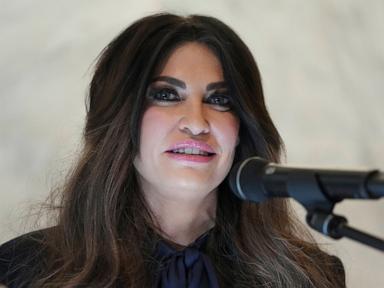
When Kimberly Guilfoyle exited her post as the United States Ambassador to Greece following an abrupt White House demand for her resignation, the diplomatic corps in Washington and Athens experienced a rare moment of synchronized quiet. Her brief tenure ended under a cloud of financial and operational misconduct allegations, transforming what was meant to be a cushy diplomatic reward into an unmitigated public relations disaster for the administration. Behind the sanitized statements issued by White House Press Secretary Katie Zacharia lies a cautionary tale about the hazards of treating strategic foreign postings as patronage prizes for loyalists who lack any foundational grasp of statecraft.
The friction began months before the final ouster. Appointed by Donald Trump and confirmed by a polarized Senate, Guilfoyle arrived in Athens not with a portfolio of geopolitical objectives, but with an expectation that the office would function as an extension of her domestic social cachet. Investigative reporting by outlets such as The Wall Street Journal revealed an ambassador more preoccupied with securing luxury travel funded by local tycoons and venting over exclusion from high-profile economic forums than managing critical security and economic alliances in the Eastern Mediterranean.
Diplomacy is an exercise in quiet restraint, delicate signaling, and institutional continuity. Guilfoyle operated in an entirely different register. Reports surfaced detailing how she allegedly sought financial assistance from a political donor to cover personal credit card bills, blurring the line between public service and private extraction in a manner that alarmed career State Department officials. When an ambassador leans on local financiers for personal liquidity, the host government notices. Foreign ministries interpret these maneuvers not as eccentric personal behavior, but as a direct pipeline of vulnerability.
The structural rot within the Athens embassy became impossible for Washington to ignore as Secretary of State Marco Rubio found himself visibly agitated during a visit to the region, snapping at journalists who dared ask about the mounting scandals. Rubio’s defensive posture on the tarmac underscored a deeper institutional panic. The embassy was effectively paralyzed, functioning without coherent leadership while local media lampooned the mission as a headless entity.
What makes the Guilfoyle episode significant beyond tabloid politics is how it exposes the mechanics of modern political patronage. Ambassadorships have historically served as landing pads for major campaign donors or political allies. Yet, successful political appointees typically rely on seasoned career diplomats to run the machinery of the mission while they handle ceremonial representation. Guilfoyle’s tenure inverted this dynamic. By utilizing unofficial gatekeepers and alienating the professional foreign service cadre, she created a leadership vacuum that invited external scrutiny and internal sabotage.
The administration’s swift cut-off of Guilfoyle was less an ethical awakening than a calculated triage operation. With midterm elections looming and congressional Democrats demanding formal investigations into the alleged pay-to-play schemes, the White House chose containment over defense. Trump himself distanced the executive office from the fallout, telling reporters on the South Lawn that he did not like what he read.
Guilfoyle has vowed to vigorously defend herself against the allegations, framing the pressure to resign as an unfair smear campaign. Yet her defense runs headfirst into a paper trail of financial entanglements and bruised alliances that foreign service professionals spend decades learning to avoid.
The post in Athens remains temporarily managed by a chargé d'affaires, a quiet reminder of the wreckage left behind when loyalty is valued above competence. The diplomatic corps has returned to its routines, but the episode leaves a permanent stain on the ledger of political appointments.
The damage to America's standing in a strategically vital NATO ally will take far longer to repair than it took to dismantle.