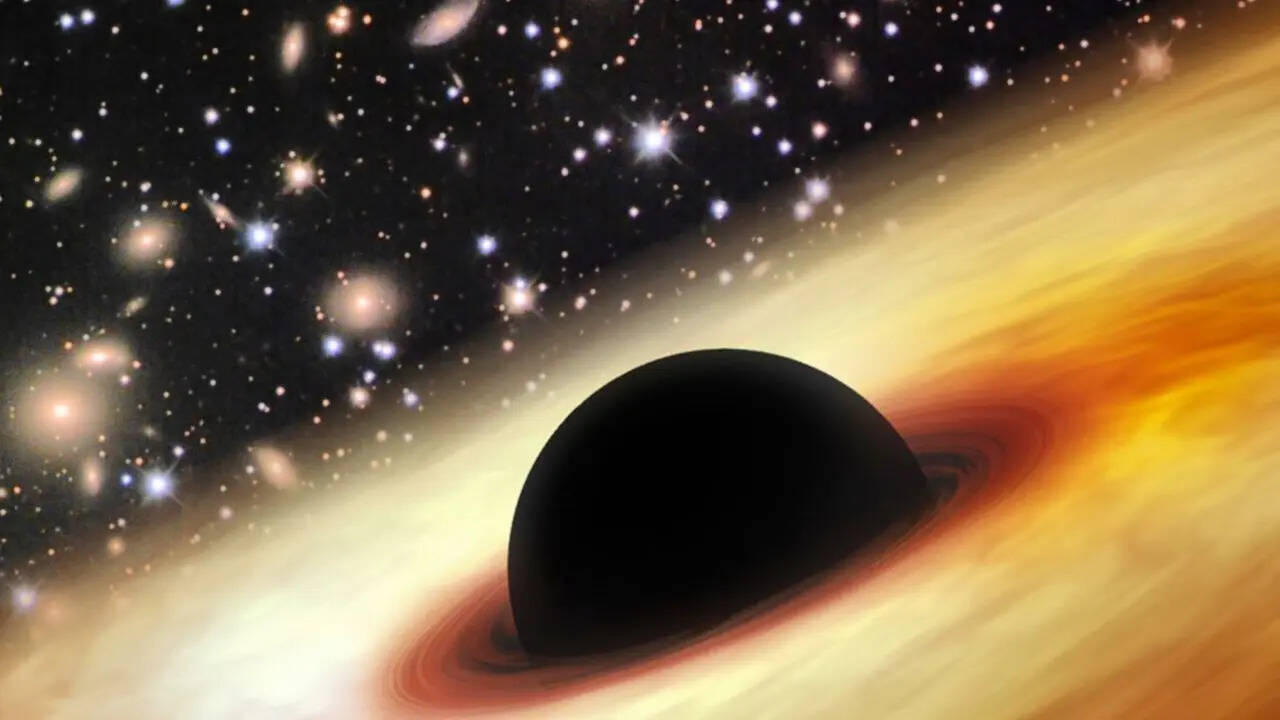
Astrophysics has a bad habit of inventing ghosts to explain shadows. For decades, the "standard model" of early universe cosmology has been tripping over its own feet trying to explain how supermassive black holes (SMBHs) grew to billions of solar masses by the time the universe was a mere 600 million years old. The lazy consensus? The Direct Collapse Black Hole (DCBH) theory.
The industry is obsessed with this idea that giant clouds of gas "skipped" the star phase to collapse directly into massive seeds. It’s a convenient narrative. It’s also likely wrong, or at the very least, a desperate patch for a leaking boat. We are looking at a classic case of theorists moving the goalposts because they can't handle the sheer efficiency of gravity.
The Myth of the Impossible Growth Rate
The current panic stems from the Eddington Limit. In standard theory, there is a maximum rate at which a black hole can consume matter. As gas falls in, it heats up and radiates light. Eventually, that radiation pressure pushes back against the incoming gas, creating a stalemate.
$$F_{rad} = \frac{\sigma_T L}{4\pi r^2 c}$$
The math says you can't grow a tiny "stellar-seed" black hole into a monster fast enough to satisfy the observations from the James Webb Space Telescope (JWST). So, theorists invented the "heavy seed"—the idea that nature cheated and started with a 100,000-solar-mass black hole right out of the gate.
But here is the nuance the popular science rags miss: the Eddington Limit assumes a spherical, steady-state environment. The early universe was anything but steady. It was a chaotic, high-density mosh pit. By clinging to the DCBH theory, we are ignoring the more terrifying and elegant reality: Super-Eddington accretion.
Why Direct Collapse is a Theoretical Crutch
To get a DCBH, you need "pristine" conditions that almost never happen. You need a massive halo of gas, and you need to prevent that gas from cooling and fragmenting into stars. To do that, theorists invoke massive doses of ultraviolet radiation from nearby galaxies to "sterilize" the gas.
I’ve seen this play out in simulation after simulation. You have to fine-tune the parameters so perfectly that the DCBH becomes a statistical anomaly. If your theory requires the universe to be a perfectly sterile laboratory to function, your theory is brittle.
We don't need "heavy seeds" if we stop treating the Eddington Limit as a physical law and start treating it as a polite suggestion. In dense, gas-rich environments, photon trapping allows matter to bury the radiation. The heat stays inside. The black hole gorges itself at five, ten, or a hundred times the "limit."
The Baryon Problem Nobody Talks About
While the media fawns over "dark stars" and "direct collapse," they ignore the actual plumbing of the universe: Baryonic feedback.
When stars form, they explode. Supernovae clear out the gas that black holes need to eat. The "standard" view says this should stop black holes from growing. But they aren't accounting for the sheer scale of the inflow. In the early universe, the "cold streams" of gas flowing along cosmic filaments were so massive they didn't care about a few puny supernovae.
We are looking at a system of extreme supply. The bottleneck isn't the seed size; it's the delivery mechanism. If you provide enough fuel, even a small seed becomes a titan. We’ve spent twenty years trying to find a "secret" origin story for SMBHs when the answer is staring us in the face: they are just better at eating than our current math allows.
The JWST Reality Check
The James Webb Space Telescope isn't confirming the DCBH theory; it’s exposing our lack of imagination. We are seeing "Little Red Dots"—high-redshift objects that are far more massive than they have any right to be.
The immediate reaction from the academic establishment is to scream "Direct Collapse!" because it’s the only tool they have left. But look at the data. These objects are often found in environments where "sterilizing" UV radiation is absent. The conditions for DCBH simply aren't there.
We are likely witnessing the result of Runaway Stellar Collisions. Imagine a star cluster so dense that the stars themselves begin to merge. You don't need a gas cloud to collapse; you need a hundred giant stars to smash into each other in a gravitational mosh pit. This creates a "intermediate" seed that bypasses the fragility of the DCBH model while remaining grounded in observable physics.
The Danger of Intellectual Comfort
The danger in the "Direct Collapse" narrative is that it halts actual inquiry. If we accept that black holes just "start big," we stop looking at the fluid dynamics of the early universe. We stop questioning the Eddington Limit. We stop looking for the "gap" between stellar-mass black holes and supermassive ones.
I’ve watched researchers burn through millions in grant money trying to simulate the "perfect" DCBH environment. It’s a waste of silicon. The universe is messy. It’s violent. It’s inefficient.
Stop Asking How They Started
The question "How did they get so big so fast?" is a flawed premise. It assumes our understanding of time and accretion in the early universe is complete. It isn't.
We are currently seeing black holes that exist at $z > 10$. At those distances, the very concept of "stable growth" is a myth. We are seeing a period of cosmic history where the density of the universe was high enough that the distinction between a "galaxy" and a "black hole fuel tank" was nonexistent.
If you want to understand the first supermassive black holes, stop looking for a "secret" mechanism. Stop looking for a shortcut. The "secret" is that gravity is more relentless than your models. The seeds didn't need to be huge; the universe just needed to be crowded.
The industry wants a clean, "A leads to B" explanation because it makes for a great headline. But the reality is a chaotic, super-Eddington feeding frenzy that doesn't care about your theoretical limits.
The universe doesn't cheat. It just doesn't follow your rules.
Stop looking for the "first" black hole and start admitting that we don't understand the speed of gravity in a high-density environment. The DCBH is a ghost. The monster is the accretion disk itself.
Eat or be eaten. That’s the only law the early universe respected. No "direct collapse" required.