The air in Boston during the mid-nineties tasted like hot asphalt, diesel exhaust, and an ancient, churning anxiety. Above ground, the city was choking. Beneath it, men wearing rubber boots and hard hats were carving out a cavernous void, trying to rewrite the geography of a metropolis that had spent centuries backing itself into a corner.
They called it the Central Artery Tunnel Project, though everyone simply called it the Big Dig. For another look, see: this related article.
To live through those years was to navigate a daily obstacle course of orange cones, deafening jackhammers, and a pervasive, bone-deep suspicion that the project was swallowing the city whole. Every day, massive mechanical jaws scooped up millions of tons of earth, clay, and gravel. It was the physical weight of old Boston, churned up and brought to the light.
And then, it had to go somewhere. Similar analysis on this matter has been shared by NBC News.
You cannot simply misplace forty million tons of dirt.
Consider the sheer scale of that logistical nightmare for a moment. Imagine standing at the edge of a subterranean excavation site, watching dump truck after dump truck rumble away into the gray dawn. Each vehicle carried a fragment of the city's underbelly. Some of it was contaminated by decades of industrial runoff, heavy metals, and the silent detritus of urban expansion. Others were just stubborn New England clay, holding fast to the bedrock.
Engineers faced a stark, unyielding reality. The city was already cramped, crowded, and suspicious. Local landfills were screaming for mercy. Dumping it all into the Atlantic Ocean was environmentally unthinkable.
So, they looked to Spectacle Island.
For generations, Spectacle Island had been Boston's dirty little secret. Located in Boston Harbor, it was a place where things went to die. Throughout the nineteenth and twentieth centuries, the island had hosted grease-recovery plants, horse-rendering facilities, and, most infamously, a municipal dump that had burned uncontrollably for years. Plumes of acrid, toxic smoke frequently drifted across the harbor, a daily reminder of a city failing to deal with its own waste. By the 1930s, the island was abandoned, smoldering, and toxic. It was a wasteland. A scar in the middle of a stunning natural harbor.
Until the Big Dig needed a dumping ground.
This is where the story shifts from bureaucratic machinery to something remarkably human. The engineers and planners realized they had a dual crisis. They had an ocean of unwanted dirt from the tunnel excavations, and they had a ruined, toxic island sitting in the middle of the harbor like a floating open wound.
Solution met problem. But it required an act of staggering engineering ambition.
Before a single pound of Big Dig soil could touch Spectacle Island, the smoldering fires beneath the surface had to be extinguished. Workers pumped water deep into the earth, capping the subterranean blazes that had burned for decades. Then came the liners, thick layers of impermeable clay, and millions of tons of protective material.
And then the dirt arrived.
Barges laden with the gray, heavy earth of Boston's underground hauled their loads across the choppy harbor waters day after day. Picture a procession of flat-topped vessels cutting through the fog, carrying the very foundations of the city back out to sea. Crane operators, deckhands, and environmental scientists worked in shifts, orchestrating a silent ballet of restoration. They buried the poison beneath feet of clean, compacted earth. They sculpted the landscape.
They built hills.
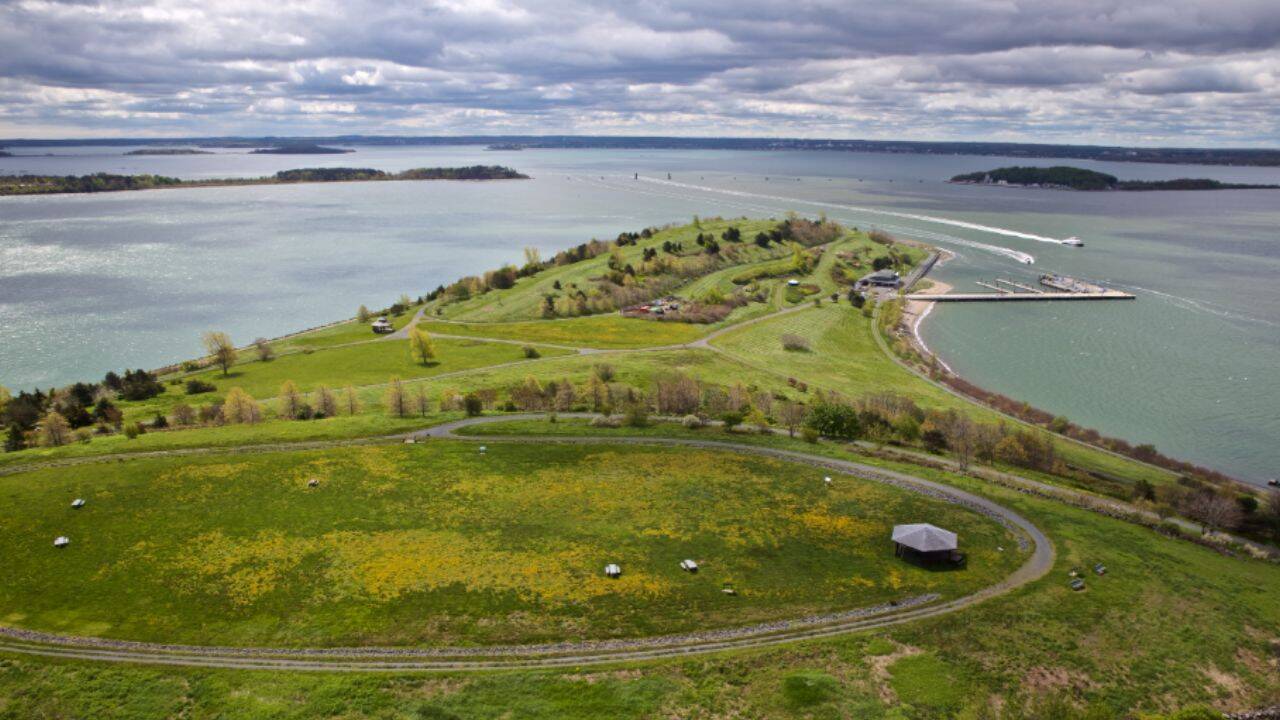
Where jagged refuse and toxic ash once sat, gentle slopes began to rise. Landscape architects mapped out green meadows, walking trails, and a sandy beach. They planted thousands of trees and shrubs, trusting that roots would take hold in soil that had once been rejected by the mainland.
Today, if you take a ferry out to Spectacle Island, you will find it hard to believe what lies beneath your feet.
The air smells of salt water, sea grass, and wild roses. Families spread checkered blankets on manicured lawns where smoke once choked the sky. Hikers climb to the crest of the island's highest drumlin, catching a panoramic view of the Boston skyline—the very skyline made possible by the tunnels carved out below, and the dirt that now anchors this sanctuary above.
It is a strange, poetic symmetry. The earth that was ripped from the belly of the city to ease its traffic congestion became the foundation for its most peaceful retreat.
We spend so much of our lives hiding our scars, burying our messes, and hoping the things we discard will simply vanish into the ether. Boston tried that for a century on an island of trash. But true redemption, it turns out, requires us to look the mess in the eye, haul it across the water, and rebuild it into something better.
The heavy trucks are long gone. The jackhammers have finally fallen silent. The harbor water laps quietly against a shore that was once a burning dump, now holding up the weight of trees, grass, and sky.
:max_bytes(150000):strip_icc()/ar-American-Cheese-taste-test-horizon-4x3-54cc339550cd44b9a818c17bdfd5428d.jpg)