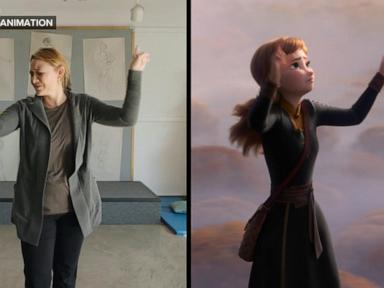
Disney+ just changed how we experience the classics. For years, the Deaf and hard-of-hearing community relied on captions that often missed the rhythm, the soul, and the emotional punch of a powerhouse ballad. That's over. The streaming giant is launching a series of "Songs in Sign Language" videos, featuring professional Deaf performers who don't just translate words—they translate the vibe.
If you think this is just about subtitles on screen, you're wrong. Sign language is a visual, spatial, and physical language. It’s got its own grammar. It’s got its own poetry. When you watch a song like "We Don't Talk About Bruno" or "Part of Your World" performed in American Sign Language (ASL), you aren't just seeing the lyrics. You're seeing the character’s internal struggle, their joy, and the beat of the music reflected in every movement. This is a massive win for inclusion, but honestly, it’s also just a fascinating new way to watch your favorite movies.
Why sign language versions matter more than captions
Captions are fine for dialogue. They tell you what's being said. But music is a different beast. Standard closed captioning usually looks like "[upbeat music playing]" or "[singing continues]." That’s lazy. It tells a viewer that something is happening without letting them feel it.
Sign language performers, often called ASL interpreters or Deaf performers, use their entire bodies to convey tone. A sharp, quick sign indicates a staccato beat. A flowing, wide movement shows a melodic swell. For a kid who grew up in a world where Disney magic felt a little quiet, seeing a character’s anthem performed in their primary language is life-changing.
Disney didn't just hire random actors for this. They worked with actual experts in the Deaf community. These performers spend weeks studying the source material. They have to decide how to sign "A Whole New World" in a way that feels like flying. It’s an art form. It’s not just "word-for-sign" translation. It’s a cultural adaptation.
The technical side of the Disney sign language collection
You might wonder how this actually looks on your TV. Usually, these videos appear as separate shorts or as a picture-in-picture option. Disney is leaning toward high-quality, standalone performances where the signer is front and center. You see the movie footage, but the performer is the star.
Which songs made the cut
Disney started with the heavy hitters. You can expect to see the biggest hits from the "Renaissance era" and the modern blockbusters.
- Frozen: "Let It Go" is an obvious choice because it’s so expressive.
- The Little Mermaid: "Part of Your World" allows for beautiful, fluid signing that mimics being underwater.
- Moana: "How Far I'll Go" captures the yearning and the call of the ocean through sweeping gestures.
- Encanto: "Waiting on a Miracle" and "We Don't Talk About Bruno" offer complex, fast-paced challenges for signers.
This isn't a one-off gimmick. It’s part of a broader push to make the Disney+ library actually usable for everyone. They’ve been under pressure for a while to improve accessibility, and this is a loud, proud response to those critiques.
The performers behind the magic
We need to talk about the talent here. Often, these performers are Deaf artists who have been advocating for this kind of visibility for decades. They aren't just "helpers." They are creators.
Think back to the viral videos of ASL interpreters at concerts like Rihanna’s Super Bowl show or Waka Flocka Flame sets. People loved them because the energy was infectious. Disney is tapping into that same energy. They're giving these artists a global stage. This helps hearing audiences realize that sign language isn't just a tool for the "disabled"—it's a vibrant, beautiful language that adds depth to the performance.
I’ve seen some critics ask why they don't just use AI to generate sign language avatars. That would be a disaster. Current AI lacks the facial nuance and emotional timing required for music. A computer can’t feel the heartbreak in a "Beauty and the Beast" song. A human can. Disney chose humans, and that was the right call.
Better accessibility leads to better storytelling
When a company like Disney invests in ASL, it forces them to think about their stories differently. It makes the world bigger. It acknowledges that "the Disney experience" isn't one-size-fits-all.
This move also educates hearing children. When a kid sees a sign language version of their favorite song, they start asking questions. They learn about different ways of communicating. It normalizes a world where everyone is invited to the party. That's the real power of the "Songs in Sign Language" series. It’s education disguised as entertainment.
How to find these videos on Disney+
Finding them isn't always intuitive if you aren't looking for them. Usually, they’re tucked away in the "Extras" tab of a specific movie or listed under a special "Accessibility" or "Sign Language" collection on the home screen.
If you haven't checked them out yet, do it. Even if you don't know a single sign, the performances are captivating. You'll notice details in the music you never heard because the performers are highlighting them with their hands.
Go into your Disney+ app right now. Search for "Sign Language." Watch "Let It Go" or "Under the Sea." Pay attention to the facial expressions. Notice how the performer uses the space around them to build the world of the song. It’s a masterclass in performance art. If you have kids, sit them down and watch together. It’s a great way to start a conversation about how different people see and hear the world. Don't just settle for the standard version when there’s a much more expressive one available.