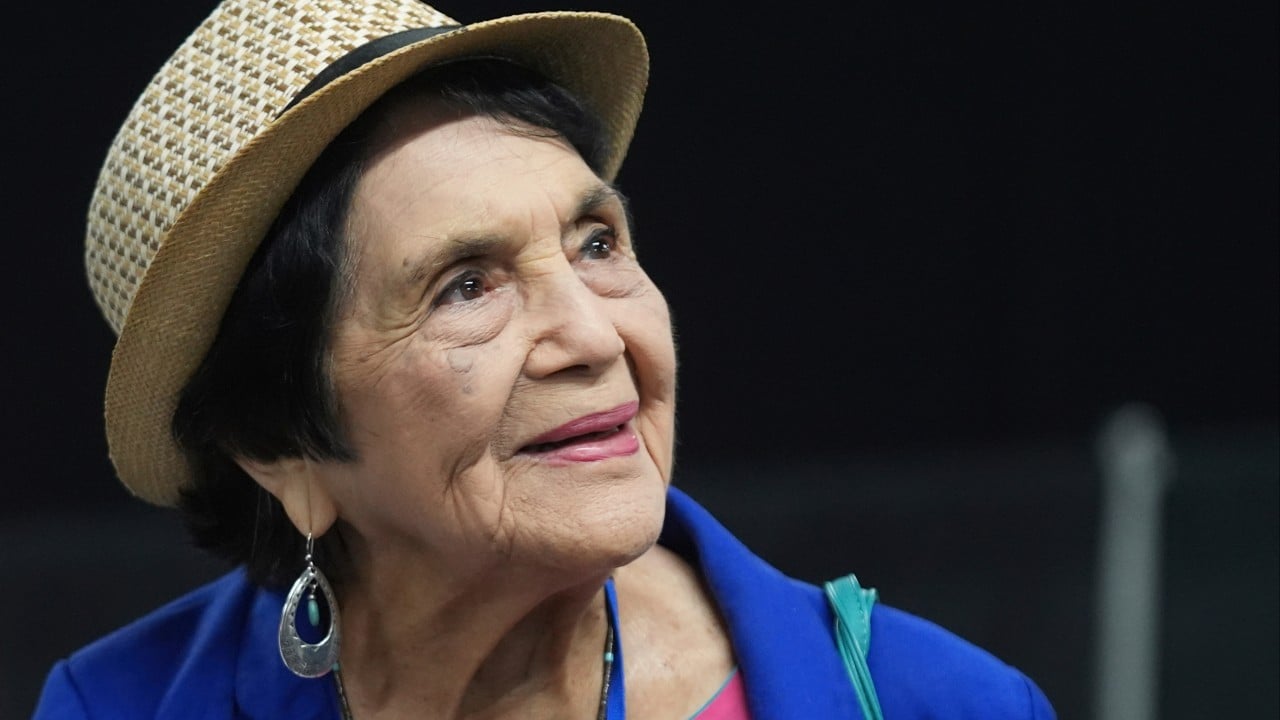
Dolores Huerta, the fiery co-founder of the United Farm Workers and the strategist who turned agricultural boycotts into a national moral reckoning, has died at the age of 96. While the obituaries will inevitably soften her edges into a neat, comforting myth of peaceful protest, the reality of her life was far sharper, bloodier, and more complicated. She did not just ask for a seat at the table. She starved California's agribusiness giants of cash until they had no choice but to pull up a chair.
Born Dolores Clara Fernandez on April 10, 1930, in the mining town of Dawson, New Mexico, Huerta learned early how power operates in America. Her father, Juan Fernandez, was a miner and migrant worker who eventually won a seat in the New Mexico state legislature. Her mother, Alicia Chavez, ran a 70-room hotel in Stockton, California, after divorcing Juan, frequently waiving rent for impoverished farmworker families during the Great Depression. That dual inheritance—institutional politics from her father and fierce, practical solidarity from her mother—forged the exact blueprint Huerta would use for the next seven decades.
Most people know the slogan. Sí, se puede. Yes, it can be done. Huerta coined those three words in 1972 during a chaotic organizing drive in Phoenix, Arizona, when local politicians insisted that farmworkers could never be organized in a right-to-work state. Barack Obama later borrowed the English translation for his 2008 presidential campaign, stripping it of its radical roots and turning it into a shiny piece of electoral branding. For Huerta, it was never a campaign jingle. It was a survival mechanism used in dusty union halls where workers were routinely beaten by company thugs and arrested by compliant local sheriffs.
The Architect Behind the Myth
History loves a single, charismatic male figurehead, which is why Cesar Chavez became the saintly face of the farmworker movement while Huerta remained the tactical engine working in the shadows. The division of labor between them was stark. Chavez fasted, marched, and embodied the spiritual weight of the cause. Huerta drafted the contracts, ran the boycotts, lobbied cynical politicians in Sacramento and Washington, and stared down agribusiness attorneys across the bargaining table.
Growers hated negotiating with her. They expected a deferential woman they could patronize or intimidate. Instead, they got a relentless tactician who knew every inch of California labor law and refused to blink when threatened with bankruptcy or violence. During the historic 1965 Delano grape strike, it was Huerta who recognized that walking off the fields was not enough. Replacement workers could always be bused in from across the border. To break the growers, the union had to sever their supply chain at the point of sale.
She moved to New York City to direct the East Coast grape boycott, turning suburban grocery shoppers into front-line labor militants. By 1970, millions of Americans were refusing to buy California table grapes. Retail chains panicked. Growers lost millions of dollars in rotting inventory, forcing them to sign the first collective bargaining agreements in the history of American agriculture.
The Heavy Cost of Constant Motion
There is a sanitized version of activism that pretends you can change the world while maintaining a balanced, idyllic personal life. Huerta never pretended. She was married twice, divorced twice, and raised eleven children while living on a union stipend of five dollars a week plus food and housing expenses.
Her children grew up in union offices, on picket lines, and in the homes of sympathetic volunteers while their mother traveled constantly. Some of her children later spoke candidly about the emotional toll of sharing their mother with an entire social movement. Critics on the right used her messy personal life to attack her credibility, accusing her of neglecting her maternal duties. Even within the movement, macho traditionalists bristled at taking orders from a divorced mother of eleven who refused to stay in the kitchen.
Huerta absorbed the criticism without apology. She understood a brutal truth that modern corporate feminism often ignores: systemic power does not yield to polite requests made between nine and five. Winning basic human dignity—like clean drinking water, portable toilets in the fields, and protection from toxic pesticides—required total, consuming obsession.
Violence in the Streets of San Francisco
The myth of nonviolence often obscures the extreme violence inflicted upon the people practicing it. In September 1988, at the age of 58, Huerta stood outside the St. Francis Hotel in San Francisco protesting the policies of then-Vice President George H.W. Bush. She was distributing leaflets on a public sidewalk when the San Francisco Police Department moved in to clear the crowd.
An officer named Frank Macochetti repeatedly struck Huerta in the torso with his baton. The beating was so severe that it shattered two of her ribs and ruptured her spleen. She underwent emergency surgery and nearly bled to death on the operating table. The city of San Francisco eventually paid out a massive settlement, and the police department was forced to overhaul its crowd-control policies, though Macochetti was never criminally prosecuted.
That night in San Francisco exposed the thin veneer of respectability surrounding civil rights icons. Even with decades of national prominence and direct access to the halls of power, Huerta remained a target the moment she stepped back onto the street to challenge the status quo. She returned to organizing as soon as she could walk without excruciating pain.
The Uncomfortable Truth About What Happened Next
To treat Huerta's death merely as a moment for nostalgic celebration is to ignore the sobering reality of the industry she fought to reform. In the 1970s, the United Farm Workers boasted roughly 80,000 members and wielded genuine political terror over California's agricultural empire. Today, union membership among American farmworkers hovers in the low single digits.
The decline was not solely the fault of ruthless growers or hostile Republican administrations, though both played massive roles. Internal fractures inside the UFW during the late 1970s and 1980s decimated the organization. Chavez grew increasingly paranoid, purging longtime organizers and shifting the union's focus away from field organizing toward insular, quasi-religious community living. Huerta remained loyal to Chavez until his death in 1993, a decision that alienated many of the movement's sharpest grassroots strategists.
Meanwhile, agribusiness adapted. Growers automated harvesting, relied heavily on the H-2A temporary agricultural worker visa program—which ties a worker's legal status directly to their employer, making unionization nearly impossible—and shifted production to countries with weaker labor protections.
The conditions Huerta fought against in 1965 have mutated rather than vanished. Farmworkers in California, Florida, and Washington still die from preventable heatstroke every summer. They still suffer disproportionately from pesticide-related cancers, and federal overtime protections remain a patchwork of state-by-state exceptions.
Beyond the Fields
After leaving her formal leadership role at the UFW, Huerta refused to retire into the comfortable speaking-circuit irrelevance that claims most aging activists. In 2002, using the prize money from the Puffin/Nation Prize for Creative Citizenship, she launched the Dolores Huerta Foundation.
She pivoted back to hyper-local, unglamorous community organizing in California's Central Valley—the deeply conservative, agricultural heartland where oil derricks sit beside almond orchards. Her foundation trained working-class residents to run for local school boards, water districts, and city councils. She recognized that national headlines mean nothing if the local water board is controlled by agricultural interests that refuse to clean up nitrate-contaminated tap water in poor neighborhoods.
Up into her nineties, Huerta was still walking precincts, knocking on doors in 100-degree heat, and barking orders at young organizers who struggled to keep up with her pace. When President Barack Obama awarded her the Presidential Medal of Freedom in 2012, he noted that she had been arrested 22 times for peaceful civil disobedience. She wore those arrests like campaign medals, proof that she had never traded her principles for institutional approval.
Dolores Huerta proved that a single, relentless organizer without money, institutional backing, or formal authority could bring a multi-billion-dollar industry to its knees. She leaves behind a blueprint that is sitting on the table, waiting for anyone with the nerve to pick it up and start knocking on doors.