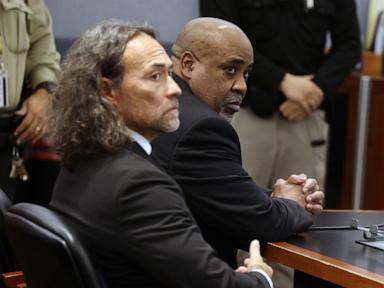
For nearly thirty years, the murder of Tupac Shakur felt like an open wound that would never heal. Theories ranged from absurd internet rabbit holes to elaborate federal cover-ups. Everyone had a guess, but nobody faced a courtroom. That changed when Duane "Keffe D" Davis was convicted of first-degree murder for orchestrating the legendary rapper's 1996 killing and subsequently sentenced to 40 years to life in prison.
If you followed the headlines, you probably wondered how prosecutors finally secured a conviction decades after the fact. The answer isn't a miraculous new forensic breakthrough or a sudden change of heart from eyewitnesses. It's much simpler and much more avoidable: the defendant spent years talking too much.
How a Memoir and Police Interviews Sealed Keffe D's Fate
Most criminal cases rely on physical evidence like DNA, ballistic matches, or pristine security footage. This case didn't have those luxuries. The shooting happened on a Las Vegas strip corner on September 7, 1996, back when dashcams were rare and high-definition street cameras didn't exist.
Instead, the state's case was built almost entirely on Duane Davis's own admissions. For years, Keffe D treated his role in the drive-by shooting like a badge of honor. He talked to police under proffer agreements, gave interviews to true-crime documentary crews, and laid out the entire plot in his 2019 memoir, Compton Street Legend.
Chief Deputy District Attorney Binu Palal made it clear during the trial that Davis didn't need to pull the trigger to be guilty. Under Nevada law, an organizer or accomplice who provides the weapon and orchestrates the plan carries the same legal weight as the shooter. Prosecutors walked the jury through how Davis acquired a Glock .40 caliber handgun, handed it to the back seat of a white Cadillac, and directed the vehicle to hunt down Shakur after an earlier casino brawl.
When Davis's defense attorney, Michael Sanft, argued that his client was just a professional storyteller spinning tall tales to make money and court fame, the jury didn't buy it. Jurors deliberated for less than three hours before returning a guilty verdict. You can't spend a decade bragging about coordinating a murder on camera and then expect a jury to write it off as fiction.
The Trigger Behind the Tragedy
To understand why Keffe D orchestrated the hit, you have to look at the hours leading up to the shooting inside the MGM Grand in Las Vegas. Earlier that evening, Tupac Shakur and members of Death Row Records confronted Orlando "Baby Lane" Anderson—Davis's nephew—near a casino elevator bank. Anderson was a member of the South Side Compton Crips, a gang locked in a brutal rivalry with factions connected to Death Row.
The beatdown of Anderson in the lobby bruised more than just his ego; it struck at gang politics. Keffe D viewed the assault as an intolerable disrespect that demanded immediate retaliation. Witnesses testified about the frantic scramble that followed. Davis sourced a firearm, rounded up associates, and tracked down the black BMW carrying Shakur and Suge Knight.
When the white Cadillac pulled up alongside Shakur's car at a red light, the shots fired from the back seat ended one of music's brightest lights and set off decades of cultural fallout. Anderson, the man widely believed to have fired the fatal shots, was killed in an unrelated gang shooting in Compton two years later, leaving Davis as the sole surviving adult from inside that car.
Why the Trial Took Decades to Happen
People often ask why law enforcement took nearly thirty years to bring charges if Keffe D had been talking for so long. The delay comes down to legal technicalities and police strategy. For years, statements Davis made to police were protected under immunity deals meant to help investigators gather intelligence rather than prosecute him directly.
However, immunity has expiration dates and specific rules. Once Davis started broadcasting his story publicly on podcasts, in documentaries, and via his self-published book, those protections dissolved. He effectively waived his own shield by turning his alleged crime into commercial media.
The Las Vegas Metropolitan Police Department finally pulled the trigger on a grand jury indictment, leading to his dramatic arrest outside his suburban Las Vegas home. The subsequent trial featured testimony from retired police officers, forensic pathologists, and eyewitnesses who lived through the chaos of 1990s hip-hop history. Despite defense claims that the investigation was sloppy and biased, the mountain of recorded admissions proved insurmountable.
At sentencing, Judge Carli Kierny handed down a term of 40 years to life, ensuring that the man who set the machinery of death in motion will likely spend the remainder of his days behind bars. Defence teams have indicated plans to appeal based on the lack of direct physical evidence, but legal analysts agree that overturning a conviction built on a defendant's own admissions is an uphill battle.
The chapter on the legal accountability of Tupac Shakur's murder is finally closed, proving that while secrets can last for decades, ego has a habit of catching up in the end.