The heat in Toubab Dialaw does not just sit on your skin; it breathes with you. Fifty kilometers south of Dakar, the Atlantic Ocean crashes against red cliffs with a rhythmic violence that feels like a heartbeat. Ordinarily, this is a quiet fishing village where the salt air bleaches the wood of the pirogues and the midday sun forces everyone into the long shadows of baobab trees. But once a year, the silence is broken. The air thickens with the scent of roasted maafe and the metallic tang of sweat.
The ground begins to tremble. It is not an earthquake. It is the rhythmic thud of a thousand feet striking the earth in unison. This is the Rythmes et Formes du Monde, one of the most significant dance festivals in Africa, yet calling it a "festival" feels too clinical. It is a reclamation.
The Architect of the Motion
Think of Germaine Acogny. She is often called the "Mother of Contemporary African Dance," but she moves with the agility of someone who has cheated time. Years ago, she looked at these jagged cliffs and saw a stage. She founded l’École des Sables—the School of Sands. It is exactly what it sounds like: a sprawling sanctuary where the floor is not polished mahogany or sprung linoleum, but the fine, unforgiving grit of the Senegalese earth.
To understand why dancers from every corner of the globe flock to this village, you have to understand the sand. If you dance on a hard floor, you can faking your balance. You can rely on the friction of your shoes. In the sand, there is no lying. If your center is weak, the earth swallows your ankles. If your movement is timid, you disappear in a cloud of dust.
To dance here is to negotiate with the planet itself.
The Village is the Stage
During the festival, the borders between performer and spectator dissolve. There is no velvet curtain. There are no ushers. Instead, there is a "Sabbar"—a traditional Senegalese drum circle that acts as the village’s collective nervous system.
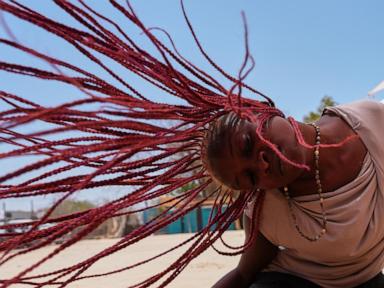
Imagine a young man named Moussa. He is hypothetical, but he represents a dozen faces you see in the crowd. Moussa has spent his morning hauling nets from the sea. His hands are calloused, and his shoulders ache from the weight of the Atlantic. But when the djembe players begin their rapid-fire assault on the afternoon heat, Moussa isn't a fisherman anymore. He is a conduit. He joins the circle, his movements a blur of Sabar dance—high knees, explosive leaps, and a frantic, joyous energy that seems to defy the laws of biology.
The professional dancers from Europe, Asia, and America stand on the sidelines, watching with wide eyes. They have spent years in studios with mirrors and barres, perfecting the geometry of their limbs. Yet, in Toubab Dialaw, they realize they are missing something fundamental. They have the form, but the village has the rhythm.
A Language Without a Dictionary
The festival serves as a massive, sweating laboratory for human connection. In a world that feels increasingly fractured by digital screens and linguistic barriers, the language spoken in the red dust of Senegal requires no translation.
Consider the technical reality of what happens during these performances. The dancers often engage in "mbalax," a genre that blends traditional griot percussion with modern jazz and soul influences. The polyrhythms are staggering. While a Western ear might struggle to find the "one" in a measure, the local children—some no older than five—clap along with a precision that would put a metronome to shame.
It is a sophisticated mathematical exchange disguised as a party.
The stakes are higher than they appear. Senegal is a country where tradition and modernity are in a constant, sometimes uncomfortable, embrace. For the youth of Toubab Dialaw, the festival is a reminder that their culture isn't a museum piece. It is a living, breathing asset. It is "soft power" in its purest form. When a choreographer from New York spends a month in the village learning how to ground their weight like a Senegalese wrestler, the global hierarchy of art shifts just a little bit.
The Ghost in the Movement
As the sun begins to dip below the horizon, painting the cliffs in shades of bruised purple and burning orange, the energy changes. The "Contemporary" part of the festival takes over. This isn't just about tradition; it’s about the future.
Performers use their bodies to tell stories of migration, of the climate crisis affecting the very coast they stand on, and of the enduring ghost of colonialism. One dancer moves slowly, his body coated in white clay, mimicking the agonizing crawl of a soul trying to cross a border. The crowd goes silent. The only sound is the wind whistling through the dry grass and the distant, eternal roar of the surf.
In this moment, the festival stops being "entertainment." It becomes a protest. It becomes a prayer.
You realize then that the "color" people talk about when they describe Senegal isn't just the vibrant wax-print fabrics or the painted buses. It is the color of the human spirit pushed to its absolute limit. It is the audacity to dance in a place where life is hard, where the sun is fierce, and where the water is rising.
The Dust Never Truly Settles
By the time the final drum beat echoes out over the Atlantic, the village is transformed. The dancers will pack their bags and head back to Paris, Tokyo, or New York, carrying the grit of Toubab Dialaw in the treads of their shoes. They will find themselves in a sterile studio weeks later, and they will realize that their movement has changed. It is heavier. More honest.
Back in the village, the fishermen return to their boats. The red dust settles back onto the leaves of the bougainvillea. But the vibration remains.
If you ever find yourself on those cliffs, don't look for a grand stadium or a ticket booth. Just listen. Follow the sound of the wood hitting the skin of a drum. Look for the spot where the dust is rising in a golden halo against the sun.
There, you will find the truth. We don't dance to escape the world. We dance to remind the world that we are still here, our feet firmly planted in the sand, refusing to be moved.