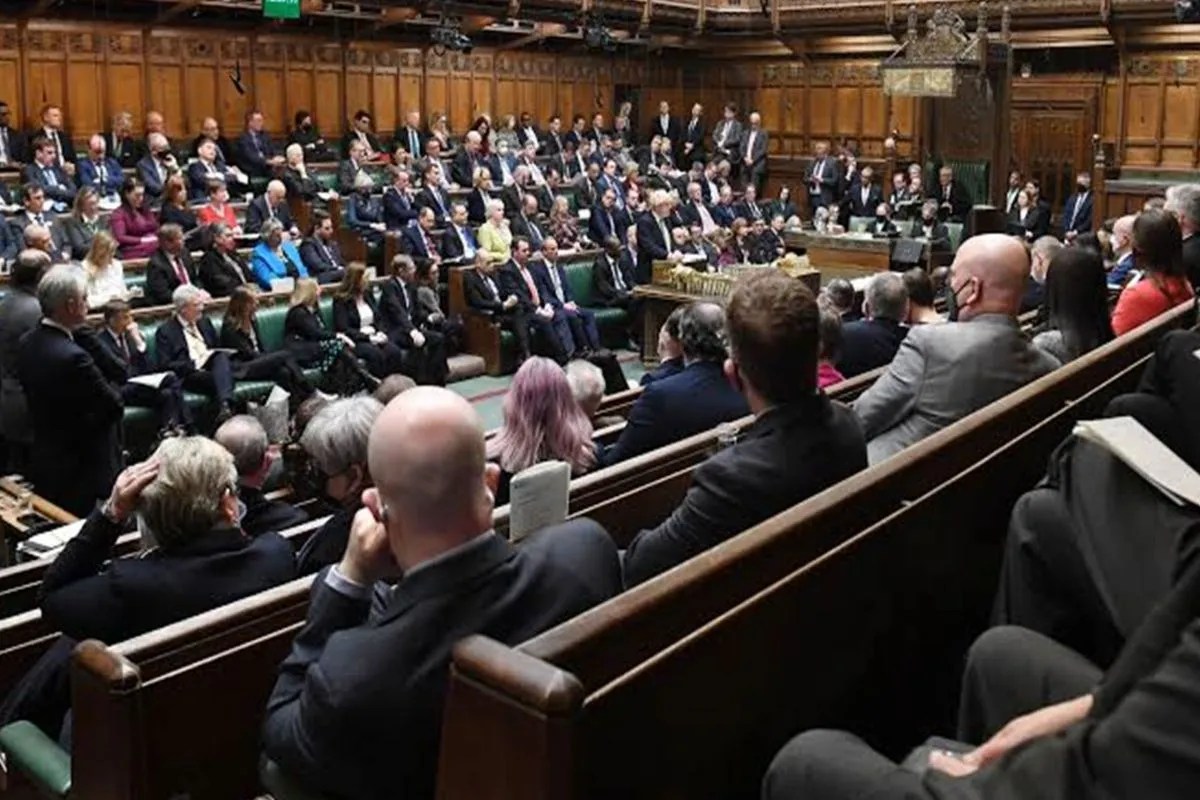
Headline-driven coverage of a UK House of Commons Early Day Motion (EDM) ahead of Jammu and Kashmir Accession Day (October 26) almost always mistakes parliamentary visibility for executive policy. When an EDM highlights the October 26, 1947 Instrument of Accession signed by Maharaja Hari Singh and reaffirms India's sovereignty and territorial integrity over Jammu and Kashmir, domestic outlets frequently frame the event as a decisive shift in British state posture. That reading misstates how Westminster operates. In the UK system, an Early Day Motion is a formal instrument for backbench expression and signature gathering, not a binding resolution of the House of Commons and not a statement of His Majesty's Government.
Understanding what a motion like this actually accomplishes requires separating three distinct layers: legislative procedure, diplomatic signaling, and domestic diaspora politics. Standard reporting compresses them into a single triumphant narrative. A rigorous analysis unpacks the exact institutional mechanics, identifies what can be verified from parliamentary records versus what remains an educated hypothesis about downstream influence, and maps how backbench initiatives interact with bilateral friction and British domestic constituencies.
Deconstructing Standard Coverage and Its Blind Spots
Typical coverage of a Jammu and Kashmir Accession Day motion follows a predictable template. It opens with the headline claim that British lawmakers affirmed India's sovereignty ahead of October 26, names the lead sponsor and cross-party signatories, notes the historical anchor of Maharaja Hari Singh's 1947 Instrument of Accession, and treats the text itself as proof of strategic momentum.
Three analytical flaws weaken that approach.
First, it treats an input signal as a policy output. In the House of Commons, tabling an EDM puts text on the order paper and invites other Members of Parliament (MPs) to add their names. Very few EDMs are ever debated on the floor or put to a vote; their primary function is to register political sentiment, attract media attention, and demonstrate constituent or cross-party alignment. Confusing an EDM with a substantive House resolution overstates its constitutional weight.
Second, standard reporting flattens cross-party sponsorship into a monolithic national stance. When a motion draws signatures from MPs across different parties—such as Conservative, Labour, Liberal Democrat, or unionist legislators—that signals multi-party engagement among individual parliamentarians. It does not bind party whips, cabinet ministers, or the Foreign, Commonwealth and Development Office (FCDO). In parliamentary democracies with strong party discipline and executive control over foreign affairs, individual backbenchers routinely take positions on international disputes that diverge from, go further than, or remain independent of official government policy.
Third, superficial coverage misses the asymmetrical signaling dynamics of Kashmir debates in London. For years, public parliamentary attention in the UK on Kashmir has disproportionately centered on human rights critiques, autonomy demands, or disputes over governance following the 2019 constitutional changes. A motion framed around Accession Day and territorial integrity counter-programs that narrative on the parliamentary record. Yet counter-programming on the order paper is not the same as altering the UK executive's diplomatic phrasing, multilateral posture, or bilateral trade and security priorities.
Known Facts Versus Educated Hypotheses
A disciplined assessment separates verified institutional facts from analytical inference.
Verified Institutional Facts
- Procedure: An Early Day Motion in the UK House of Commons is a motion submitted for which no day has been fixed for debate. Its practical role is to allow MPs to place views on the parliamentary record and test support through signatures.
- Legal non-bindingness: An EDM does not express the formal collective decision of the House of Commons unless debated and agreed to, and it does not establish or alter UK government policy.
- Historical reference: Accession Day marks October 26, 1947, when Maharaja Hari Singh executed the Instrument of Accession acceding Jammu and Kashmir to India.
- Textual themes: Motions of this type pair historical reference to the Instrument of Accession with language affirming sovereignty and territorial integrity, alongside themes such as diaspora observance, counter-terrorism, and dialogue.
Educated Hypotheses on Downstream Effects
- Narrative counterbalance hypothesis: Tabling an Accession Day motion shortly before October 26 likely aims to create a documented counter-record in Westminster at a moment when rival narratives around Kashmir often circulate in advocacy circles and social media.
- Constituency signaling hypothesis: MPs who sponsor or sign such motions often respond to active British-Indian and Kashmiri diaspora networks in their constituencies or maintain long-standing foreign policy interest groups, using parliamentary filings to signal attentiveness to voters and community leaders.
- Diplomatic leverage hypothesis: While an EDM does not bind Whitehall, sustained cross-party visibility on sovereignty and counter-terrorism can make it slightly harder for critics to portray Westminster as uniformly hostile to New Delhi's position, even if the FCDO maintains cautious, calibrated public language on disputed territory.
Distinguishing these two categories prevents overclaiming. We know with certainty how an EDM works constitutionally; we can only hypothesize, rather than prove mechanically, how much it shifts public debate or executive posture in a given news cycle.
The Three Pillars of Parliamentary Signaling on Kashmir
To evaluate any UK parliamentary motion on Jammu and Kashmir without hype or cynicism, examine it across three structural pillars: Institutional Weight, Coalition Breadth, and Strategic Framing.
1. Institutional Weight
Every legislative act sits on a spectrum of authority. At the bottom is a single MP's speech or an EDM placed on the record without debate. Above that sit Westminster Hall debates, select committee inquiries, and formal ministerial responses—where government ministers must state official policy on the record. At the top sit binding legislation and formal government treaties or communiqués.
An EDM operates at the record-building tier. Its value lies in creating a citable parliamentary artifact—a formal text that supporters, commentators, and diplomats can reference as evidence that British legislators put a specific formulation into the official record. Its limitation is equally clear: absent government adoption or floor time, it carries zero statutory or executive force.
2. Coalition Breadth
Signature count and party spread matter more than rhetorical adjectives. A motion signed solely by members of one faction reads as partisan or ideological positioning. A motion that gathers signatures across multiple parties—including governing and opposition benches—signals a broader parliamentary touchpoint.
Even then, analysts should track breadth versus depth. A small handful of cross-party signatures demonstrates willingness among specific MPs to co-sign, whereas a large, sustained wave of signatures across dozens of constituencies indicates deeper legislative traction. In both cases, signature totals are a measure of backbench interest, not executive commitment.
3. Strategic Framing
What a motion includes—and what it leaves out—defines its political utility. Framing the issue around the October 26 Instrument of Accession grounds the argument in legal-historical continuity rather than present-day partisan slogans. Pairing sovereignty language with references to diaspora ties, counter-terrorism, and peaceful dialogue widens the coalition of legislators who feel comfortable signing, because it links territorial integrity to security and community cohesion.
Conversely, framing a motion purely around historical grievances narrows its appeal to MPs already invested in that specific dispute. The architecture of the text determines whether the motion functions as a broad diplomatic reference point or a niche advocacy marker.
Cause-and-Effect Chains Standard Reporting Misses
Cause and effect in parliamentary diplomacy rarely moves in a straight line from a motion's text to a change in foreign policy. Several second-order mechanisms shape what happens next.
The Media Amplification Loop
When an EDM is tabled ahead of Accession Day, it enters a ready-made media calendar. Outlets covering international affairs and diaspora news pick up the filing, often summarizing the motion's headline claim while omitting the procedural caveat that EDMs are not debated or binding. That creates a feedback loop: domestic audiences see headlines suggesting UK parliamentarians endorsed India's position, which reinforces political salience at home even though nothing changed in Downing Street or the Foreign Office.
The Counter-Motion Dynamic in Westminster
UK parliamentary procedure is open to rival filings. When one group of MPs tables an EDM emphasizing sovereignty and the Instrument of Accession, rival advocacy networks or opposing MPs can table separate motions or seek debates highlighting different grievances or historical interpretations. Rather than settling the debate in London, a single EDM often triggers competing record-building rather than consensus.
The Executive Insulation Mechanism
Why do UK governments rarely change foreign policy positions because of an EDM? Because foreign policy formulation in London is centralized in the executive branch, shaped by treaty obligations, intelligence assessments, trade negotiations, multilateral diplomacy, and broader regional stability. A backbench motion imposes reputational noise, not legal constraint. Ministers can acknowledge parliamentary sentiment politely without altering official diplomatic language on sovereignty or disputed borders.
The Diaspora Constituency Bottleneck
In constituencies with substantial South Asian populations, foreign policy issues frequently intersect with local civic life. However, diaspora communities themselves are not monolithic—encompassing diverse regional origins, generational perspectives, and political views. An MP sponsoring a motion aligned with one community narrative may strengthen ties with vocal supporters while facing pushback from constituents holding opposing views. That local trade-off constrains how far many MPs are willing to go beyond signing a motion.
Operational Takeaways for Analysts and Communicators
Anyone tracking or communicating around UK parliamentary motions on sensitive geopolitical files should treat the filing as a tactical data point, not a strategic victory.
- Audit the procedural vehicle first. Always verify whether an action is an Early Day Motion, a formal House resolution, a select committee report, or a ministerial statement. Never equate an un-debated EDM with official UK policy.
- Track signatory composition over time. Look at who signs early, who joins later, and which parties are represented. Cross-party signatures carry different political meaning than single-party ones, and total count indicates whether the motion gained momentum or stalled.
- Separate domestic narrative value from bilateral leverage. Recognize that an Accession Day motion can be highly useful for public diplomacy, media framing, and diaspora engagement while exerting minimal direct pressure on executive decision-making.
- Watch for executive responses, not just backbench text. Real shifts in state posture show up in official government statements, bilateral joint communiqués, ministerial visits, and policy documents—not in backbench order-paper filings.
Limitations of This Analytical Framework
No analytical model removes uncertainty from parliamentary politics. First, parliamentary records show who signed a motion and when, but they do not reveal behind-the-scenes lobbying, personal relationships, or informal assurances between diplomats and legislators. Second, media ecosystems amplify certain filings far more than others regardless of their legislative weight, meaning perceived impact can diverge sharply from institutional reality. Third, political coalitions in the House of Commons shift with electoral cycles and party leadership changes, so a signature pattern in one session does not guarantee durability in the next.
Strategic Recommendation for Tracking and Engagement
Treat UK Early Day Motions on Jammu and Kashmir as low-cost, high-visibility signaling instruments within a broader public diplomacy stack. If your objective is accurate intelligence analysis, pair every EDM tracking note with a check on whether any minister or select committee has actually weighed in—so decision-makers never confuse parliamentary record-building with a change in British state policy. If your objective is strategic advocacy or communications, use Accession Day filings as a timely anchor to reinforce legal-historical arguments and cross-party engagement, while directing sustained institutional effort toward executive dialogue, policy briefings, and substantive bilateral initiatives where actual policy decisions are made.