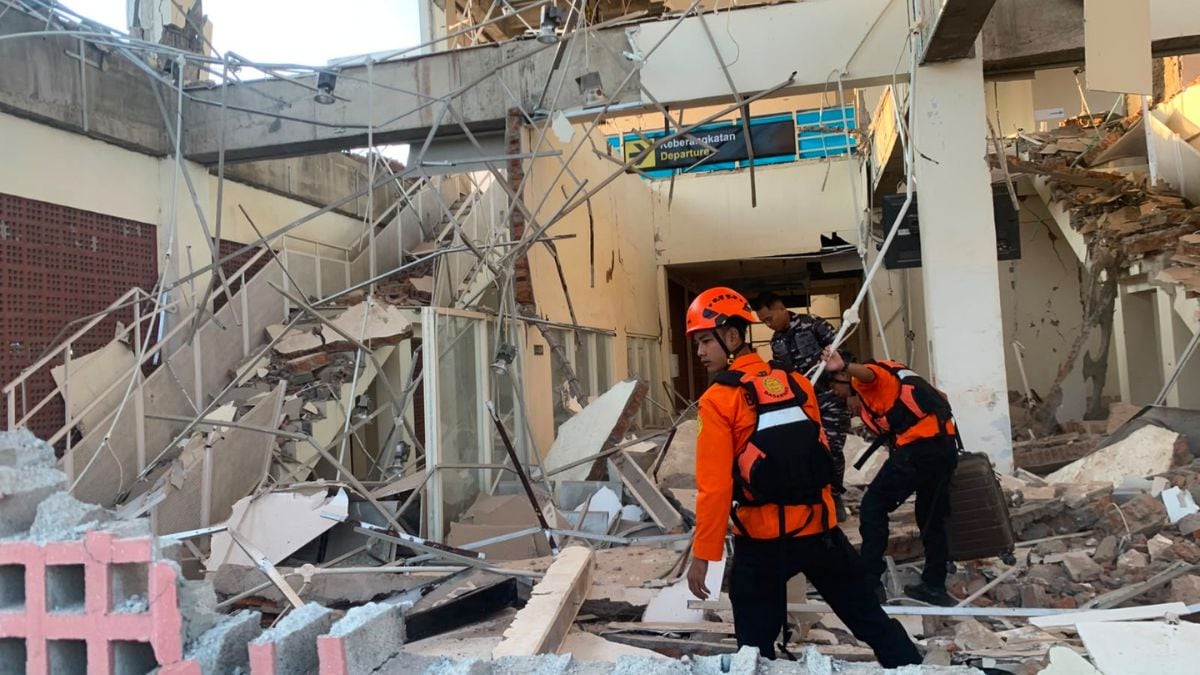
The floor does not simply move during a 7.7 magnitude earthquake. It betrays you. For millions of people across the Indonesian archipelago, the ground beneath their feet is the one constant they never question. You build your home on it. You plant your crops in it. You walk your children to school across it. And then, in less than a minute, the solid earth turns into liquid malice.
Silence follows. Then dust.
When the tremor struck, concrete did not crack; it screamed. Walls folded inward like paper houses. Roof tiles cascaded into the streets like shattered glass. At least five lives vanished into the rubble before they even understood what was happening. Statistics reduce these moments to cold digits on a screen, but behind that casualty toll lie unlit kitchen stoves, half-finished cups of coffee, and shoes left neatly by front doors that will never open again.
Consider what happens next: the immediate panic gives way to a heavy, suffocating quiet. In neighborhoods where homes once stood shoulder-to-shoulder, residents crawl through the grey haze. They do not have heavy machinery. They have bare hands. They scrape away bricks and twisted rebar, listening for a breath, a cough, a whisper from the dark.
Indonesia sits upon one of the most volatile tectonic zones on the planet, the Pacific Ring of Fire. This is not a secret. It is a geographic reality written in ancient stone and frequent catastrophe. Tectonic plates grind against one another beneath the ocean floor, storing immense pressure over decades, sometimes centuries, until the friction point breaks. When it lets go, the energy released dwarfs the power of modern explosives. It is physics operating on a scale that humbles human ambition.
Yet, humanity persists in the path of the fault lines. We have to. Millions of families make their lives here because the volcanic soil is rich, the oceans are giving, and home is simply where your people are. You cannot pack up a hundred million lives and move them away from a geological hazard zone. Instead, you learn to live with the rumble. You learn to watch the horizon. You learn to hold your breath when the walls start to shimmy.
Building codes in developing seismic zones often tell a tragic story of economics versus engineering. When resources are scarce, reinforced concrete becomes a luxury rather than a standard. Mortar is mixed with too much sand. Steel beams are thinner than they should be. When the 7.7 magnitude force arrives, it exploits every single shortcut, every compromised corner, every hurried afternoon of construction. The earthquake is an uncompromising auditor. It finds every flaw and exposes it to the light.
Night falls differently after a disaster. Power grids fail, plunging shattered communities into pitch darkness punctuated only by the sweeping beams of rescue flashlights. Families hallow open patches of grass, far away from any structure that might decide to collapse in an aftershock. Fear is a physical weight in the air. Every distant rumble of thunder or passing truck sends a fresh wave of terror through the crowd. People clutch their children closer, staring into the dark, waiting for the earth to remember its anger.
Rescue workers move like ghosts through the wreckage. They are exhausted, their faces smeared with white dust, their boots ruined by pulverized stone. They pull survivors from the debris not with the aid of high-tech sensors in many rural sectors, but through sheer grit and shouted directions. Someone hears a sound beneath a fallen ceiling slab. Everyone freezes. The searchers dig faster, their fingers bleeding through torn fabric, desperate to pull one more life back from the edge.
This is the hidden cost of our geography. We marvel at the breathtaking beauty of tropical islands, emerald jungles, and sun-drenched coastlines, but we often forget the violent geological machinery that birthed them. Every mountain range, every deep trench, every island arc was hammered into existence by this exact kind of violence.
The tremors will return. The fault lines do not sleep, and they do not forgive. But neither do the people who call these islands home. As the dust settles and the arduous rebuilding begins, mortar will meet brick once more. Foundations will be poured again, deeper this time, stronger this time.
Dawn breaks over the broken streets, casting long, sharp shadows across the concrete ruins. A single rooster crows in the distance. Somewhere down the block, a shovel strikes stone, and the work starts all over again.