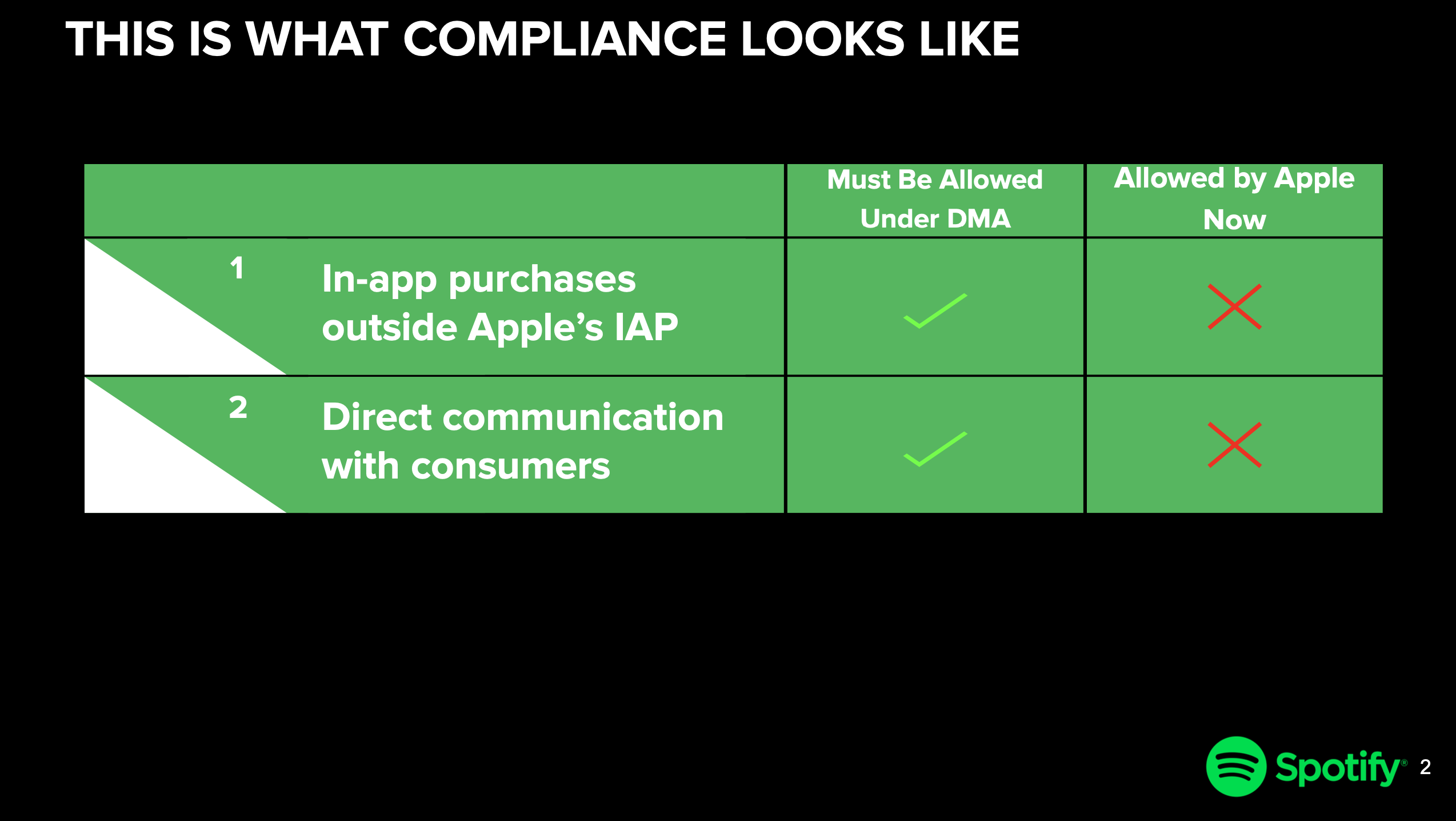
Platform economics dictate that when a designated gatekeeper faces regulatory coercion, the resulting structural modifications are rarely acts of voluntary benevolence. Instead, they represent an optimization of rent-extraction mechanics under new boundary conditions. Apple's structural overhaul of its European Union App Store fee schedule, driven by enforcement actions under the Digital Markets Act, marks a transition from a fixed deterrent model to a variable margin-capture model.
To understand why Apple replaced its contentious per-install penalty with a percentage-based commission, one must analyze the microeconomics of software distribution, developer cost functions, and regulatory friction.
The Mechanics of Regulatory Coercion
Prior to the current framework, Apple’s initial compliance strategy under the Digital Markets Act relied on a high-fixed-cost deterrent structure. The centerpiece of this approach was the Core Technology Fee, which charged developers fifty euro cents per annual install after a threshold of one million downloads. For utility and media applications operating on low margins or relying on massive volumes of free users, this fee function created an existential barrier to alternative distribution. It penalized scale rather than monetization, making third-party app marketplaces economically unviable for high-volume publishers.
Old Model: High Fixed Penalties (Core Technology Fee)
-> Punished download volume regardless of revenue
-> Suppressed migration to alternative app stores

New Model: Variable Revenue Share (Core Technology Commission)
-> Scales directly with transaction volume
-> Aligns platform fees with commercial yield
The European Commission viewed this architecture as a calculated attempt at circumvention, culminating in substantial antitrust penalties and ongoing non-compliance proceedings. The strategic error in Apple's initial posture was the assumption that developers would accept punitive fixed liabilities to maintain access to the iOS user base. When regulatory enforcement intensified and courts upheld gatekeeper designations, the cost of non-compliance—measured in potential daily turnover fines—exceeded the yield of the fixed-fee barrier. The overhaul is therefore an operational adjustment to maintain revenue integrity while legally complying with mandated interoperability.
The Modular Fee Architecture
The revised business terms replace fragmented regional frameworks with a unified contractual model across the European Union. This model dismantles the initial acquisition fee and store services fee, restructuring monetization into distinct transactional paths.
The Standard In-App Purchase Route
For developers utilizing Apple's proprietary payment processing within the official App Store, the commission drops from the historical thirty percent benchmark to twenty-six percent, with reduced tiers down to fifteen percent for qualifying participants in specialized developer programs or subscription lifecycles. This path preserves Apple's end-to-end transaction visibility.
The Hybrid and External Payment Routes
For applications choosing alternative payment processing or external link-out mechanisms within the official marketplace, commissions scale at twenty percent or fifteen percent, respectively. Crucially, developers can now deploy Apple's native payment system side-by-side with alternative payment options within the same application interface, a practice previously barred. Once selected, these distribution parameters must remain fixed for a mandatory twelve-month operational window, locking in developer commitment and reducing pricing volatility for the platform.
The External Distribution Route
For applications hosted on alternative app marketplaces or distributed directly via the web, the punitive per-install fee is expunged and replaced by a five percent Core Technology Commission applied to digital transactions.
This matrix shifts the financial risk from the developer to Apple. Under the old per-install model, a developer of a free game with ten million downloads faced immediate liability even if monetization was negligible. Under the new five percent transaction commission, Apple only extracts value when the developer successfully monetizes. This aligns platform incentives with merchant success, removing the artificial barrier that previously locked software publishers into the proprietary App Store ecosystem.
The Non-Financial Constraints and Minor Safeguards
While the headline narrative focuses on financial concessions, the structural framework introduces strict non-financial compliance requirements, particularly regarding consumer safety and minor protection.
The regulatory bargain between Apple and the European Commission required codifying strict guardrails for minors. Applications categorized under the Kids segment are explicitly prohibited from incorporating external payment links. For users under thirteen, outbound web payment routing is barred. For adolescents under eighteen, any alternative payment pathway must integrate a mandatory parental gate.
These requirements serve a dual purpose. From a regulatory perspective, they satisfy child protection mandates under European digital law. From a platform strategy perspective, they introduce friction into alternative payment funnels. A mandatory parental gate degrades conversion rates for consumer applications targeting younger demographics, neutralizing some of the economic advantage that alternative payment processors might otherwise offer over Apple's native infrastructure.
Margin Implications for Enterprise Publishers
To evaluate the true impact on publisher economics, consider the cost function of a high-volume digital service provider operating in the European market.
Under the legacy architecture, migrating off the App Store to an independent web distribution model incurred the Core Technology Fee, which rapidly outpaced operational savings for viral applications. With the introduction of the five percent Core Technology Commission, the marginal cost of transacting outside the ecosystem becomes predictable.
However, external payment processing is not friction-free. Merchants must factor in third-party merchant-of-record fees, customer support overhead, fraud management, and user acquisition drop-off caused by fragmented checkout flows. When a developer utilizes an alternative payment processor charging two to three percent, plus Apple's five percent Core Technology Commission, the total extraction rate reaches eight percent. This compares favorably against the twenty-six percent in-app purchase rate, providing a genuine economic incentive for large-scale publishers to invest in proprietary billing infrastructure.
Conversely, smaller developers participating in the Small Business Program—who qualify for reduced fifteen percent or ten percent tiers on native rails—may find that the operational complexity of managing external billing, tax compliance across multiple EU jurisdictions, and customer support outweighs the minor margin delta. For these entities, the optimal strategy remains utilizing Apple's turnkey infrastructure.
Strategic Execution for Platform Participants
Publishers operating within the European Union must transition away from static financial modeling and adopt a multi-variable scenario analysis.
Audit the current user acquisition funnel to isolate the ratio of new versus recurring transactions, as specialized reduction tiers apply preferentially to long-term subscriptions. Calculate the true total cost of ownership for external billing, factoring in merchant processing fees, chargeback rates, and the five percent Core Technology Commission. If the net savings of alternative payment integration exceed seven to ten percent of top-line digital revenue, initiate infrastructure development for web-based distribution or alternative marketplace integration. If the margin differential is marginal, absorb the platform fee to preserve checkout conversion rates and user trust. Maintain this configuration across the mandatory twelve-month operational cycle while monitoring further regulatory adjustments from global competition authorities mirroring the European framework.