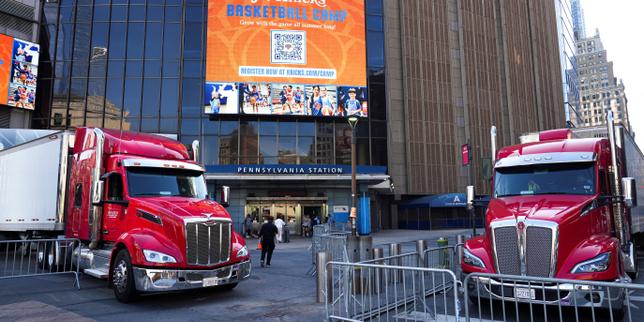
The convergence of the Taylor Swift and Travis Kelce brands represents the most significant consolidation of cultural and economic capital in modern media history. While mass media treats their relationship as a narrative spectacle, an analytical deconstruction reveals a highly engineered optimization strategy designed to capture multi-demographic attention equity. The launch of their highly anticipated wedding events at Madison Square Garden (MSG) is not merely a high-profile ceremony; it is a structural masterclass in managing the competing forces of radical scale and absolute information asymmetry.
To analyze how an event of this magnitude operates, we must evaluate it through a dual-framework model: the maximization of physical security versus the extraction of media value. When public figures reach this velocity of fame, standard event management models collapse. The MSG venue selection functions as a strategic pivot point, offering an infrastructure capable of handling unprecedented logistical pressure while serving as a secure fortress in the center of the world's dense media market.
The Paradox of Absolute Privacy Under Peak Public Scrutiny
The primary challenge of the Swift-Kelce MSG event lies in balancing high visibility with total informational control. In economic terms, this requires solving for zero information leakage while operating inside a global media hub. The strategic playbook relies on a three-tier operational security framework.
- Perimeter Sterilization via Spatial Monopolies: Madison Square Garden sits atop a major transit hub, presenting extreme logistical vulnerabilities. To counteract this, the operational strategy requires a total buyout of not just the arena, but the subterranean and adjacent airspace rights. By controlling the physical perimeter to a radius of several blocks, the organizers eliminate the proximity advantages typically held by paparazzi and unvetted crowds.
- The Zero Trust Digital Environment: Information leakage is fundamentally a human asset problem. The event employs strict hardware isolation policies. Non-negotiable containment protocols—such as locking all guest communication devices in signal-blocking Yondr pouches—alter the data ecosystem of the room. By removing the physical ability to capture real-time high-definition video or audio, the organizers maintain a strict monopoly over the event's visual assets.
- Contractual Non-Disclosure Velocity: Traditional NDAs lack teeth when dealing with high-net-worth guests or opportunistic vendors. The legal framework governing this event relies on liquidated damages clauses scaled to the projected valuation of the exclusive media rights. If a breach occurs, the financial penalty is explicitly calculated to exceed any potential payout from a media outlet, shifting the economic incentive structure toward absolute compliance.
The Value Multiplier of Cross Demographic Integration
The economic engine driving the Swift-Kelce phenomenon is the structural overlap of two historically distinct consumer bases: the hyper-engaged, digitally native pop music fandom and the high-volume, mainstream sports entertainment audience. This intersection creates a network effect where the combined brand equity grows exponentially rather than additively.
[Swift Fandom: High LTV, Digital Native] ──┐
                                           ├─► [Unified Hyper-Brand: Unprecedented Scale]
[NFL/Sports Fandom: Linear, Mass Market] ──┘
The data confirms that this cross-pollination permanently expands the total addressable market. When the National Football League experienced a massive influx of female viewers during the 2023–2024 season, it wasn't a temporary spike; it was a fundamental shift in demographic alignment. The MSG event cements this integration. By choosing a venue synonymous with both elite athletic performance and historic musical milestones, the couple anchors their unified brand in a physical space that legitimizes both halves of the cultural equation.
The Logistical Cost Function of the MSG Activation
Operating an event of this scale inside Manhattan introduces severe economic and structural bottlenecks. The cost function of executing a secure, private event at Madison Square Garden can be broken down into three main operational variables.
- The Opportunity Cost of Venue Displacement: MSG is one of the highest-grossing arenas in the world. Booking the venue for an extended multi-day private event requires compensating the ownership group for displaced ticket sales, concessions, merchandise revenues, and potential sports scheduling disruptions. The baseline cost of venue acquisition alone enters the mid-eight-figure range before a single security guard is deployed.
- Municipal Asset Mobilization: An event capable of drawing tens of thousands of onlookers to Midtown Manhattan requires extensive coordination with local government and law enforcement. The private enterprise must internalize the costs of specialized police details, traffic rerouting protocols, and sanitation surges. The financial burden shifts entirely to the event entities, requiring a highly capitalized corporate structure behind the personal event.
- Supply Chain Redundancy: From specialized staging to elite catering, every vendor must undergo rigorous background checks and security clearance protocols. This drastically reduces the pool of available suppliers, allowing approved vendors to command a premium. The economic reality of this restricted marketplace is a compounding cost multiplier across the entire production chain.
The Strategic Value of Scarcity in a Hyper Saturation Market
In an era defined by content overproduction, value shifts from availability to scarcity. The modern media landscape rewards continuous engagement, but elite status requires periodic, total withdrawal from the public eye. The "secret well-kept" aspect of the MSG event is a deliberate economic strategy designed to manufacture long-term asset value.
By blacking out the actual proceedings of the event, the Swift-Kelce collective creates a massive informational vacuum. The media market abhors a vacuum; consequently, the perceived value of the eventual, officially sanctioned media assets—whether a documentary feature, an exclusive photo spread, or a curated digital drop—increases exponentially. This is the monetization of absence. Controlling the distribution timeline ensures that the narrative cannot be commoditized or diluted by fragmented third-party reporting.
Operational Vulnerabilities and Structural Limitations
Despite the rigorous engineering behind the event, several critical failure points remain inherent to the strategy. No system can achieve absolute security when dealing with human components and physical environments of this complexity.
The first limitation is the human factor of high-profile guest lists. While vendors can be bound by devastating financial penalties, enforcing the same legal rigidity on billionaire peers, industry executives, and ultra-high-net-worth individuals introduces social friction. A single indiscreet comment from a high-status attendee to an unvetted contact bypasses the technological and contractual barriers put in place.
The second bottleneck is the physical reality of Manhattan's urban geography. High-altitude long-lens photography and drone surveillance present constant threats that municipal airspace regulations can only partially mitigate. The economic cost of enforcing a literal counter-surveillance umbrella over an open-air transit grid is prohibitive, forcing reliance on interior containment and architectural shielding.
Capital Allocation and Long Term Brand Monetization
The execution of the Madison Square Garden activation establishes a new benchmark for how cultural capital is consolidated and deployed. This is not a personal milestone functioning in isolation; it is a corporate merger disguised as a cultural event. The strategic play moving forward requires transitioning this temporary surge of attention equity into permanent, scalable revenue streams.
The unified entity must now focus on institutionalizing their combined market power. This involves the creation of a centralized joint-venture media company designed to manage the intellectual property, merchandising rights, and media production outputs generated by the union. By insourcing the production of their own narrative, they eliminate the middleman of traditional media conglomerates, capturing the entire value chain from content creation to global distribution. The MSG event serves as the foundational proof of concept for this hyper-scaled corporate vehicle, demonstrating that with sufficient capitalization and rigorous operational execution, absolute privacy and maximum market impact can coexist.