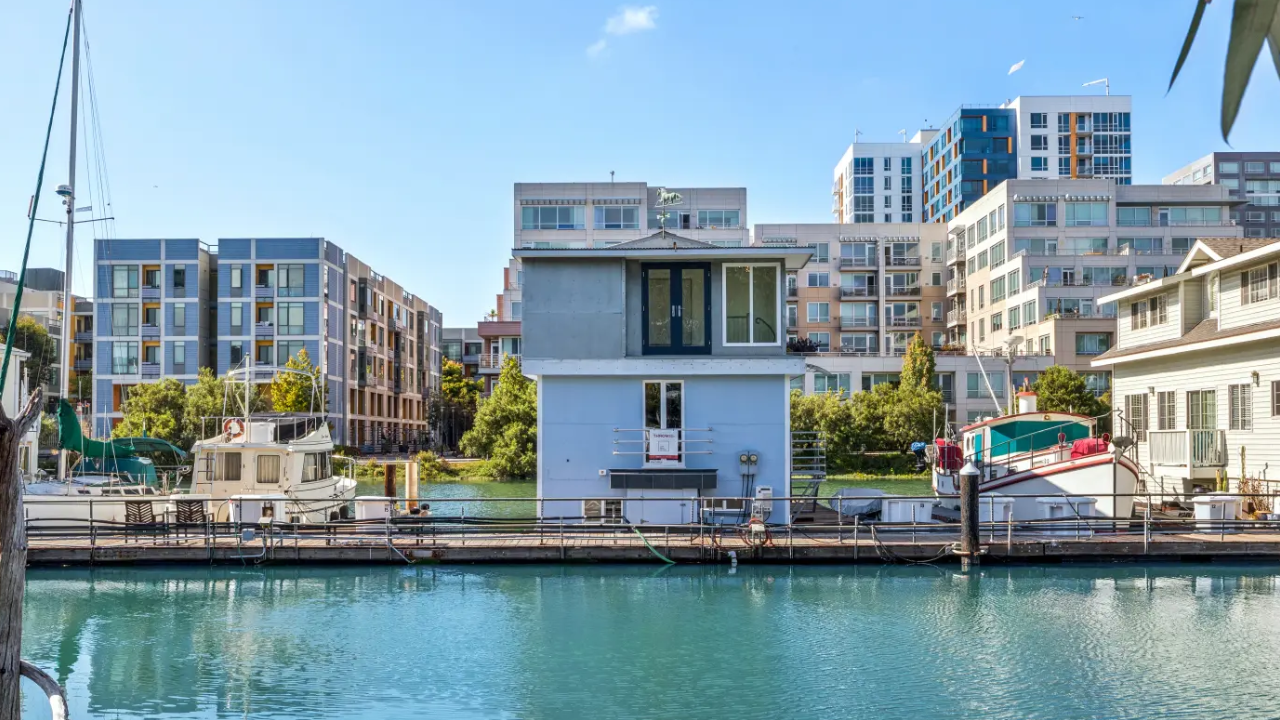
Real estate markets function on supply elasticity, regulatory capture, and structural constraints. When a physical asset class operates under a strict, politically mandated supply ceiling, standard valuation metrics break down. The recent listing of a three-bedroom floating home in San Francisco’s Mission Creek at $1.749 million provides an empirical window into a hyper-restricted market. This asset is not merely a residential dwelling; it is a fixed-supply equity in a regulatory monopoly. To understand why such assets command pricing power detached from traditional square-foot comps, one must deconstruct the microeconomics of artificial scarcity, slip administration, and alternative depreciation schedules.
The Structural Mechanics of Artificial Supply Caps
Urban land markets rely on zoning laws to control density. Aquatic real estate, however, introduces a different layer of constraint: physical harbor capacity governed by municipal and port authorities. Mission Creek contains a rigidly fixed inventory of approximately twenty permitted floating homes. The Port of San Francisco caps the total slip infrastructure, rendering horizontal or vertical expansion mathematically impossible.
In a standard residential market, a price increase triggers supply response—developers build more units, dampening price velocity. In the Mission Creek ecosystem, the price elasticity of supply is identically zero.
- The Regulatory Moat: New slips cannot be excavated or permitted due to environmental protection mandates, navigational right-of-ways, and public trust doctrines.
- The Intergenerational Transfer Factor: Because open-market transactions are rare, a significant proportion of floating homes change hands via inheritance or private network transfers rather than public listings.
- The Liquidity Friction: Low transaction velocity means price discovery is inefficient. Each public listing serves as a market-clearing price anchor for the entire micro-community.
When supply is permanently inelastic, demand shocks—driven by proximity to major urban employment centers like Mission Bay and adjacent technology headquarters—translate entirely into capital appreciation rather than volume expansion.
The Cost Function of Floating Asset Ownership
Valuing a floating structure requires rewriting standard real estate financial models. Buyers are acquiring a dual-component asset: a depreciating superstructure (the floating barge and architectural buildout) sitting on a perpetually appreciating intangible asset (the maritime slip lease rights and location equity).
Traditional real estate cost functions isolate land and structure. For Mission Creek inventory, the cost function incorporates variables foreign to terrestrial property:
- Slip Fees vs. Property Taxes: Owners do not own the underlying waterbed or the fee-simple land. They own the floating chattel and pay ongoing slip occupancy fees to the master leaseholder or port authority, substituting traditional property tax burdens with maritime operating expenses.
- Maintenance Amortization: Marine environments exact a severe penalty on materials. Hull integrity, marine growth mitigation, saltwater corrosion of mechanical systems, and compliance with regional wastewater discharge standards create a non-linear capital expenditure curve.
- Financing Constraints: Standard residential mortgages often do not apply. Floating homes are frequently classified as personal property (chattel) rather than real property, requiring specialized marine loans that carry higher interest rates, larger down payment requirements, and shorter amortization schedules.
The $1.749 million price tag must be adjusted for these operational drag factors. The capitalization rate of a floating home diverges sharply from a terrestrial condominium because the ongoing operational drag (mooring fees, specialized insurance, and marine engineering upkeep) reduces net operating yield.
Market Positioning and Capital Concentration
The buyers attracted to Mission Creek floating assets are largely immune to standard interest rate volatility. They are optimizing for spatial differentiation and lifestyle uniqueness within an urban core. This introduces behavioral economics into the valuation model: the Veblen good phenomenon, where desirability increases as a function of extreme scarcity.
Urban cores are increasingly characterized by homogenous high-density vertical construction. A floating community provides horizontal spatial isolation within a dense metropolitan grid. This creates an asymmetric utility profile:
- Proximity Premium: The location bridges maritime lifestyle with immediate access to dense employment nodes, bypassing standard suburban commuting friction.
- Community Cohesion: With only twenty units, the social structure operates like a closed cooperative. Social capital within the slip network acts as an informal barrier to entry, further insulating the asset class from broad market corrections.
Valuation Disconnects and Alternative Asset Parity
Comparing a Mission Creek houseboat to a terrestrial condominium of identical square footage yields analytical errors if executed via naive comparables. Terrestrial properties benefit from land appreciation and predictable municipal services. Floating homes carry structural obsolescence risks tied to rising sea levels, changing municipal maritime policies, and climate adaptation mandates for San Francisco Bay.
If a buyer pays roughly $1,750,000 for a three-bedroom marine residence, the cost per square foot often matches or exceeds prime terrestrial real estate in the surrounding neighborhood. Buyers are paying a premium for regulatory immunity against future housing development. No new competitor can build a floating home next door to obstruct views or increase neighborhood density.
Strategic Allocation Playbook
To evaluate opportunities within hyper-scarce micro-markets like Mission Creek, capital allocators must shift from standard property valuation to infrastructure network analysis.
- Audit the master lease agreement governing the slip to identify duration, renewal risk, and fee escalation caps before assigning terminal value to the asset.
- Factor marine structural engineering inspections as a primary line item in the due diligence phase; deferred hull maintenance represents an unrecoverable capital liability.
- Isolate the value of the floating asset from standard urban real estate cycles, recognizing that ultra-low inventory assets are illiquid stores of value rather than short-term trading instruments.