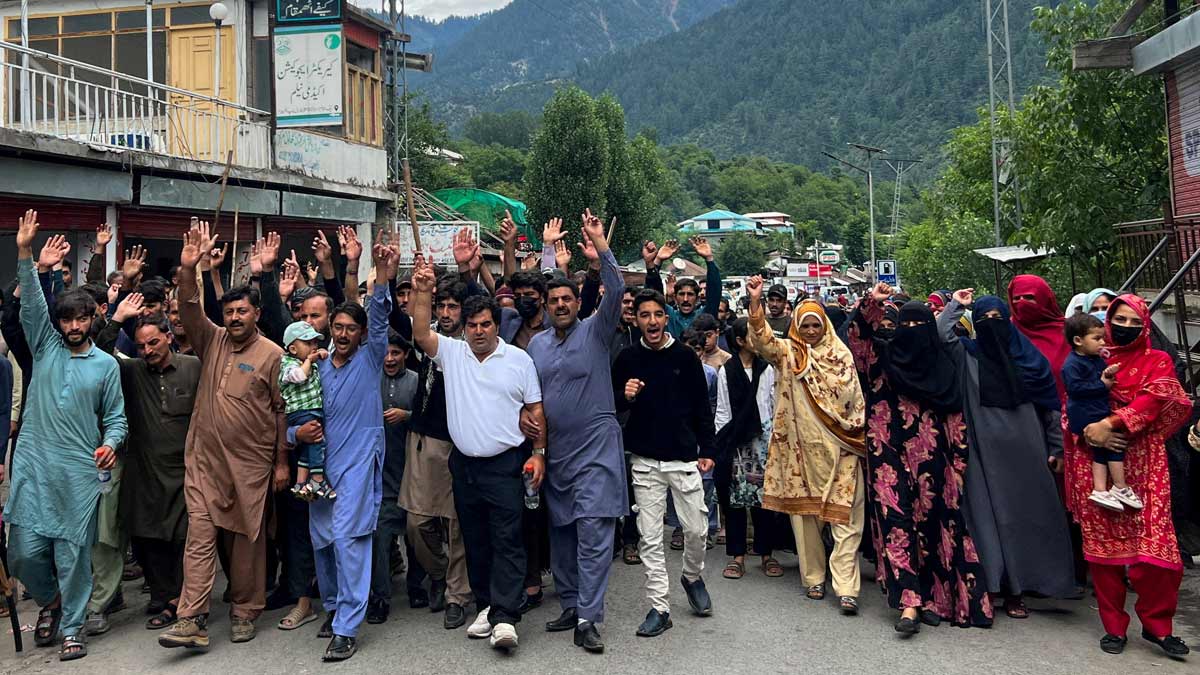
The escalating confrontation between the Jammu Kashmir Joint Awami Action Committee (JAAC) and the state administration in Muzaffarabad is not merely a localized political dispute. It represents a structural breakdown in the fiscal and resource-sharing contract between the federal government of Pakistan and the semi-autonomous territory of Azad Jammu and Kashmir (AJK). By analyzing this crisis through the lens of resource pricing asymmetries and fiscal transfer mechanisms, we can map the structural vulnerabilities that made this showdown inevitable.
The structural tension is driven by two distinct but compounding economic grievances: the pricing of hydroelectricity generated within the region and the subsidization of essential commodities, specifically wheat flour. When these local economic pressures intersected with Pakistan's macroeconomic stabilization requirements—primarily dictated by external debt servicing and structural adjustment programs—the regional governance model collapsed into active civil resistance.
The Hydro-Fiscal Asymmetry Framework
The primary driver of the JAAC mobilization is the perceived unfairness in electricity pricing. To understand why this issue has mobilized large segments of the population, we must examine the physical and economic mechanics of the region's energy contribution to the national grid.
AJK hosts major hydroelectric installations, most notably the Mangla Dam and the Neelum-Jhelum Hydropower Project. These facilities generate low-cost, renewable energy that is fed directly into the National Transmission & Despatch Company (NTDC) grid of Pakistan.
The economic friction arises from the divergence between the cost of generation and the end-user tariff:
- Generation Cost vs. Consumer Tariff: Hydroelectric power from local plants is generated at a highly cost-effective rate per kilowatt-hour (kWh). However, when electricity is distributed back to local consumers, it is priced according to national weighted average tariffs, which incorporate the high cost of thermal power plants fueled by imported coal and liquefied natural gas (LNG).
- The Net Hydel Profit Dispute: Under Article 161(2) of the Constitution of Pakistan, provinces are entitled to a "Net Hydel Profit" (NHP) for electricity generated from hydel stations located within their territories. Because of AJK’s unique constitutional status as a semi-autonomous territory rather than a formal province, its financial receipts have historically been governed by ad-hoc water usage charges rather than the full NHP rate applied to provinces like Khyber Pakhtunkhwa. This structural exclusion deprives the regional government of significant non-tax revenue.
This pricing structure creates a localized transfer of wealth. The regional population bears the environmental and displacement costs of large-scale hydro projects while paying inflated energy tariffs calculated on a national energy mix they do not consume.
The Subsidy Cost Function and Fiscal Limits
The second pillar of the JAAC demands involves the subsidization of wheat flour (atta). The pricing of wheat in AJK is highly sensitive to policy shifts in Pakistan's agricultural provinces (primarily Punjab) and federal import choices.
Total Subsidy Burden = Q * (P_market - P_subsidized)
Where:
Q = Total quantity of wheat consumed in AJK
P_market = The procurement and transport-adjusted market price of wheat
P_subsidized = The politically mandated price demanded by the JAAC
The regional government cannot balance this equation without external budgetary support. The fiscal space of the AJK government is constrained by three structural bottlenecks:
- Limited Tax Base: The local revenue generation capacity is structurally weak, leaving the region highly dependent on financial transfers from the federal government of Pakistan via the AJK Council and direct bilateral grants.
- Federal Austerity Constraints: The federal government of Pakistan is operating under strict fiscal consolidation guidelines. These macroeconomic constraints restrict the federal government's ability to bail out regional administrations or underwrite open-ended commodity subsidies.
- Logistical Premium: Transporting bulk commodities like wheat into mountainous terrains incurs high transport costs, inflating $P_{market}$ and widening the subsidy gap that the local administration must cover.
When the federal government reduced fiscal transfers to align with macroeconomic stabilization targets, the local administration attempted to pass these costs onto consumers through higher utility bills and flour prices. This action triggered the JAAC's collective resistance.
The Sovereign-Subnational Bargaining Dilemma
The confrontation in Muzaffarabad demonstrates the limits of traditional state bargaining models. Historically, the state resolved local grievances through short-term financial concessions. However, the JAAC's decentralized, non-partisan structure has altered the bargaining dynamics in three ways:
Horizontal Mobilization vs. Vertical Patronage
Traditional political disputes in the region are mediated through established political parties and patronage networks. The JAAC bypassed these channels by organizing horizontally across trader unions, transport associations, and civil society groups. Because the organizers do not seek electoral office, they are resistant to standard political co-optation.
The Credible Threat of Economic Disruption
By targeting Muzaffarabad—the administrative capital—and threatening to disrupt logistics routes and power transmission infrastructure, the JAAC established a highly credible threat of economic disruption. This leverage forced the federal government to bypass the regional cabinet and negotiate directly with the committee's representatives.
The Precedent of Financial Concessions
When the federal government announced a multi-billion rupee emergency relief package to lower electricity tariffs and subsidize wheat, it resolved the immediate crisis but created a significant moral hazard. By demonstrating that mass mobilization can successfully bypass national fiscal policy, the state has set a precedent that other cash-strapped regions may replicate.
Strategic Forecast and Policy Interventions
The current equilibrium established by the emergency relief package is unstable. Funding long-term subsidies through ad-hoc federal grants in an inflationary environment is fiscally unsustainable. To prevent a recurrence of the Muzaffarabad standoff, the regional and federal administrations must transition from emergency crisis management to structural reforms.
The first step requires formalizing AJK’s hydro-financial relationship with the federal government. The ad-hoc water usage charge must be replaced with a structured formula aligned with the Net Hydel Profit model. This reform would provide the Muzaffarabad administration with a predictable, non-debt-creating revenue stream directly tied to its energy output, enabling it to fund local development and targeted social safety nets without relying on federal emergency bailouts.
The second reform must address the subsidy distribution mechanism. General price subsidies on wheat and electricity disproportionately benefit high-income households and encourage smuggling across administrative borders. The regional administration must phase out universal price controls and transition to targeted, digital cash transfers for vulnerable households. Implementing a localized registry linked to national identity databases will protect poor households while reducing the overall fiscal burden on the state.
Without these structural adjustments, the underlying economic friction will persist. As macroeconomic stabilization pressures continue to compress public spending across Pakistan, the structural divide between regional resource generation and local consumption costs will inevitably spark the next round of civil unrest. The Muzaffarabad march was not an isolated event; it was a clear warning that the existing fiscal framework has reached its structural limits.