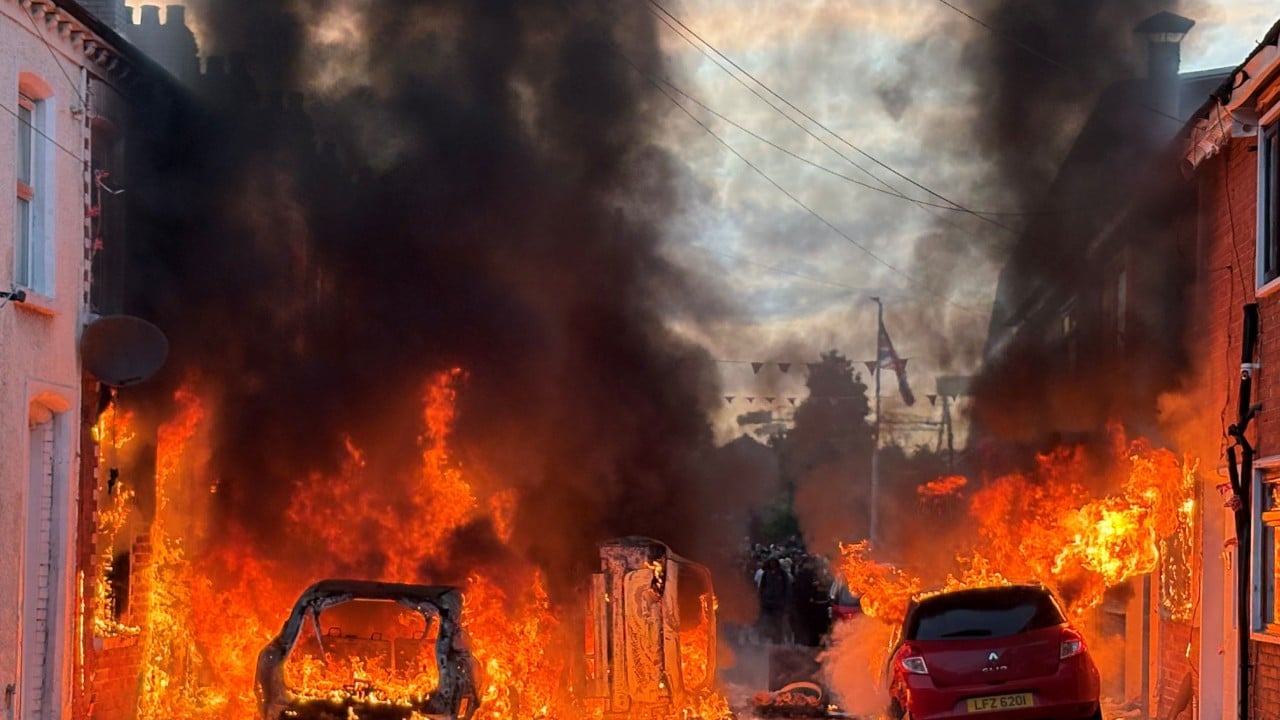
A brutal knife attack in north Belfast leaves a local man in critical condition. Within hours, graphic video footage hits X. Instead of local police managing a community in shock, the narrative gets hijacked by a billionaire sitting thousands of miles away.
Elon Musk is right in the middle of it again.
By blasting out calls for street protests to his 240 million followers, Musk has drawn furious condemnation from UK politicians. They accuse him of intentionally stoking racial division and weaponizing a local tragedy to push his global anti-immigration stance. The result on the ground? Pure chaos. Masked mobs, burning cars, and families evacuated from their homes in the middle of the night.
The Digital Spark and the Street Violence
The timeline moves fast. On Monday night, a horrific stabbing occurred outside a block of flats in Belfast. The victim, Steven Ogilvy, suffered severe slash wounds to his back, face, and eyes. Police quickly arrested a 30-year-old Sudanese national and charged him with attempted murder.
Before the blood was even cleaned off the pavement, the digital machinery kicked in. Right-wing figures, including Reform UK politicians and far-right activist Tommy Robinson, began posting protest locations online. Robinson framed the incident as "yet another invader attack."
Then Musk weighed in. He shared Robinson's protest list directly.
"Only by protesting REPEATEDLY and LOUDLY will there be any change!!" Musk posted.
He didn't stop there. He amplified claims by politicians like Rupert Lowe demanding that "millions must go," and blamed the unrest entirely on open borders.
What happens on X rarely stays there. By Tuesday night, Belfast was burning. Masked men set up makeshift roadblocks using street furniture, stopping cars to check the ethnicity of the drivers. Mobs targeted council houses, smashing windows and launching arson attacks on properties belonging to immigrants and ethnic minorities. Firefighters had to pull terrified families, including a two-month-old baby, through flames while rioters shouted about getting foreigners out.
When Algorithms Dictate Local Reality
The real issue isn't just that a famous tech guy has an opinion. It's the asymmetry of power. Local leaders in Northern Ireland—from First Minister Michelle O'Neill to Justice Minister Naomi Long—pleaded for calm. They begged people to let the Police Service of Northern Ireland (PSNI) do their jobs.
But their voices are quiet whispers compared to the megaphone of the world's richest man.
Naomi Long didn't hold back, pointing out that the people driving the chaos online "would struggle to find Belfast on a map." They don't have to live with the fallout. They don't have to rebuild the burned-out Middle Eastern supermarkets or comfort the children forced to flee their beds.
Labour Party Chair Anna Turley called Musk's interventions "appalling." She noted that bad-faith actors sitting in safety overseas face zero risk while putting vulnerable local communities in immediate danger.
Musk's defenders argue he's just reflecting public anger over uncontrolled immigration. The suspect, police confirmed, was in the country legally with a five-year visa after traveling from Dublin to Belfast. For Musk and his supporters, pointing this out isn't stoking violence; it's highlighting a policy failure.
But there's a massive difference between debating immigration policy and telling an angry, masked mob to hit the streets in a city with a notoriously fragile peace.
The Playbook We Keep Seeing
We've been here before. This isn't an isolated incident; it's a predictable pattern. During the UK-wide riots in August 2024, Musk used similar rhetoric, famously declaring that "civil war is inevitable."
Social media platforms used to at least pretend to act as neutral moderators during active civil unrest. Under Musk, X operates on a different philosophy: maximum engagement at all costs. Conflict drives clicks. Clicks drive traffic.
When a high-profile user with hundreds of millions of followers validates a flash protest, it legitimizes the anger of the people on the street. It turns a localized criminal investigation into a global culture war.
For the people living in north Belfast, the immediate future looks tense. Police are bracing for a long, volatile summer of protests and counter-protests.
If you want to understand how modern riots happen, look past the petrol bombs and the balaclavas. Look at the notifications on your phone. The infrastructure of unrest is digital, global, and completely insulated from the consequences of the fire it lights.
Step away from the rage-bait algorithms. Stick to verified updates from local emergency services and trusted community leaders who actually have to live in the neighborhood. Don't let a tech billionaire's timeline dictate the safety of your streets.