Salt crusts on the windowpanes of the conference center in Nuku'alofa. Outside, the Pacific Ocean rolls in with an ancient, terrifying indifference, its heavy blue swells crashing against reefs that have protected Polynesian shores for ten thousand years. Inside, the air conditioning hums a sterile, freezing tune. The chairs should be scraping against the linoleum. They should be crowded with delegates leaning in, whispering over thick briefing dossiers, trading quiet bargains, and arguing over the future of an ocean that covers a third of the planet.
Instead, rows of leather seats remain heartbreakingly vacant.
The Pacific Islands Forum is happening. Or, at least, something bearing its name is stumbling forward under a crushing weight. Several key leaders are missing. Empty nameplates sit mutely under fluorescent lights.
Why? Because a quiet war is being fought across these turquoise waters. It is a war waged not with torpedoes or carrier strikes, but with checkbooks, diplomatic arm-twisting, and the slow, grinding pressure of two superpowers wrestling for dominion over the horizon. Beijing and Taipei are fighting over scraps of recognition among tiny nations with massive maritime borders, and the cost of their rivalry is paid in the currency of Pacific unity.
Listen.
Can you hear it?
Nothing. That is the sound of an island nation being forced to choose.
To understand why empty chairs at a regional summit matter to anyone living thousands of miles away, you have to stand where the water meets the land.
Picture a hypothetical village elder named Viliami, sitting on a woven mat in Tuvalu. He remembers when his grandfather could walk a hundred yards out onto the reef at low tide without getting his knees wet. Now, the high tide laps at the foundations of his concrete-block home. For Viliami, the existential threat is literal. The sea is rising. His people are drowning. When leaders gather at the Pacific Islands Forum, Viliami is not thinking about geopolitics. He is thinking about survival. He is thinking about relocation funds, seawalls, and freshwater wells turning brackish with salt.
Yet, when the region's leaders finally sit down at the mahogany table, the oxygen in the room is sucked out by a different kind of rising tide.
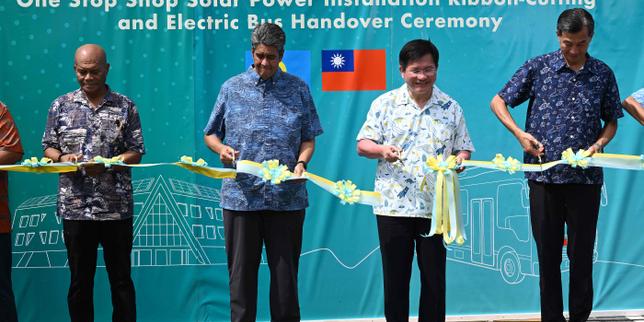
The rivalry between China and Taiwan has cast a long, dark shadow over what should be a unified front against climate collapse. Beijing claims Taiwan as its territory and demands that international bodies freeze Taipei out. Meanwhile, Taiwan maintains diplomatic ties with a dwindling handful of Pacific island states, fighting fiercely for every ounce of international legitimacy it can claw back.
When a summit meant to address catastrophic weather patterns and collapsing fisheries gets hijacked by diplomatic boycotts and proxy credential battles, the human cost is immediate. It is devastating.
Tuvalu, Nauru, Palau. These are not just dots on a map. They are sovereign voices. But when great powers play chess with their aid packages and diplomatic recognition, those voices fracture.
Look at the mechanics of this influence. It is seductive. It arrives in the form of gleaming new sports stadiums, paved highways, and low-interest loans that stretch repayment terms across generations. For a small island nation struggling to build basic infrastructure, turning down millions of dollars in assistance feels like an impossible luxury.
But assistance always comes with an invisible anchor.
When a delegation stays home from a regional summit because of a diplomatic dispute over who belongs at the table, the solidarity of the Blue Continent cracks. The Pacific Islands Forum was built on a simple, radical premise: Talanoa. It is a traditional word for inclusive, participatory dialogue without preconditions. It means sitting together, face-to-face, until you reach a consensus.
You cannot practice Talanoa when the chairs are empty.
Consider what happens next. When the Pacific family is divided, it loses its collective bargaining power on the world stage. At global climate conferences like COP, a unified Pacific bloc carries moral weight. They are the frontline witnesses to climate catastrophe. When they speak with one voice, the world listens. But when they are splintered by external rivalries—some leaning toward Beijing, others holding the line for Taipei, others caught agonizingly in the middle—their voice becomes a whisper.
The great irony is that the ocean does not care about geopolitics.
A storm surge whipped up by a warming sea does not check a country's passport to see if its government recognizes Beijing or Taipei before it tears the roof off a schoolhouse. Coral bleaching does not pause because diplomats are deadlocked over credentials. Rising salinity does not negotiate.
And yet, the diplomatic theater continues.
During a recent summit session, tempers flared behind closed doors. Arguments erupted over protocol, over who was invited, over whose flag was displayed where. Outside, fishermen cast their nets into a lagoon that grows warmer by the year. They do not know the acronyms of the communiqués being drafted inside. They only know that the fish are moving into deeper, colder waters, forcing them to burn more fuel they can barely afford to buy.
We have watched this movie before in other parts of the world. A region rich in culture, marine biodiversity, and strategic positioning is treated as a chessboard. The players sit in distant capitals, moving pawns across a vast expanse of blue water, calculating influence in ports and shipping lanes.
The Pacific is not a chessboard. It is a home.
It is home to communities that navigated these waters by the stars long before modern cartography existed. They survived by cooperation, by reading the subtle shifts in swell patterns and bird migrations. They know that trying to conquer the ocean is a fool's errand. You must learn to live with it, and you must learn to live with each other.
The empty chairs at the Forum are a symptom of a deeper malady. They reveal the fragility of small-state diplomacy in an era of aggressive great-power competition. When giants stumble around the room, the people standing near their feet get crushed.
Yet, resilience runs deep in these islands.
Even as leaders spar and delegations boycott, civil society groups, youth activists, and traditional chiefs continue to meet on the margins. They trade stories of adaptation. They share seeds that survive in salty soil. They organize community-led conservation projects that bypass the bureaucratic paralysis of high-level politics. They refuse to let their future be mortgaged to a dispute they did not start and cannot control.
The sun dips below the horizon in Nuku'alofa, painting the sky in violent shades of violet and gold. The ocean turns the color of a bruised plum.
Inside the conference hall, the lights are switched off. The empty chairs sit in the darkness, waiting for leaders who may or may not return next year. Outside, the tide keeps coming in, inch by relentless inch, washing over the dark sand, indifferent to the quarrels of men, whispering of things that endure long after the arguments have faded into silence.