There is a specific kind of silence that settles over a booth at 2:00 AM when the coffee has gone cold and the hash browns are little more than grease stains on white porcelain.
I know that silence. Anyone who has ever tried to build something out of nothing—a business, a software patch, a second chance—knows the exact weight of a vinyl bench in a twenty-four-hour diner. The fluorescent lights hum at a frequency that vibrates right behind your eyes. Outside, the freeway traffic thins to the occasional roar of a long-haul semi. Inside, the air smells like scorched dark roast, bleach, and quiet desperation. You might also find this connected story interesting: Why Obsessing Over Retail Sales and Fed Minutes Is a Trap.
For decades, one specific booth at a Denny’s on Berryessa Road in East San Jose carried a small piece of brushed metal screwed into the wall.
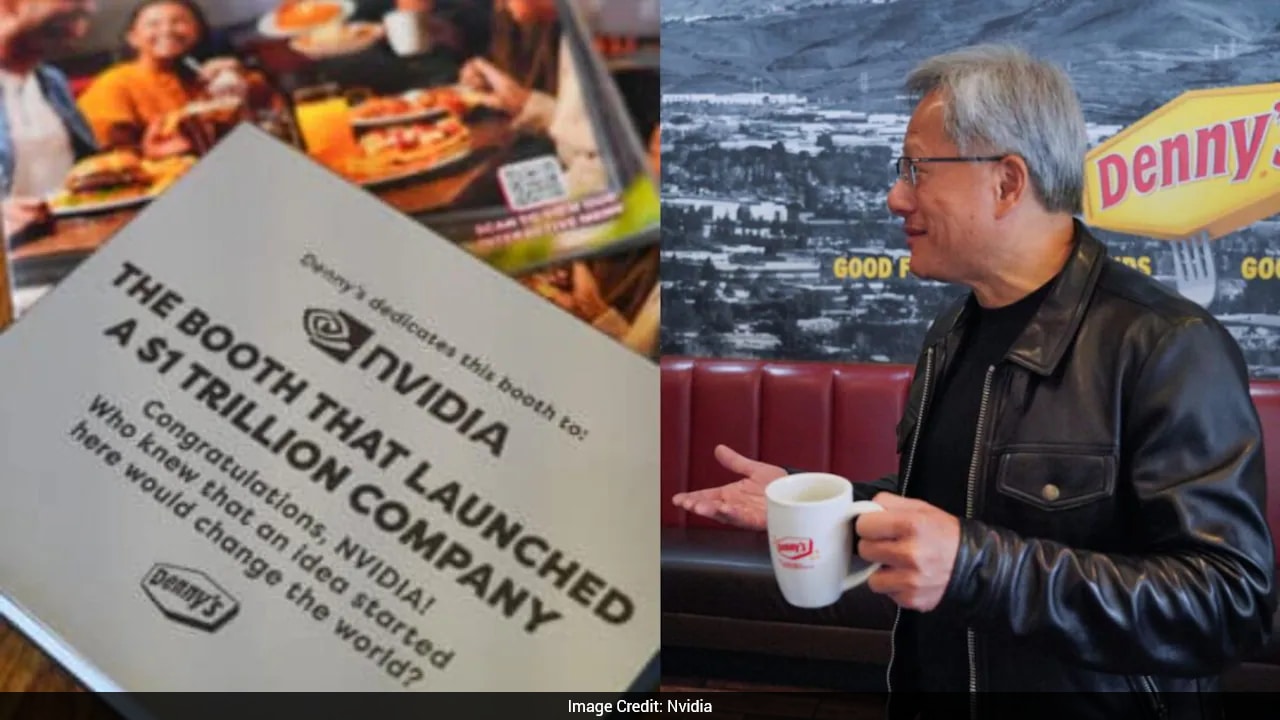
It was not a grand monument. It did not feature marble columns or velvet ropes. It was a simple commemorative plaque marking the spot where, in 1993, three engineers—Jensen Huang, Chris Malachowsky, and Curtis Priem—sat over bottomless cups of coffee and sketched out the future of computing on paper napkins. That diner was the birthplace of Nvidia. As extensively documented in detailed coverage by Bloomberg, the results are notable.
Now, the plaque is gone. The restaurant removed it following the ripples of Jensen Huang’s exit from the company he built into a multi-trillion-dollar colossus.
On paper, this looks like a footnote. A minor bit of corporate housekeeping in a strip mall parking lot. A piece of metal unscrewed from drywall, leaving behind four tiny holes and a slightly darker rectangle where the paint never faded.
Look closer, though. When you strip away the press releases and the market-cap tickers, what happened on Berryessa Road tells a much sharper, heavier story about memory, ambition, and the strange violence of outgrowing your own origins.
The Anatomy of a Myth
To understand why an empty patch of diner wall matters, you have to understand how Silicon Valley worships its own creation myths.
Every empire needs a manger. Hewlett-Packard has its redwood garage in Palo Alto. Apple has its suburban tract home in Los Altos. Amazon has its doors-turned-desks in Bellevue. These places are treated like secular shrines because they offer a seductive promise to every broke dreamer staring at a blank screen: You do not need capital, pedigree, or permission. You just need a table and an obsession.
In 1993, the Berryessa Road Denny’s was the least glamorous shrine in California.
Picture a hypothetical twenty-something engineer walking through those glass doors today—let us call her Maya. She has two hundred dollars in her checking account, a laptop with a cracked hinge, and an idea for a neural network architecture that nobody on Sand Hill Road will return her emails about. For years, Maya could walk into that diner, order a four-dollar side of toast, and look at that plaque. It was physical proof that the distance between a sticky vinyl booth and global dominance was measurable.
Jensen Huang himself used to lean into that history. Before he became the leather-jacketed rockstar of artificial intelligence, he was a former Denny’s dishwasher and busboy. That detail was gold. It turned a ruthless, brilliant semiconductor executive into a folk hero. The story was clean, circular, and deeply American. The kid who scrubbed the plates came back to buy the future from the corner booth.
Then, the scale changed.
When Numbers Lose Their Meaning
There is a point where a company stops being a business and becomes weather.
Over the past few years, Nvidia did not just grow; it detonated. It became the primary engine behind the generative AI boom, its graphics processing units serving as the picks, shovels, and dynamite for every major tech conglomerate on earth. Valuations climbed past one trillion, two trillion, three trillion dollars—numbers so absurdly large that the human brain refuses to process them as money. At that altitude, a billion dollars is a rounding error.
Think of it like watching a small town you grew up in suddenly get paved over to build an international airport. You still recognize the curve of the hills on the horizon, and the air still smells like pine after it rains, but the grocery store where you bought popsicles is now Terminal C. The intimacy is dead.
As Nvidia swelled into an institutional juggernaut, the gap between the diner on Berryessa Road and the glass-and-steel spaceships of the company’s Santa Clara headquarters became too wide to bridge with nostalgia. A plaque in a budget diner feels charming when your company is worth ten billion dollars. When your company dictates the geopolitical leverage of superpowers, and the man at the center of that gravitational pull steps away from the helm, that same plaque starts to feel strangely fragile. Almost incongruous.
People often ask why a restaurant would take down a plaque honoring its most famous customers. Was it a corporate directive? A lease dispute? A quiet act of rebranding? The literal mechanics—who held the screwdriver and who signed the work order—are almost beside the point. In the service industry, walls are prime real estate, and symbols only stay up as long as they serve the room.
Once Jensen Huang stepped out of the operational driver's seat, the narrative spell broke. Without the founder actively steering the ship, the origin story shifted from living history to archived trivia.
The Invisible Stakes of the Booth
I remember sitting in a similar diner off Highway 101 back in 2014, trying to convince a co-founder not to quit. We had spent six months building a logistics tool that three different enterprise clients had just rejected in the same week. My hands were shaking from too much caffeine and four hours of sleep. We had spread our wireframes across the table, weighting down the corners with salt shakers and packets of strawberry jam.
In that moment, you are not thinking about IPOs or legacy. You are thinking about whether you can afford to fix the alternator on your Honda Civic. You are terrified of looking foolish in front of the people who told you to keep your day job.
That is the reality that commemorative plaques inevitably sanitize. They freeze a moment of sheer, nauseating terror and turn it into a triumphant postcard.
When the plaque was installed in 2023—thirty years after those first napkin sketches—it was meant to cement a legend. Jensen Huang even returned to the booth to unveil it, smiling for the cameras, bridging the three-decade chasm between the struggling startup founder and the titan of tech. It was a victory lap.
Yet victory laps have a short shelf life in an industry built on creative destruction. Silicon Valley does not actually love history; it loves momentum. The moment a chapter closes—especially a chapter defined by a singular, larger-than-life leader—the ecosystem immediately begins scavenging for the next myth.
What the Drywall Remembers
If you walk into that San Jose restaurant today, the booth is still there. People still slide across the padded seats at midnight. Truckers, night-shift nurses, college students cramming for midterms, and quiet founders nursing lukewarm decaf still sit in that exact corner.
None of them need a piece of engraved metal to tell them what happens in a place like that.
A plaque is a trophy, and trophies are always for the benefit of the onlookers, never the players. When the players leave the field, taking the trophy down does not erase the game that was played. If anything, removing it restores the booth to what it was always supposed to be: neutral ground. An unremarkable patch of laminate and vinyl where anyone, regardless of their bank balance or their pedigree, can sit down with a cheap pen and a paper napkin and try to outsmart the odds.
There is a quiet mercy in an empty wall. It does not demand that you measure yourself against a trillion-dollar shadow while you are just trying to get through the first ten lines of code. It does not turn your desperation into a tourist attraction.
Four small screw holes in painted drywall, slowly gathering dust under the hum of the fluorescent tubes, while outside the glass, the freeway traffic keeps moving into the dark.