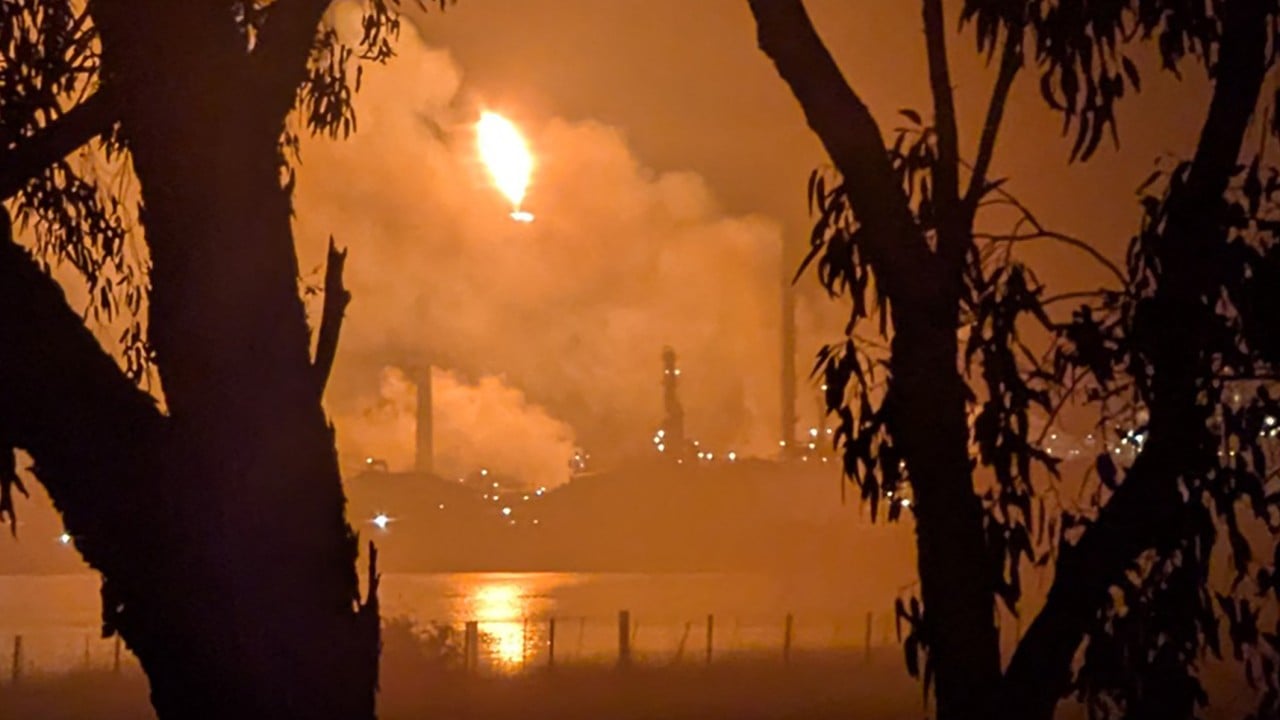
Australia’s liquid fuel security is an exercise in managed decline, where a single localized disruption—a refinery fire—exposes the systemic rot of a just-in-time supply chain. The incident at a domestic refinery does not merely represent a localized industrial accident; it acts as a stress test for an energy architecture that has traded redundancy for cost-efficiency. This analysis deconstructs the mechanics of Australian fuel vulnerability through the lens of refining economics, geopolitical maritime bottlenecks, and the physics of the "Days of Consumption" metric.
The Triad of Domestic Supply Fragility
To understand why a fire at one facility triggers national petrol shortage fears, one must quantify the three structural pillars that govern Australian fuel availability.
- The Refining Deficit: Australia has transitioned from an era of domestic processing to one of import dependency. With the closure of the majority of its large-scale refineries over the last decade, the remaining facilities operate at near-maximum capacity simply to meet baseline demand. When one goes offline, the loss is binary: the capacity is either 100% or 0%, with no "swing" capacity available to absorb the shock.
- The Maritime Lead-Time Gap: Australia relies on a 21-to-30-day "floating pipeline" of tankers primarily from Singapore, South Korea, and Japan. If a domestic refinery fails, the physical replacement of that volume requires three weeks of transit time across high-traffic sea lanes. There is no instantaneous digital solution for a physical molecule of Octane.
- The Strategic Reserve Paradox: Unlike Northern Hemisphere powers, Australia’s fuel reserves have historically been held in commercial tanks rather than government-owned salt caverns. These commercial stocks are managed for profit, not resilience, meaning they are kept at the lowest possible levels to minimize holding costs.
[Image of oil refinery process flow diagram]
The Mechanics of the Crack Spread and Local Pricing
Market anxiety regarding petrol prices following a refinery fire is often dismissed as speculation, but it is grounded in the "Crack Spread"—the pricing difference between a barrel of crude oil and the refined products produced from it.
Domestic refinery outages force wholesalers to compete for spot-market cargoes in the Asian trading hub. This sudden surge in demand for immediate delivery (Prompt Physical Cargoes) drives up the price for the entire region. Even if the fuel hasn't reached Australian pumps yet, the replacement cost of that fuel is priced into the market immediately. This creates a disconnect where consumers pay for a global shortage triggered by a local failure.
The Inventory Depletion Curve
The impact of a refinery fire follows a predictable mathematical decay.
- Phase 1: Initial Drawdown (Days 1–5): Retailers utilize onsite storage. Prices remain stable but wholesale "racks" begin to tighten.
- Phase 2: Distribution Re-routing (Days 6–14): Fuel is trucked from interstate terminals to the affected region. Logistics costs spike, and the "last mile" delivery becomes the primary bottleneck.
- Phase 3: The Import Arrival (Days 20+): If the refinery remains offline, the first emergency-ordered tankers arrive. The price floor is now reset to the higher international spot rate plus the emergency freight premium.
Strategic Reserves and the IEA Mandate
The International Energy Agency (IEA) requires member nations to hold 90 days’ worth of net oil imports. Australia has frequently fluctuated below this threshold. The systemic risk is not just the fire itself, but the lack of "buffer stock" to bridge the 21-day maritime gap.
The current strategy relies on "Stockholding Obligations" (SSO), which mandate that industry players hold minimum levels of petrol and jet fuel. However, these obligations do not account for catastrophic infrastructure failure at the processing level. The system assumes the pipes keep flowing. When the "refinery gate" closes due to fire, the SSO acts as a terminal buffer that can be exhausted within a fortnight under panic-buying conditions.
[Image of global oil supply chain map]
Technical Constraints of Refinery Restarts
A refinery is not a light switch; it is a complex thermal equilibrium system. A fire-related shutdown introduces three technical hurdles that extend the "fear period" of a shortage:
Thermal Stress and Metallurgy
The sudden cooling of high-pressure units (hydrocrackers or catalytic reformers) during an emergency shutdown can cause "brittle fracture" in steel components. Every valve, pipe, and vessel must undergo non-destructive testing (NDT) before a restart is authorized by safety regulators. This process can take weeks, even if the fire damage was superficial.
Catalyst Poisoning
Many refining processes rely on precious metal catalysts. If a fire causes an uncontrolled shutdown, these catalysts can become "coked" or contaminated. Replacing a catalyst charge is a multi-million dollar capital expense that requires lead times for procurement, further delaying the return of domestic supply.
Regulatory and Forensic Delays
Insurance investigators and workplace safety boards prioritize "root cause analysis" over supply chain speed. The site remains a crime scene or a restricted zone until the investigation concludes, effectively freezing the domestic supply contribution for the duration of the inquiry.
The Geopolitical Multiplier
The Australian refinery fire occurs against a backdrop of global oil volatility. In a stable market, an Australian outage is a blip. In the current global oil crisis, it is a compounding factor.
The global refining system is currently "long" on crude oil but "short" on refining capacity. There is plenty of oil in the ground, but not enough machines to turn it into fuel. This makes every single refinery—no matter how far away—critical to the global balance. When an Australian refinery goes dark, it removes volume from the Asian regional balance, forcing other nations to bid higher for the remaining supply.
Structural Recommendations for Energy Sovereignty
The recurring "fear" of fuel shortages following minor industrial incidents proves that the current market-led model is insufficient for national security. A transition to a resilient energy framework requires three specific shifts:
- Mandatory Onshore Strategic Storage: The government must decouple strategic reserves from commercial inventory. Dedicated, state-owned storage facilities must hold a 30-day "emergency bridge" of refined product, specifically located near major population centers to bypass port bottlenecks.
- Hardening of Existing Infrastructure: To mitigate the "single point of failure" risk, remaining refineries must be incentivized to invest in redundant processing trains. This ensures that a fire in one unit does not necessitate a total site shutdown.
- Diversification of the Fuel Mix: The most effective way to reduce refinery-fire risk is to reduce the total volume of liquid fuel required. Accelerating the electrification of heavy transport and the adoption of hydrogen for industrial heat reduces the "Days of Consumption" pressure on the remaining liquid fuel infrastructure.
The immediate strategic play for industrial stakeholders and policymakers is to treat the refinery fire as a signal of systemic inadequacy rather than a freak accident. The focus must shift from "When will the fire be out?" to "Why does 20% of our fuel security depend on a single set of pipes?" Failure to address this leads to a permanent state of price volatility and supply anxiety.